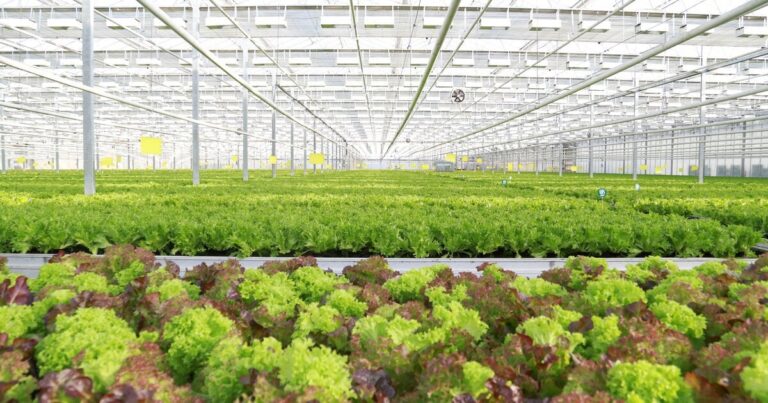
Bok choy and pak choi belong to the same subspecies, Brassica rapa subsp. chinensis, which the papers spell pak choi or pakchoi. It has been grown hydroponically far less than lettuce, so the numbers are few. Three open papers give a base: a comparison of systems from Thailand (2026), an EC study from Shanghai (2018), and light trials at Wageningen University (2025).
Below is what you can take from them: how many days from sowing to harvest, which system gave the heaviest plants, which EC to hold, what light does, and where burned leaf edges come from. The conditions in these papers are narrow, and I will say where that limits the numbers.
How Many Days From Sowing to Harvest
Hydroponic bok choy is cut 32 to 49 days after sowing: 32 days for a small plant at 75°F (24°C) in a vertical farm, and 49 days to full weight in the Thai trial. The 45 to 60 days from field notes in Ontario run a little longer.
| Source | Conditions | Sowing to transplant | In solution until harvest |
|---|---|---|---|
| Susilo et al., 2025 | vertical farm, 75°F (24°C), LEDs | 11 days | 21 days (harvest on day 32 from sowing) |
| Thaenkaew et al., 2026 | room at 68-77°F (20-25°C), LEDs | 14 days | 35 days |
| Ding et al., 2018 | greenhouse in Shanghai | until the sixth true leaf | 20 days |
| OMAFRA, Ontario | open field | transplant about 4 weeks after seeding | 45-60 days from seeding to harvest |
In Susilo, the cultivar Hybrid Special weighed 1.1 to 1.8 oz (30 to 50 g) on day 32, depending on the light. That is the weight of all leaves, without the stem and root. Planting density was 44 plants per square meter (4.1 per square foot), so by my arithmetic the result is 0.27 to 0.45 lb of leaves per square foot (1.3 to 2.2 kg/m²) per cycle. A small rosette of 1.1 to 1.8 oz (30 to 50 g) took 32 days, while 2.3 oz (65 g) in the Thai trial took 49. Do not compare these two numbers directly: the cultivars, light, and solution differ. The Wageningen chamber also ran with elevated CO₂ (800 µmol/mol), and Susilo and Ding planted into stone wool blocks watered with solution, not into NFT or deep water.
Which System Gave the Heaviest Plants: NFT, Deep Water, or Drip

In the Thai comparison, drip hydroponics won: 2.3 oz (64.8 g) per plant versus 1.6 oz (44.5 g) in NFT and 0.95 oz (26.9 g) in deep water at 35 days after transplant. There was one room, the conditions were the same, and only the system changed.
| System | Plant height, in (cm) | Fresh weight, oz (g) |
|---|---|---|
| Deep water (DFT) with an air stone | 12.0 (30.49) | 0.95 (26.9) |
| NFT | 14.6 (37.11) | 1.6 (44.5) |
| Drip | 16.4 (41.71) | 2.3 (64.8) |
The authors write that drip beat deep water by 58% and NFT by 31%. Those percentages are taken from 64.8 g, the drip result. In plain multiples, drip gave 2.4 times the weight of deep water and 1.5 times the weight of NFT.
Do not read this paper as a law. Each system had 10 plants, and the authors counted every plant as its own replicate, which overstates certainty. The cultivar is not named, the paper has no oxygen or solution temperature readings, and the authors did not calculate system costs. The explanation for the drip advantage (precise delivery, less time under water, oxygen at the root) remains the authors’ assumption.
A more careful takeaway: if your system already works and the plants grow evenly, one paper is no reason to change it. If you are building a new one just for bok choy, drip was the only system to pass 2.1 oz (60 g). For choosing between systems by scale and budget, see our article on NFT, DWC, Kratky, and drip. Oxygen matters for deep water, and our wiki on DWC covers it.
Which EC to Hold: The Heaviest Plants Are Not the Best Tasting
The Shanghai authors recommend EC 1.8 to 2.4 dS/m (the same as mS/cm), even though the highest fresh weight came at 4.8. They grew the cultivar Shanghaiqing for 20 days in eight solutions from plain water up to EC 9.6, at pH 5.8.
| EC, dS/m | Taste on a 10-point scale | Nitrate, mg/g |
|---|---|---|
| 0 (plain water) | 4.36 | very low |
| 1.2 | 7.88 | 0.297 |
| 1.8 | 8.00 | 0.686 |
| 2.4 | 8.22 | not named in the text |
| 4.8 | 6.16 | 1.18 |
| 9.6 | 4.20 | 1.25 |
Up to EC 1.2 the plants had smaller leaves and less biomass, and some leaves turned yellow. From 1.8 up they looked better, and at 4.8 they had the largest leaves. At 9.6 growth was suppressed: new leaves turned dark and old ones yellowed. Taste was rated by 5 to 10 people eating boiled plants, so it is the opinion of a small panel, and no lab measurement was made.
Nitrate rose with EC: 0.297 mg/g at 1.2, 0.686 at 1.8, and 1.18 at 4.8. The method takes a sample of fresh leaves, so these are most likely milligrams per gram of fresh weight, though the text does not state the unit separately. Raising EC to 4.8 for a few extra leaves means 1.7 times the nitrate of EC 1.8 and worse taste (6.16 versus 8.00 points). Where nitrates are really a concern is covered in a separate article.
Two other papers held the solution in this range. The Thai one used EC 1.5 to 2.5 mS/cm and pH 5.5 to 6.5. The Wageningen one used EC 2.3 and pH 5.7. Our wiki table gives leafy lettuce and greens EC 1.2 to 2.0 and pH 5.8 to 6.2 (EC and pH by crop), and does not name bok choy separately. For bok choy, these researchers held pH 5.5 to 6.5 (5.7 to 5.8 in two papers) and EC 1.5 to 2.5, and the Shanghai paper narrowed the optimum to 1.8 to 2.4. I would start from those numbers.
Light: Hours Versus Brightness, and Tipburn
A higher daily light integral (DLI) gave more weight, and a longer day had a small edge over a brighter lamp, though not in every cultivar. The Wageningen authors compared four doses from 10.8 to 18.9 mol/m² per day in two ways: different hours at PPFD 250 µmol/m²/s, or different brightness at 18 hours.
| Route to the dose | Setting | DLI, mol/m² per day |
|---|---|---|
| Longer day | 12 / 15 / 18 / 21 hours at PPFD 250 | 10.8 / 13.5 / 16.2 / 18.9 |
| Brighter lamp | PPFD 167 / 208 / 250 / 292 at 18 hours | 10.8 / 13.5 / 16.2 / 18.9 |
From the lowest to the highest dose, fresh weight rose about 67% when hours were added and 26% when brightness was added (the authors’ summary). For Hybrid Special at PPFD 250, the graph shows roughly 1.1 oz (30 g) at 12 hours versus 1.8 oz (50 g) at 21 hours. Part of that gap comes from the starting point: at the lowest dose, the brighter lamp with 18 hours gave Hybrid Special about 1.3 oz (37 g), more than 12 hours at PPFD 250, and at the highest dose 21 hours pulled ahead with about 1.8 oz (50 g) against 1.6 oz (46 g). In Shanghai Green there was no significant difference between the two routes. The worst result at DLI 18.9 came from the brightest lamp, PPFD 350 at 15 hours. Vitamin C at the highest dose was about 25% above the lowest and did not depend on how the dose was reached. Your own lamp and hours can be run through our DLI and PPFD calculator, and the basics are in the wiki on PPFD and DLI.
There is a flip side. The number of plants with burned leaf edges (tipburn) grew with DLI, and more often with a longer day than with a brighter lamp. Hybrid Special had at least one affected plant in almost every treatment. This is calcium shortage in young leaves during fast growth (our wiki on calcium and magnesium). The authors suggest keeping night humidity above 95% and putting airflow on the growing point. They take those measures from the literature on lettuce and other crops, and this study did not test them on pak choi.
Temperature and Bolting
The Ontario field sheet gives an optimum of 59-64°F (15-18°C), while the lab papers held 68-77°F (20-25°C) in Thailand and 75°F (24°C) at Wageningen. The sources do not explain the gap.
The OMAFRA sheet covers Shanghai pak choy in open ground: it is sensitive to day length and bolts under long days, although that is not often a problem in Ontario. Early cold, sharp temperature swings, and low nutrition also provoke bolting. The three research papers do not mention bolting at all: the Wageningen plants were lit up to 21 hours but cut on day 32. So there are no data on what happens to bok choy under long days and warmth after week five, and the sources give no reason to delay the harvest.
Harvest and Storage
Cut bok choy is held at 32°F (0°C) and 95-100% humidity for two to three weeks, as the OMAFRA sheet advises. The Wageningen authors stored single leaves in bags for 21 days at 39°F (4°C), and their visual rating did not depend on how much light the plant got while growing.
OMAFRA advises harvesting in the cooler part of the day and removing field heat quickly. In a hydroponic setup that means cutting in the morning before the lamps run at full power and moving the crop straight into the cold. For a small green product in a few days, without a full rosette, see our pak choi microgreens card.
Where to Start and What the Sources Do Not Say
- Solution: EC 1.8 to 2.4 mS/cm, pH 5.5 to 6.5. At 4.8 there is 1.7 times the nitrate of 1.8, and the taste is worse.
- Schedule: transplant on day 11 to 14 after sowing, cut 21 to 35 days later, depending on the plant weight you want.
- System: drip for a new build, and no need to replace an existing NFT or DWC.
- Light: a bigger dose gives more weight, hours and brightness are close to equal, and watch the edge of the youngest leaf.
- Cold: 32°F (0°C) and high humidity after the cut.
What is missing from these papers: a bok choy trial in the Kratky method, winter data for Ukrainian greenhouses, and economics (what it costs and what it sells for). Cultivars are named in two of the papers (Shanghaiqing in the Shanghai one; Hybrid Special, Shanghai Green, and Red Summer at Wageningen) and not in the Thai one, so the numbers may shift for the large white-stemmed bok choy. Grow one batch on these settings first, then change one variable at a time.