Microgreens usually do not regrow after cutting, and pea is the exception most often named. The pea card in our catalog says the opposite: there will be no regrowth. There is no contradiction, because it all depends on how high you cut.
The more interesting question is how much a second cut gives and whether it is worth keeping the tray on the shelf a few more days for it. In the measurements we found, the second cut equals 22 to 83% of the first. The longer you wait for it, the bigger share of the first cut it has to deliver: at 3 days 22-30% is enough, at 5 days you need 37-50%, at 9 days 67-89%.
Why pea regrows and radish does not
Microgreens are cut above the growing medium. Radish, broccoli, and sunflower have a single growing point at the top, so after the cut there is nothing left to regrow. Pea is built differently: the cotyledons stay in the seed, and the stem carries nodes with side buds. The authors of the Chinese tray trial discussed below write that after the first cut the cotyledons are still plump, and two to three cuts can be taken from them.
As long as one node stays on the stem, the plant keeps growing. That is what the Washington State University (WSU) guide to pea shoots says: shoots are clipped about 0.5 inch (1.3 cm) above the ground, the first cutting is usually the best quality, but the second through the fourth are also “very good.” That is a field crop on beds, not a tray, but the mechanism is the same.
The Japanese grower Murakami Farm, which produces pea shoots, tested where to cut when peas regrow in water: a cut above the upper side bud gave a harvest two days earlier than a cut below it, almost at the seed. By its account the regrowth is ready in 7-10 days.
The pea card says: “There will be no regrowth.” That is true for a cut flush with the medium, which is how a tray is cut for sale: the node goes with the stem. For a second cut you have to leave part of the stem, and a section below covers that.
What the measurements show: 22 to 83% of the first cut
Numbers turned up in three places. Here they are side by side.
| Source | Second cut vs. first | Days to second cut | Conditions |
|---|---|---|---|
| On The Grow, US, updated May 23, 2026 | 22-28% (116 of 500 g, 145 of 512 g, 96 of 430 g) | 9 | Three trays: Kratky, a standard 10×20 in (25×51 cm) tray, and a large sprouting tray. Cut height not stated. |
| Aquager, a grow-kit maker, July 19, 2026 | 30-50% | 3-5 | The author’s estimate, no measurements given. Cut 0.5 in (1.3 cm) above the mat, bottom leaf pair left in place. |
| Chinese tray trial, page dated Nov. 11, 2022 | about 83% (three cuts in a ratio of 1.2 : 1 : 1) | about 5 | Absorbent paper instead of a medium, no fertilizer, 350 g of seed per 60×25 cm (24×10 in) tray. Cut at about 4-5 in (10-12 cm) with a node left. The page names no author, journal, or year for the trial. |
The trial does not give the days in the third row; we derived them from two of its numbers: three batches took 18 days, a single one took 8, so each later batch took 5. We could not find the original, and the page has no author, so this row has the weakest provenance and the best result.
The gap could come from the conditions. In the Chinese trial the seed was sown at 350 g per 1,500 cm², which is 2.3 kg per square meter (0.47 lb per square foot). Our 50 g on a Ukrainian berry tray (19×11.4 cm, 217 cm²) works out to the same 2.3 kg per square meter, so the density matches. The On The Grow write-up does not say how high they cut or whether a node was left. So their 22-28% can be compared with the Chinese 83% only with caution.
The sources without numbers disagree too: WSU, above, calls the second through fourth cuttings “very good,” while the abstract of a paper in Anhui Agricultural Sciences (2012, no. 36) by Qi Xiuling and coauthors at Guangxi Agricultural Vocational and Technical College says that first-cut pea sprouts beat second-cut ones on yield and quality. We did not open the full text. MP Seeds answers “yes, once” and adds that the regrowth is weaker.
The Chinese trial also calculated one more figure, biological efficiency: kilograms of greens per kilogram of seed. It was 6.37 for three cuts against 2.78 for one, 2.3 times higher. That is a gain on seed. Pea seed costs us UAH 3.30 out of UAH 92.82 of revenue per tray, 4%, so there is almost nothing to save on it.
What a shelf day costs: when a second cut pays off
A tray of pea sits on the shelf for 9-12 days. In our Ukrainian tray profit breakdown (in Ukrainian, priced in hryvnias) 100 g of pea brings UAH 92.82 in revenue, which is a restaurant price 15% below the shelf price. The seed and the growing mat that a second cut does not use cost UAH 9.90 (3.30 and 6.60). A fresh sowing earns UAH 82.92 per cycle, or UAH 6.91 to 9.21 per shelf day.
A second cut takes the shelf for d more days and returns a share f of the first cut. It beats resowing if f × 92.82 / d is larger than 82.92 / cycle. That gives the minimum share: f = 0.893 × d / cycle. The table below works it out for two cycle lengths. It is a ratio, so it holds in any currency as long as seed and mat are about 11% of the sales value of a tray.
| Days to second cut | Fresh-tray cycle of 9 days | Cycle of 12 days |
|---|---|---|
| 3 | 30% | 22% |
| 4 | 40% | 30% |
| 5 | 50% | 37% |
| 7 | 69% | 52% |
| 9 | 89% | 67% |
Read it like this: if your cycle is 12 days and the second cut arrives after 5, it has to deliver at least 37% of the first cut. Less than that and resowing would have earned more.
Apply it to the measurements. The nine-day On The Grow test (22-28%) misses by a wide margin; it needed 67-89%. The Aquager estimate sits on the line: 30-50% at 3 days pays, while 30% at 5 days does not. The Chinese trial (about 83% in about 5 days) clears it with room to spare, since 37-50% was enough.
The model ignores that the stub of stem left on the tray makes the first cut lighter (no source weighed this) and it ignores the risk of mold. Both count against the second cut. On the other hand, the table only makes sense when the shelf is always full. If trays sit idle for lack of orders, a shelf day costs nothing, and a second cut is just extra greens, minus the light.
How to cut for a second flush

- Cut 0.5-1 in (1.3-2.5 cm) above the medium and leave the bottom pair of leaves: WSU and Aquager say half an inch, On The Grow says an inch. Use clean scissors.
- Keep the medium evenly moist, neither dried out nor soaked, with the same light as the first grow.
- Keep the air moving: On The Grow and MP Seeds both mention it.
- Start checking on day 3 or 4. If nothing has appeared by day 7, or the new growth is pale and sparse, Aquager says to discard the tray and resow.
- Feeding. The seed reserve runs down in the Chinese trial, and the authors suggest feeding the leaves or roots for the second and third batches, although they gave no fertilizer themselves.
- Grow so the first node sits low, and add light for 1-2 days before the cut and for two days after it; the same authors suggest this so the buds in the leaf axils can develop.
Aquager calls a third cut almost never worth the wait. In the Chinese trial the third batch matched the second (1.2 : 1 : 1), but the cycle there was five days.
Mold and quality of the second cut
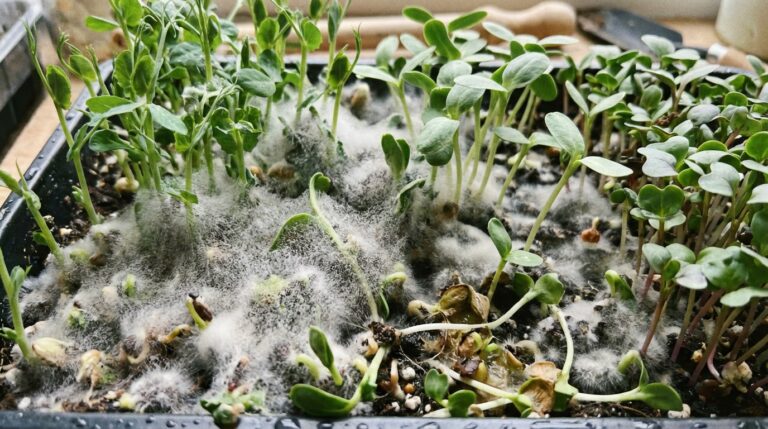
The longer a tray sits in the medium, the higher the risk of mold, fungus, and bacteria. That is On The Grow’s statement, with no numbers behind it. The second cut on their trays came out more fibrous, paler, and showing signs of stress, while Aquager describes it as thinner and shorter. For mold on trays, its causes and prevention, there is a separate guide.
Weigh, inspect, and taste the second cut separately from the first, and do not mix them in one bag.
How to test it on your own trays
The sources with numbers disagree, so only your own shelf can settle it. Three trays from one sowing are enough.
- Cut tray A flush and resow it right away. Record the weight of the cut and the days of the cycle.
- Cut trays B and C 0.5-1 in (1.3-2.5 cm) above the medium. Record the weight of the first cut: that shows how much the leftover stem costs you.
- From day 3 watch B and C. Cut the second flush when the leaves are full and green, and record its weight and the days since the first cut.
- Calculate f (weight of the second cut divided by weight of the first) and compare it with the table row for your days and your cycle. Note any mold.
For a farm with a full shelf I would not build a second cut into the plan until it has passed a test like this. For a home kitchen it is a free bonus on top of the first cut, and the only thing to lose is a few days of space. Measurements on the pea you actually sow are worth more than any table above. For soaking pea seed (what in and for how long) there is a separate guide.
The second cut of pea: the short version
- A second cut works only if a node is left on the stem; a cut flush with the medium does not regrow.
- Measurements give 22% to 83% of the first cut. The higher figures come from a trial with no named author, the lower ones from two online shops.
- Payback depends on days: at 3 days 22-30% of the first cut is enough, at 5 days you need 37-50%, at 9 days 67-89%.
- Cut 0.5-1 in (1.3-2.5 cm) above the medium, leave the bottom leaf pair, and do not let the medium dry out.
- If there is no new growth on day 7, discard the tray and resow.
- Before building a second cut into the plan, test it on three trays and calculate f and the days.