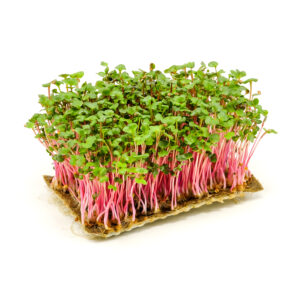

Smooth chicken liver pâté with butter and thyme, spread on rye toast. Red Koral radish microgreens add crunch and a peppery bite. 35 minutes plus 2 hours chilling.
INGREDIENTS
- 500 g - chicken livers (about 1 lb)
- 120 g - unsalted butter (1 1/2 tbsp for cooking, 7 tbsp softened for the pâté)
- 1 - onion (about 4 oz / 120 g)
- 1 - garlic clove
- 3 - fresh thyme sprigs
- 2 tbsp - brandy or cognac (30 ml)
- 1/4 cup - heavy cream (60 ml)
- 1 tsp - salt
- 1/2 tsp - ground black pepper
- 12 - slices rye bread (about 13 oz / 360 g)
- 20 g - Red Koral radish microgreens
STEPS
- Rinse the livers, pat them dry with paper towels, and trim off membranes, connective tissue, and any greenish spots. Halve the larger lobes. Slice the onion into half-moons and crush the garlic with a knife.
- Melt 1 1/2 tbsp (20 g) of butter in a skillet over medium heat. Cook the onion for 6-7 minutes until soft and lightly golden, add the garlic and thyme, and cook 1 minute more.
- Raise the heat, add the livers in a single layer, and cook for 3-4 minutes per side. They are done when a thermometer in the center of the thickest piece reads 165°F (74°C).
- Pour in the brandy and let it bubble for 1 minute. Season with salt and pepper, remove the thyme sprigs, and let the livers cool for 10 minutes.
- Transfer the livers, onion, and pan juices to a blender, add the cream and 7 tbsp (100 g) of softened butter. Blend for 2-3 minutes until smooth and adjust the salt. For a silkier pâté, press it through a fine sieve.
- Spoon the pâté into jars, press plastic wrap directly onto the surface, and chill for at least 2 hours.
- Toast the bread in a toaster or a dry skillet until crisp. Let the toasts cool slightly, spread them with pâté, and top each with a pinch of radish microgreens.
Why Radish Microgreens Here
Chicken liver pâté is smooth, rich, and soft, which is exactly why it starts to feel heavy by the third toast. It needs a contrast. Red Koral radish microgreens taste like young radishes: juicy, crunchy, with a peppery bite that cuts through the butter. Their coral-red stems also stand out against the brown pâté. The pâté is served cold, so the microgreens stay crisp on it, but on hot toast they wilt within minutes. Add them once the bread has cooled a little.
About the Ingredients
Livers. Fresh and chilled, firm, with an even dark red-brown color. Before cooking, trim off membranes, connective tissue, and any greenish spots from bile: they make the pâté bitter.
Butter. Unsalted, softened to room temperature. It shapes both the flavor and the texture: with 7 tbsp (100 g), the chilled pâté slices cleanly and spreads well.
Brandy. 2 tbsp (30 ml) adds depth, and the alcohol cooks off in the pan. Cognac or dry sherry work too, or skip the alcohol and add 1 tbsp of apple juice.
Bread. Rye or whole-grain sourdough with some tang. A baguette works as well, but the pâté feels heavier on white bread.
Variations
- Swap the radish microgreens for mustard microgreens: the heat gets sharper, closer to horseradish.
- Cook half a peeled apple with the onion: the pâté turns sweeter and lighter in color.
- Seal the jars with a 1/8-inch (3-4 mm) layer of melted butter: the top of the pâté will not darken.
- Serve with a spoonful of cranberry sauce on each toast and the microgreens on top.
Serving and Storage
Take the pâté out of the fridge 15-20 minutes before serving: straight from the cold, it spreads poorly and tastes flat. Spread it thickly on warm toast and add the microgreens right before serving.
In a covered jar, the pâté keeps in the fridge for up to 3 days. Use fresh microgreens for the toasts. How long radish microgreens last in the fridge and at room temperature is covered in our guide to microgreens shelf life.
CHEF'S TIPS
Do not leave the livers pink inside. In recent years, numerous Campylobacter and Salmonella outbreaks in the US have been linked to pâtés made from undercooked chicken livers, and USDA advises cooking them to 165°F (74°C) throughout. A thermometer is more reliable than the color of the cut.
Overcooked livers make a grainy, dry pâté. Take them off the heat as soon as the thermometer reads 165°F (74°C).
The butter for the pâté must be soft. Cold butter breaks into lumps, and the pâté turns out uneven.