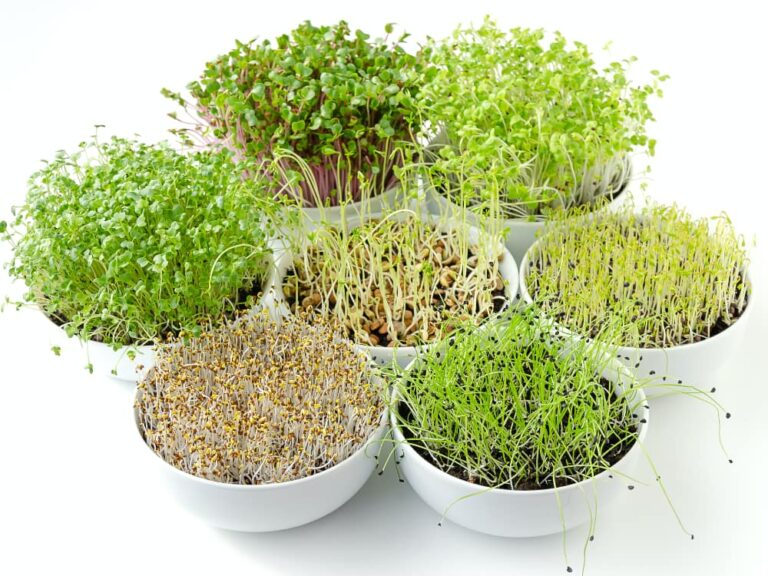
“Farmers market” sounds like a place where anyone can set up a table and sell what they grow. With microgreens it is not that simple: the law says plant-origin products at an agri-food market are sold only after a laboratory working at that market confirms they are fit for consumption. There is also an exception that is easy to misread.
Below is what the law and the ministry orders actually require, what you can prepare at home before the first Saturday, and how to work out whether a day at the market covers the stall, the drive and your time.
What “farmers market” means to the law
The Law on the Safety and Quality of Food Products does not contain the words “farmers market.” It has “agri-food market”: a business entity that creates proper conditions for selling agricultural products, including foods, in specially equipped and designated places (Art. 1, item 1). So a weekend fair on a square and a market with counters and pavilions may have different status. The first thing to ask the organizer is whether it is an agri-food market or a fair governed by local decisions. I did not study fairs; what follows is about agri-food markets.
Note Article 37: selling foods of one’s own home production anywhere other than an agri-food market is prohibited (part 1, item 2). So the law allows foods of your own home production to be sold only at agri-food markets. But with that comes an extra check.
The market lab: what it does with microgreens
Under Article 36 of the same law (part 1 as revised by Law No. 4718-IX of December 16, 2025), plant-origin products may be sold at an agri-food market if a state inspector has confirmed their fitness based on tests by an accredited laboratory at that market. A market without such a laboratory may not operate. The Ministry of Agrarian Policy’s Order No. 1279 of April 19, 2024 on hygiene requirements for agri-food markets repeats this (Section V, items 1 and 13). The order took effect six months after official publication, which was June 5, 2024 in the Official Gazette of Ukraine.
The exception sits in the same provision: foods of non-home production that come with documents ensuring traceability are not subject to these tests. The law does not define “home” and “non-home” production: I looked in the text of the law and the order, and there is no explanation. So my assumption is that a registered facility, a numbered lot, a harvest date and a label count as “non-home.” That is only an assumption, and one call to the market administration and the laboratory will settle it. Ask directly: do they test microgreens, how long it takes, what it costs, and what to show from your documents.
What to prepare at home: your facility registration number (how to get it is in the article on registering food production), the cut date, and a lot number on each container. Without them there is nothing to prove “non-home” with.
Table, cold and water
Order No. 1279 is fairly specific about the sales spot:
- Vegetables, greens, fruit and fresh mushrooms are sold from tables, vehicles, crates, baskets and sacks placed on stands, platforms or pallets. Selling from the ground or floor is prohibited (Section V, item 8).
- Sales spots for perishable products are equipped with refrigeration that provides the temperature regime and lets it be monitored (Section IV, item 2). Selling such products without refrigeration is prohibited (Section V, item 13).
- Foods at the market must be stored and offered at a temperature that prevents microorganisms from multiplying and toxins from forming (Section II, item 3). The order does not name specific degrees.
The order does not say whether microgreens count as perishable. The data below put their life at only 2-4 days at ambient temperature, so treat a cooler bag or an icebox as a required part of the table.
Degrees are in the Penn State Extension guidance (updated December 16, 2025). It says that dark storage at 41°F (5°C) can extend shelf life up to 10-14 days versus 2-4 days at ambient temperature, and that humidity should be kept consistent and as high as possible. Temperature swings cause condensation, which shortens post-harvest life. One more tip from there: do not wash microgreens before selling, because that shortens their life, and tell the customer to wash them before eating. These are American recommendations, but the physics is the same.
Scales, price tag and card terminal

The rules of trade (Cabinet Resolution No. 833 of June 15, 2006, version of March 13, 2019, in force as of October 18, 2026) cover retail trade and sole proprietors alike. Three items matter for you:
- Measuring instruments, scales included, must be in working order, bear a verification stamp and undergo periodic verification (item 11).
- Prices are shown on tags or in price indicators (item 20).
- At the buyer’s request you must verify weight and price and give them control measuring instruments, and you must make payment by electronic means possible (item 21).
So scales without a stamp will not do at a market, and the card terminal is named outright in item 21. Whether you need a cash register depends on your status and separate rules: item 11 of the resolution only says that this is decided “in accordance with regulations.” I do not cover taxes or the sole proprietor group here.
Labels, loose product and words
The full list of fields for packaged microgreens, from weight to lot, is in the article on labeling and selling. Two market-specific points are not covered there.
Loose product. If you scoop microgreens for a customer from a large container or pack them at their request, then under part 9 of Article 6 of the Law on Consumer Information on Foods it is enough to provide, in a manner of your choosing, the product name and allergen information from Annex 1. For microgreens that means mustard, celery, soy, sesame and gluten-containing cereals (wheat, oats, barley), where present. The rest (part 10) you must show on the customer’s request. If the name already says “mustard microgreens,” the allergen is named.
Shelf life. For fresh fruit and vegetables that are not peeled or cut, the minimum durability date may be voluntary, but the law expressly excludes sprouting seeds and similar products, including sprouted legumes (Art. 18, part 1, item 5, point “a”). The law does not say whether microgreens are “similar.” The simplest approach is not to guess and to print a cut date and a use-by date.
The words on the sign above your table, from “natural” to “eco,” have their own rules, covered in the article on “natural,” “farm” and “eco”.
Living trays or cut greens
Penn State describes both options: microgreens can be sold right in trays or in containers with a seeding mat, which removes the harvest cost. The downside is named too: transport needs more space than cut greens do. For a small car or a trunk that is an important argument. A simple approach: take both formats in small amounts and see which one goes first.
How to work out a market day
A price in one place and a price in another cannot be compared until both are converted to weight. That is argued, using chain shelves and a wholesaler for restaurants, in the piece on what chefs pay for microgreens. For a market the formula is: day profit = units sold × (price - unit cost) - day costs.
| Line | What to enter |
|---|---|
| Revenue | Containers sold × price per container |
| Unit cost | Seed, growing medium, tray, container and label per unit |
| Market stall | Fee to the organizer per day or month |
| Laboratory | Cost of the test, if it is paid, and the time it takes |
| Drive and cold | Fuel, ice or cold packs, electricity |
| Your time | Harvest, packing, drive, standing at the market, cleanup |
| Leftovers | What does not sell and where it goes |
About leftovers: according to Penn State, microgreens live 10-14 days in the cold versus 2-4 when warm. So unsold product kept cold can go to restaurants the next day: that channel has its own article, on restaurants, and all channels are compared in the channel map. For a sense of the gap between direct sales and wholesale, here is the one example from the source: in Pennsylvania, $1.75 for a half ounce in a bag was seen at a direct market and $40 per pound wholesale. My arithmetic: that is $56 per pound, 40% more than wholesale. I do not convert to hryvnias here: I have no price data I opened for Ukrainian markets.
A checklist before the first Saturday
- The facility is registered and the registration number is written down.
- You know whether the market is an agri-food market and what the administration and lab say about microgreens.
- You have a table on stands, a cooler bag or icebox, and price tags.
- Scales with a verification stamp and a card terminal.
- Every container has a name, lot, cut date, use-by date and producer.
- The names on your sign comply with the law: no “eco” or “organic” without a certificate.
- You calculated unit cost and day costs before going to the market, not after.
Local rules of trade at markets are adopted by city councils and are not covered here. Before your first day, read the rules of the specific market and ask the administration about requirements for sellers.