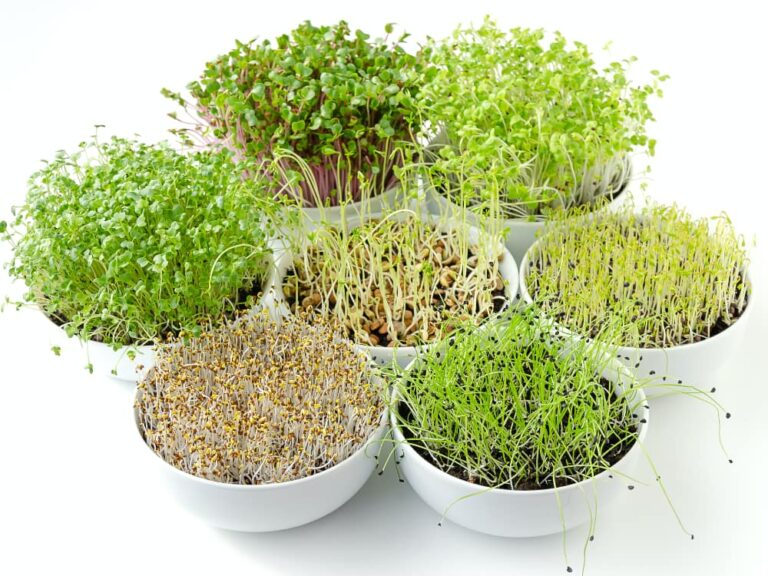
Ask ten growers what it costs to start a microgreens business and you get ten numbers, most of them invented. Here are three that are not: about $500 buys one shelf at current retail, $4,384 is the exact capital in the reference budget published by University of Missouri Extension, and $50,000 is the ceiling on the USDA microloan that most small growers actually qualify for. Each tier below comes with a shopping list, a weekly output, and the paperwork that starts applying at that level.
Equipment prices are a September 2026 snapshot from two suppliers who publish their catalogs openly. Everything else comes from the Missouri budget, from federal rules, or from arithmetic on those two, which I mark as mine wherever it appears. Where I have no verified figure, the line stays empty and I say what to put in it.
Three tiers and what actually separates them
The surprise in this table is the middle row. Going from $500 to $5,000 buys almost no extra growing capacity. What it buys is cold storage, and that changes who can buy from you.
| Tier | Capital | Growing positions | Trays per week | What applies |
|---|---|---|---|---|
| One shelf | about $500 | 16 | 8 to 14 | below the federal produce threshold |
| Reference system | $4,384 | 16 | 8 to 14 | same, plus a cooler and a delivery schedule you control |
| Microloan build | $50,000 | 176 | 90 to 155 | covered farm, third-party audits, loan servicing |
Weekly output is my arithmetic on the Missouri crop table: 16 growing positions running 27 cycles a year on a microgreen mix is 432 trays, and the same positions running 46 cycles of radish is 736. Divide by 52 and you get the range in the column.
Tier one: one shelf, about $500
A wire rack in a spare room, four levels, four 1020 trays per level. Retail prices as of September 2026:
- 1020 trays: $146.99 for thirty shallow extra-strength trays at Bootstrap Farmer, or $149.99 for thirty heavy-duty trays at True Leaf Market. A single tray runs $6.29.
- Lights: $59.99 for a 2-foot LED with a stand, or $136.99 for a 48-inch strip light or an 80-watt dual-spectrum fixture.
- Fans: $102.99 for a four-fan kit sized to one tier.
- Seed in bulk: sunflower black oil, 5 pounds for $48.38; pea, 5 pounds for $70.40; radish, 5 pounds for $165.72.
- A complete 1010 kit with a light, if you want to test one crop before committing: $104.99.
Add the rack, growing medium, a scale that reads to a tenth of an ounce, and a pair of shears, and you land between four and six hundred dollars. The scale belongs on that list next to the light: seeding rate is a weight, and a handful is not repeatable even for someone who sows every day. The reasoning behind the numbers is in seeding rates.
What this tier is for is finding out whether you can produce the same tray twice. Three failures show up on the first trays, and each one has an address. Pale stretched stems mean the light is too far or too weak. Mold on day three means top watering and still air. An uneven stand means the seeding rate or the seed lot. All three cost you a week here instead of a season later, and the common ones are collected in seven mistakes that make beginners quit.
Federal produce rules mostly leave you alone at this level. A farm whose average annual produce sales fall below $34,324, adjusted for inflation and averaged over the previous three years, is not a covered farm under 21 CFR 112.4, so the Produce Safety Rule does not apply. Buyers may still ask for paperwork for their own reasons, and that is a different conversation from a federal requirement.
You are ready to move up when every tray you cut has somewhere to go and someone asks about next week.
Tier two: the same shelf plus a cooler, $4,384
University of Missouri Extension publishes a microgreens planning budget, G693, written by Manita Ale and Juan Cabrera-Garcia and funded through a USDA Farm Service Agency award. It prices one specific system: a stainless steel shelf unit, four levels, four 1020 trays of a single crop per level, under artificial light.
| Item | Quantity | Cost | Service life |
|---|---|---|---|
| Reinforced 10×20 trays | 20 | $200 | 3 years |
| Stainless steel shelf unit, 4 levels | 1 | $150 | 10 years |
| LED lights | 4 | $900 | 10 years |
| Fans | 4 | $220 | 10 years |
| Harvest knife | 1 | $30 | 10 years |
| Cold storage | 1 | $2,500 | 10 years |
| Growing infrastructure, 8 square feet | 8 | $384 | 10 years |
| Total capital | $4,384 |
Read the proportions instead of the total. The cooler is $2,500 of $4,384, which is 57 percent of the capital for one appliance, and everything that actually grows the crop comes to $1,884. The step from a $500 shelf to this build is the step into cold storage.
That is worth sitting with, because the cooler is what lets you harvest Tuesday and deliver Thursday. Without one, your harvest schedule is dictated by your delivery schedule, and every chef who moves an order costs you a tray.
The budget also lists its assumptions, which is the most useful thing about it. Three of them deserve a second look before you copy the spreadsheet. Labor is paid: 15 minutes per tray at $20 an hour, which is $5.00 a tray, and most first-year growers quietly set that line to zero and then wonder why the profit feels imaginary. Electricity is priced at 12 cents per kilowatt-hour, which was reasonable in March 2024; the EIA’s Electric Power Monthly for June 2026 puts the U.S. average at 14.19 cents for commercial customers and 18.34 cents for residential, up from 13.54 and 17.47 a year earlier. Marketing is 15 percent of sales, which on a $46 tray is $6.90, more than the seed and the medium combined.
Tier three: $50,000 and the loan shaped exactly like it
Fifty thousand dollars is the cap on both USDA microloan programs, according to the FSA Farm Loan Information Chart dated October 2025. Whatever the tier, interest decides the outcome: Local Bounti earned $2.6 million of gross profit in half a year against an $8.5 million interest bill.
- Direct Operating Microloan: maximum $50,000, term of one to seven years, interest capped at 5 percent for beginning and veteran farmers. Funds cover livestock, equipment, feed, seed, chemicals, and supplies.
- Direct Farm Ownership Microloan: maximum $50,000, term up to 25 years, for buying a farm, constructing buildings, or other capital improvements.
- For scale, the non-micro versions run to $400,000 for direct operating and $600,000 for direct farm ownership, with correspondingly heavier paperwork.
Growers mix the two up, and they do different jobs. The operating microloan buys racks, lights, and seed, and it has to be repaid inside seven years. The ownership microloan buys or builds the space and stretches to 25. If you are building out a leased room, you want the first one; if you are buying the building, the second.
At $50,000 you are roughly eleven reference systems: 176 growing positions, 220 trays in inventory, 44 lights, and one larger cooler instead of eleven small ones. Cold storage is the only line on the list that scales in your favor. Labor does the opposite, because 15 minutes a tray at 90 trays a week is 22 hours of somebody’s time before a single delivery is made.
What you have to handle before you sell
Two federal lines decide most of this, and both move with your sales rather than with your equipment.
Below $34,324 in average annual produce sales you are not a covered farm under 21 CFR 112.4. Above it you are, and the Produce Safety Rule applies. The qualified exemption in 112.5 trades full compliance for labeling requirements and runs up to $686,476 in average annual food sales, with the majority going to qualified end users. Both figures are inflation-adjusted and averaged over the previous three years, currently 2023 through 2025.
One point that saves growers real money: microgreens are covered produce, and they are not sprouts. The sprout-specific requirements in subpart M do not apply to them. The two crops get conflated constantly, and the sprout rules are the expensive ones.
Once you sell to distributors, grocery, or institutional buyers, someone will ask for a third-party audit. USDA’s Agricultural Marketing Service publishes its rates in the Federal Register each spring, and the 2026/2027 rates took effect October 1, 2026: audit services, federal or state, run $175.00 per hour under 7 CFR Part 51, up from $171.00 the year before, and the GFSI certification fee is $250.00 per audit. AMS bills per hour per program employee, so travel and preparation are billable too. An eight-hour audit plus the certification fee is $1,650, and it repeats annually. Against $50,000 of equipment that is a rounding error; against $500 it is the whole business.
What to grow in the first trays
Pick the first crop by how fast a mistake becomes visible and by what the tray returns, in that order. The Missouri budget runs five crops through the same shelf.
| Crop | Yield per tray | Days | Cycles per year | Return over full costs | Per shelf per year |
|---|---|---|---|---|---|
| Cabbage | 15 oz | 10 | 37 | $19.45 | $11,514 |
| Broccoli | 11.5 oz | 12.5 | 29 | $14.36 | $6,663 |
| Microgreen mix | 11.5 oz | 13.5 | 27 | $14.20 | $6,134 |
| Radish | 8 oz | 8 | 46 | $5.84 | $4,298 |
| Pea | 8 oz | 11.5 | 32 | $6.58 | $3,369 |
The last column is mine: cycles per year times 16 growing positions times the return per tray. It reorders the list. Radish turns fastest, 46 cycles against 37 for cabbage, and still finishes near the bottom, because eight ounces at $4.00 cannot catch fifteen. Radish is also the crop everyone photographs for the marketing shot. Pea is the crop beginners love because it germinates reliably, and it pays the least of the five.
Seed cost drives part of that spread. Cabbage seed runs $8.00 an ounce against $2.00 for radish and $0.48 for pea, so cabbage spends $4.00 a tray on seed and still returns three times what radish does. Buying the cheap seed is how growers talk themselves into the least profitable shelf in the building. That $0.48 pea line is also the one number in the budget that does not survive a check against commercial seeding rates, and it is taken apart in the full breakdown of one 1020 tray.
Start with three to five crops you know rather than twenty with unstable results, and run one crop alone for the first two or three cycles. When something goes wrong across five trays of five different crops, there are more variables than observations. Our own shortlist is in the ten easiest microgreens, and the cycle lengths for seventy crops are in the days-to-harvest chart.
Where the money goes inside one tray
Take the tray of mix apart. Income is $46.00 at $4.00 an ounce. Operating costs are $30.06 of it, ownership costs another $1.74, full cost $31.80, and what is left over full costs is $14.20.
| Line | Per tray of mix |
|---|---|
| Seed | $1.04 |
| Growing medium | $3.00 |
| Electricity | $1.20 |
| Labor | $5.00 |
| Labels | $6.60 |
| Packaging | $4.62 |
| Marketing | $6.90 |
| Operating total | $30.06 |
Labels and packaging together are $11.22, which is a quarter of the income and eleven times the seed. That quarter is exactly what separates the two university price benchmarks, which I take apart in what chefs actually pay per ounce. That ratio holds across currencies: in our Ukrainian numbers the consumables run 15 hryvnia against 59 of revenue, also a quarter, while the seed in a tray of pea is 2.25. Growers argue about seed prices and pay for the clamshell.
Two more lines worth knowing before you build a spreadsheet. Working capital: you spend the $30.06 before the tray sells, so at 35 trays a month you need about $1,050 in circulation at all times, and at the microloan tier, around 390 trays a month, you need roughly $11,700. The budget charges 8.5 percent operating interest on exactly this. Ownership cost: $367.47 a year in depreciation and $186.32 in interest on capital, which is $1.74 per tray of mix and $1.03 per tray of radish. Small numbers that never stop.
Now compare two items by the service lives the budget assigns them. Twenty trays cost $200 and last three years, so a dollar spent on trays costs about 33 cents a year to own. Four lights cost $900 and last ten, so a dollar spent on lights costs 10 cents. The cheapest-looking item on the list is more than three times as expensive to own, which is the argument against thin trays that crack after one season. The full cost structure by line is in microgreens economics.
How many trays cover the fixed costs
Fixed costs on the reference system are depreciation of $367.47 a year plus $186.32 of interest on capital, which is $553.79 a year, or $46.15 a month. Income over operating cost on a tray of mix is $46.00 minus $30.06, or $15.94. Divide: 35 trays a year cover the equipment entirely.
Thirty-five trays out of an annual capacity of 432. That is the whole point of running this arithmetic before buying anything: the equipment was never the problem. Selling the other 397 trays is the problem, and no spreadsheet does that part for you. Companies with hundreds of millions in the bank learned that same lesson the expensive way, which is the subject of the vertical farm post-mortems.
Then add what the budget leaves out. It carries no rent line, and every $100 a month of rent is $1,200 a year, or another 75 trays you have to sell. Put your actual lease into that slot before you decide the shelf pays for itself. The break-even calculator takes your own rent, price and yield.
Run it forward for the year and the shape of a one-shelf business is clear: 432 trays of mix return $6,134 over full costs, on top of $2,160 of labor the budget already paid you at $20 an hour. That is roughly $8,300 a year from one shelf, with every cost counted. It is real money and it is not a living, which is why the growers who last treat the first year as tuition. I ran the same math from the revenue side, in a different market, in the piece on what a small room really produces. The break-even method itself is in launching microgreens production.
Who buys the first tray
Match the channel to the volume. A farmers market sets no minimum, gives you the buyer’s reaction the same day, and takes whatever you cut. Restaurants want consistency and small packs, which is a longer conversation and a steadier check. Distributors and grocery want volume, documents, and a margin, and that is where the audit fees start.
One number worth knowing before you build a plan around chefs. In the 2020 USDA Census, 24,137 farms sold directly to restaurants, caterers, and institutions, for $1.9 billion, down from $2.3 billion in 2015, with 12 percent fewer farms doing it. The market is real and it is shrinking, so the seat you want is one somebody is leaving, and you get it by being reliable rather than cheap. Of those direct sales, 78 percent happen within 100 miles of the farm, which is the honest boundary of your market.
One signed account before you buy the cooler is worth more than a five-page plan. What buyers check first is laid out in sales channels and in the walkthrough on selling to restaurants.
Your first 30 days
- Week 1. Buy one shelf, one light, and a scale. Seed two trays of radish and two of broccoli. Write down the seeding weight, the date, and the room temperature for each.
- Week 2. Cut, weigh each tray separately, and compare against the published yield. A gap of more than a quarter points at light, water, or seeding rate before it points at the seed.
- Week 3. Pull your electric bill and find your actual rate per kilowatt-hour, then replace the budget’s 12 cents with it. Give ten packs away, one of them to a chef, and ask two questions: how it looks on day three, and whether the pack size fits the plate.
- Week 4. Rebuild the per-tray budget with your numbers, keeping the $5.00 labor line in even if you are the only worker. If the business does not survive that line, it is a hobby with receipts. Then add up your last three years of produce sales, divide by three, and see which side of $34,324 you are on.
If the top tier is where you are headed, talk to your county FSA office about a microloan before you buy anything. The application is deliberately simpler than a conventional farm loan, and the 5 percent cap for beginning farmers beats most equipment financing. Whatever you finance, check who stands behind the warranty: Heliospectra went bankrupt three months after a report showing 1.69 months of cash.
One closing thought. The Missouri budget is a planning tool and it says so: the figures rest on March 2024 price forecasts for one system in one state. Your seed costs more or less, your electricity almost certainly costs more, and your market may pay $3.00 an ounce instead of $4.00. Use the structure, which is sound, and replace the numbers with yours. A budget where rent, cold storage, shrink, and your own hours sit at zero always balances. That is the budget in the ad. What happens to the operations that start from that budget is laid out in nine reasons microgreens businesses fail. The size of the industry you are entering was measured for the first time in the 2026 USDA microgreens census.