
A microgreens subscription is usually pictured simply: a customer pays once a month and the farm drops off a box every week. In the sales channel map it got one word next to farmers markets and Instagram, and CSA, the model where buyers prepay for a share of the harvest, was not covered anywhere on the site. This article is about selling to households. Standing orders with restaurants are covered separately. Here: how a subscription differs from CSA, why people leave these programs, how to build the box, how the money works and what Ukrainian law says about prepayment.
Subscription and CSA are not the same thing
The USDA National Agricultural Library describes CSA as a community of people who pledge support to a farm so that it becomes, legally or in spirit, the community’s farm, with growers and consumers sharing the risks and benefits of food production. The classic setup: a member pays at the start of the season and then gets a weekly share of whatever grew. A good year means a fuller box. Hail means a lighter one, and the money is already paid.
A subscription works like an ordinary sale, just a recurring one. The buyer pays for a specific box, for example three 50 g containers a week, and the risk of crop failure stays with the farm. For microgreens the difference matters. A field farm cannot control the weather, so CSA is how it spreads that risk. Microgreens grow indoors in 7 to 12 days, and promising exact box contents is far easier. That is why most urban microgreen farms are closer to a subscription, while borrowing the community and prepayment ideas from CSA.
CSA barely exists in Ukraine. A 2019 paper in the journal Ukrainian Society concludes that public demand for such programs has not formed yet and is much smaller than in countries with a developed agrifood system. The NGO Permaculture in Ukraine held a conference on launching CSA and translating the European CSA handbook into Ukrainian. There are no local numbers to lean on, so below I rely on US research and the site’s own calculations.
Why microgreens fit a subscription
The first reason is predictability. Peas are ready in 9 to 12 days, radish in 7 to 8, sunflower in 8 to 10. When you know thirty boxes go out on Thursday, seeding becomes a schedule. The second is storage. By the shelf life table, most brassicas, sunflower and kale hold 10 to 14 days after cutting in the cold, so a weekly box easily lasts until the next one.
The same table shows the limits. Pea shoots hold 5 to 7 days, dill up to 5 and basil 3 to 4, and basil also needs 50 to 54°F (10 to 12°C) because ordinary refrigeration turns it black. In a box, these are the crops to eat first, or they need a twice-weekly drop. Pack basil in the same cooler as radish at 36 to 39°F (2 to 4°C) and the customer opens a box of blackened leaves.
The third reason is less obvious: microgreens have no season. A field CSA in a temperate climate runs a few months a year. Microgreens grow year-round, and in November, when the field farm has stopped delivering, a box of microgreens is the freshest thing in the fridge.
Why people quit a subscription
The most detailed data on why people quit CSA comes from Ryan Galt’s team in California. In 2014 and 2015 they surveyed 409 former members from 27 CSAs and 1,149 current members from 41. Those who left for reasons outside the farm relationship (moving away, a closed pickup site, a change in household size) were excluded. Each respondent rated how important a CSA attribute was to them and how satisfied they were with it.
| CSA attribute | Former members: satisfaction minus importance | Current members: satisfaction minus importance |
|---|---|---|
| Variety of products in the share | -1.05 | 0.00 |
| Quantity of food in the share | -0.75 | +0.22 |
| Ability to choose share contents | -0.67 | +0.79 |
| High quality produce | -0.67 | -0.16 |
| Affordability | -0.54 | +0.33 |
| Convenient pickup or delivery location | -0.44 | +0.29 |
The widest gaps for former members are about the box itself, with price further down the list: monotonous, too much or too little, and nothing can be changed. Former members also rated the ability to choose as much more important (3.62 out of 5) than current members did (2.69). The authors call it the customization paradox: people who need choice leave, and the ones who stay are those happy with the box as is.
The second set of reasons is everyday life. Work schedules interfered for 42.7% of former and 28.8% of current members, child care for 11.6% and 5.6%, lack of transportation for 12.3% and 6.0%. Former members also enjoy cooking slightly less (4.4 vs. 4.6 out of 5). A box that is hard to pick up and that nobody has time to cook loses to the supermarket.
Two more findings. A separate analysis of 111 California farms lists a longer season and more crop diversity among its recommendations for keeping more members year to year. And a Wisconsin survey found that members planning to renew with the same farm placed more weight on community and rated communication with the farmer higher. Good produce keeps people in CSA in general; communication is what ties them to a particular farm.
How to build the box
Three rules for microgreens follow from this data.
- Two sizes instead of one. For example, a small box with two 50 g containers and a medium one with three. Someone getting too much moves down a size instead of canceling.
- Rotation instead of a single crop. Keep pea and sunflower as a fixed base and change the third container every week: radish, a brassica mix, dill, basil. A four-week cycle feels varied without chaos on the racks.
- Swaps by the rules. Let people drop a crop they do not eat and say in advance what replaces it. Full freedom of choice breaks the seeding plan; limited choice addresses the main reason people leave.
| Week | Fixed base | Rotating container | What to watch |
|---|---|---|---|
| 1 | pea, sunflower | China Rose radish | radish holds 10 to 12 days, eat the pea first |
| 2 | pea, sunflower | brassica mix | brassicas hold up to 14 days |
| 3 | pea, sunflower | dill | dill up to 5 days, eat it first |
| 4 | pea, sunflower | basil | keep apart from cold crops, 50 to 54°F |
Put a short note in every box: what is inside, how long each item keeps and one idea for eating it. In the Wisconsin data, communication is what ties people to a farm. For microgreens it also answers the second reason for leaving, no time to cook: the customer sees that radish can just go on a sandwich.
What it earns
Take the medium box, three 50 g containers. In September 2026 the median supermarket price for 50 g packs was 105.6 UAH per 100 g, or 52.8 UAH per container. Set the subscription at 55 UAH per container, slightly above the shelf, because the greens come to the door and were cut the day before. Variable costs come from the 200-tray calculation: 28.82 UAH per 100 g of pea, including seed, substrate, packaging and electricity. Containers for cut greens may cost differently from tray packaging, so plug in your own price.
| Item | Value | How it was calculated |
|---|---|---|
| Box price per week | 165 UAH | 3 × 55 UAH |
| Variable cost per box | 43.23 UAH | 150 g × 28.82 UAH / 100 g |
| Margin before labor and delivery | 121.77 UAH a week | 165 - 43.23 |
| Same, per month | 527 UAH per subscriber | × 4.33 weeks |
| Subscribers to cover the Group 2 sole proprietor payment | 7 | 3,631.74 UAH / 527 UAH |
| 30 subscribers: monthly margin | 15,818 UAH | 30 × 527 UAH |
| 30 subscribers: weekly harvest | 4.5 kg, about 45 trays of 100 g | before 7 to 10% losses |
Thirty subscribers take about 85 rack spaces by the ratio in the same article. The margin still excludes your time and delivery, and delivery decides everything. If one stop takes 10 minutes including driving, thirty stops are 5 hours a week. At 52 UAH an hour, the rate the site uses to value the owner’s time, that is 260 UAH a week or 1,126 UAH a month, plus fuel. Ten minutes is my assumption, not a measurement: time one route and use your own number.
Delivery or a pickup point
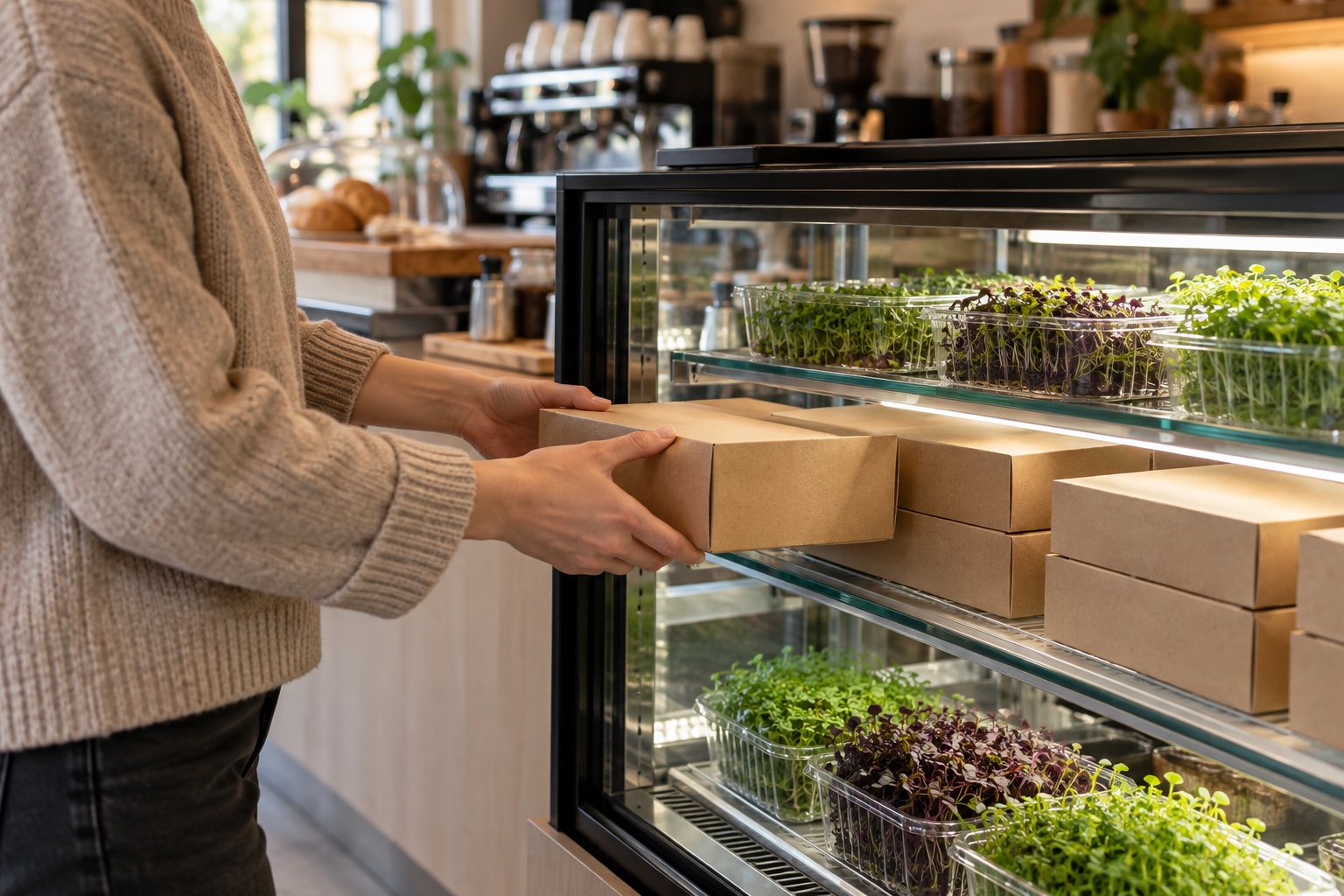
The California data suggest convenient pickup matters as much as price: work schedules got in the way for more than four in ten former members. Microgreens have three options, and they can be combined.
- Door delivery in a time window. Most convenient for the customer and most expensive for you. Make the window in the evening: people are out during the day, and a box sitting on a doorstep without cooling loses shelf life.
- A pickup point with a refrigerator: a café, an office, a farm shop. Twenty boxes at one point replace twenty stops. The fridge is not optional, or shelf life melts away in hours.
- Pickup at the farm on one day a week. Works when customers live nearby, and builds the same sense of community the Wisconsin study points to.
Coolers, ice packs and temperatures at each handoff are covered in the cold chain guide.
Prepayment and Ukrainian law
Subscriptions are mostly sold online, which makes them distance contracts. There is a catch. Ukraine’s current Consumer Protection Law says in Article 1-1 that it applies to food only where this is stated explicitly. Article 13 on distance contracts has no such statement. Whether it covers a box of microgreens is a question for a lawyer. It is simpler to meet its requirements than to argue.
Article 13 requires giving the buyer certain information before the contract is made, including: who the seller is and how complaints are handled, the main characteristics of the product, the price including delivery, payment terms, the minimum duration of the contract if deliveries are periodic, and how to terminate it. Providing this information must be confirmed in writing or by electronic message. The consumer may terminate a distance contract within 14 days of that confirmation or of the first delivery. If the confirmation is deficient, the window grows to 90 days.
Part 6 of the same article is useful for a rotating box. A seller may include a standard clause allowing an unavailable item to be replaced by another. The clause is considered fair if the replacement serves the same purpose, is of equal or better quality and costs no more. The buyer must be told about it before the contract is made. For a farm, this is the legal form of a swap table: the peas failed, so the box gets sunflower at the same price.
Ukraine’s new Consumer Protection Law No. 3153-IX takes effect no earlier than the end of martial law. It mentions goods delivered regularly by name: the 14-day withdrawal period runs from the first delivery (Article 21). Perishable goods cannot be exchanged or returned (Article 5). So no one returns a box they ate, but a customer can walk away from the rest of a prepaid month. It is simpler to build that into your terms now: refund undelivered boxes when someone cancels.
Food safety is a separate matter from consumer law: facility registration, labeling and traceability. What a farm needs there is covered in the article on selling microgreens to restaurants. This article is not legal advice; it shows which questions to settle with a lawyer before taking the first prepayment.
Skips, pauses and cancellations
Vacations kill subscriptions most often: someone leaves for two weeks, asks for no deliveries, and the trays are already growing. Tie the skip rule to the crop cycle, as with restaurant standing orders. It is simpler here: if the pause is announced a full pea cycle ahead, 12 to 13 days, the box is not seeded. If later, that week is paid for, and the box can go to a neighbor or friend.
- Skipping a week: free if announced before a set day. After that, the box is already grown.
- Pausing: up to 4 weeks a year without canceling, so a vacation does not turn into a lost customer.
- Canceling: any time, with undelivered boxes refunded. This matches the logic of the new law and takes the fear out of prepaying.
Where to start
Start with a pilot of 10 to 15 people for four weeks; the website and payment system can wait. Pick people who already buy from you at the market or on Instagram. At the end, count three things: how many renewed for a second month, how much greens ended up in the trash at your place and theirs (just ask), and how many minutes one stop actually takes. Those three numbers will tell you more than any calculation in this article.
Key points
- CSA shares crop-failure risk with buyers. For indoor microgreens that risk is small, so a prepaid subscription for a defined box is the closer fit.
- Microgreens suit subscriptions: a 7 to 12 day cycle, most crops keep a week or longer, no season. Pea, dill and basil keep for less time and get eaten first.
- California CSA members left mainly over a monotonous box, the wrong quantity and lack of choice, and over inconvenient pickup.
- Two sizes, a rotating container and rule-based swaps address the main reasons people leave.
- A medium box at 165 UAH earns about 527 UAH a month per subscriber before labor and delivery. Delivery decides whether anything is left.
- Before the first prepayment, give customers written terms: price with delivery, minimum duration, how to cancel and the swap rule.


