
Those tiny black flies hovering above your trays are not just an annoyance — they are fungus gnats (sciarids), and while you are waving the adults away, their larvae are already eating the roots of your microgreens. Here is where they come from and how to stop them at every development stage simultaneously.
What Fungus Gnats Are and Why They Are Dangerous
Sciarids are small soil-dwelling flies with several common names: fungus gnats, soil gnats, mushroom gnats. They look like very small dark flies, fly slowly, and tend to stay close to the substrate.
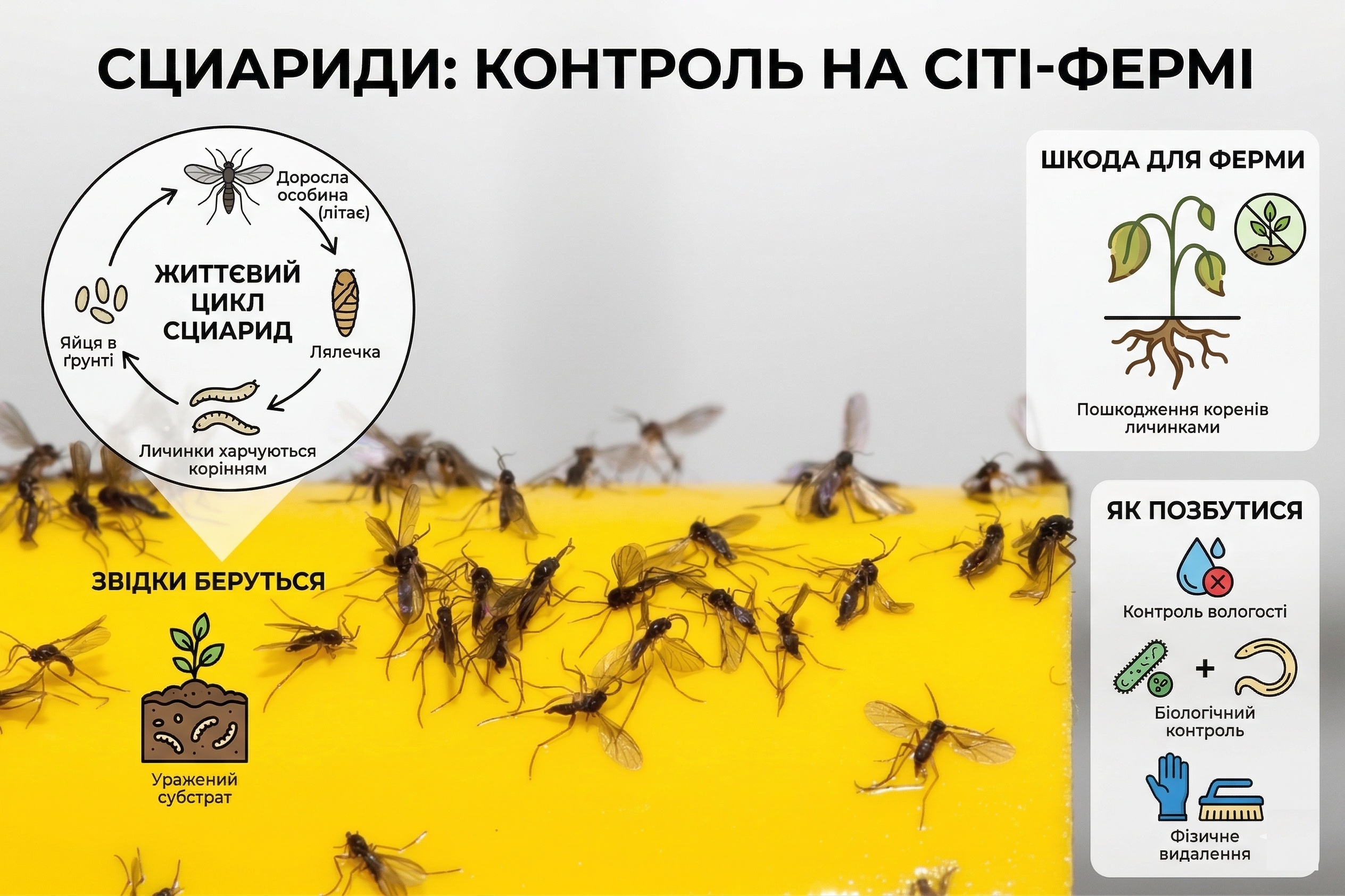
The adult insect does not harm plants directly. The entire problem lies in the larvae. They are whitish, semi-transparent, 3–5 mm long, with a distinctive black head. Most species feed on dead roots and organic matter — but some have no objection to living roots. For microgreens with their already short cycle and fine root system, that is critical.
Fact: The full development cycle of a fungus gnat — from egg to adult — takes 3–4 weeks at room temperature. A single female lays up to 300 eggs.
They are most active in summer — warmth and humidity accelerate reproduction. But on a climate-controlled indoor farm with no seasonality they can breed year-round.
Four Reasons Fungus Gnats Appear on a Farm
Before fighting them, understand where they came from. Most cases trace back to one of four situations.
Overwatered Substrate
This is cause number one. A wet top layer of substrate is the ideal egg-laying site. If the tray surface does not dry between waterings, fungus gnats will find it very quickly — especially if the substrate is rich in organic matter that breaks down readily.
Brought in from Outside
Purchased growing medium is one of the most common entry routes. Eggs and larvae may already be present at the time of purchase. The same applies to plants (including potted houseplants), fruit, and vegetables brought onto the farm. A bunch of shop flowers, a ripe banana in an adjacent room — all of these are potential sources.
Organic Waste on the Farm
Substrate remnants after harvest, food scraps, onion skins or banana peel in an open bin — for fungus gnats this is a banquet. If organic waste is decomposing anywhere near the growing zone, gnats are already there or soon will be.
Persistently High Humidity
If farm humidity is consistently above the optimal range, conditions favour not only mould but insects as well. Ventilation and microclimate control matter here too.
Prevention: Stopping Them Before They Appear
An important detail about fungus gnats that is often overlooked: you must target all development stages simultaneously — egg, larva (four instars), pupa, and adult. If you only catch adults, the population recovers from new larvae within weeks.
Substrate and Watering
The top layer of substrate must dry out regularly between waterings — that is the baseline rule. Do not allow water to pool in trays or containers. Before sowing, check the substrate for plant residues. Treat the substrate before use if necessary.
One proven technique: top-dress seed with a thin layer of vermiculite. Vermiculite does not retain surface moisture, so females cannot find a suitable egg-laying site.
Farm Cleanliness
No food scraps, no rotting fruit or vegetables in open bins near the growing zone. No potato or onion stores nearby. Substrate remnants after harvest go straight to disposal — do not let them decompose. This sounds obvious, but it is the point most often ignored.
Warning: Aquarium water, coffee grounds, and tea leaves in the substrate — strictly off-limits.
Ventilation and Microclimate
Consistent airflow, optimal temperature and humidity — conditions in which gnats are uncomfortable reproducing. Fit fine mesh over ventilation openings to physically block entry from outside.
Tray Disinfection
When reusing trays, wash and disinfect them thoroughly — the same protocol as for combating fungal pathogens. Gnat eggs and larvae survive in residual damp substrate.
Mechanical Traps and Capture Methods
While you address the root causes, simultaneously reduce the adult population. Adults do not damage plants directly, but they lay new eggs. Several methods that actually work:
- Yellow sticky traps — hang above trays. They attract adult gnats, effectively reduce the population, and double as a monitoring tool: count how many are caught per week to see whether the problem is shrinking.
- DIY funnel traps — pour a little apple cider vinegar, juice, or overripe fruit into a glass, place a paper cone on top. Gnats fly in and cannot get out.
- Vacuum cleaner — remove adults from surfaces quickly, without chemicals.
- Sticky tape and fly swatter — for targeted elimination on glass and walls where gnats gather near light sources.
Tip: Yellow sticky traps are not just a trap — they are also a monitoring system.
Treatments: What Works, What Does Not
Honesty is needed here: for microgreens, chemical and most biological treatments are not an option. It is a fast-cycle crop eaten whole — roots, stem, and all — and observing a meaningful pre-harvest interval after treatment is simply impossible.
Several products are used for houseplants and greenhouses — Lepidocide, Fitoverm, Aktara, Gerald, Bicol. For microgreens, follow the label strictly, and better yet do not use them at all. If you want to treat, do so before sowing: on empty substrate or throughout the farm between growing cycles.
The one genuinely interesting biological option for a farm is the predatory mite Hypoaspis miles. It lives in the substrate and feeds on pest larvae without touching plants. Used as a preventive measure in greenhouses and larger farms. Rare in microgreens production, but it is an option.
If Infestation Has Already Occurred
If there are already many adults and larvae are present in the substrate, partial measures will not work. Full sanitation is required.
- Remove all trays with infested substrate — do not try to “save” a sowing if larvae are already in the roots.
- Dispose of substrate containing larvae hermetically — not into compost, not into an open bin.
- Wash and disinfect the entire farm — shelves, trays, floor, walls.
- Find and eliminate the organic matter source on which they were breeding — without this, the problem will return.
- Set out yellow sticky traps before the next sowing — to monitor the situation.
- First week after restarting — water minimally; the top layer must dry out.
Key Takeaways
- Larvae cause the damage, not adults — target all development stages simultaneously.
- Cause number one: overwatered substrate and organic waste near the growing zone.
- A vermiculite top-dressing over seed is a simple, effective preventive measure.
- Yellow sticky traps serve as both a control method and a monitoring tool.
- Chemical treatments on microgreens are inadvisable — the crop is eaten whole and the cycle is too short.
- With a mass infestation, only full sanitation works — partial measures will not save the situation.
Fungus gnats are a solvable problem once you understand their development logic. Keep organic matter from decomposing, keep substrate appropriately dry, hang yellow traps as ongoing monitoring — and gnats simply cannot find conditions to reproduce. It feels harder than it is, but only the first time. After that it becomes routine farm practice.