
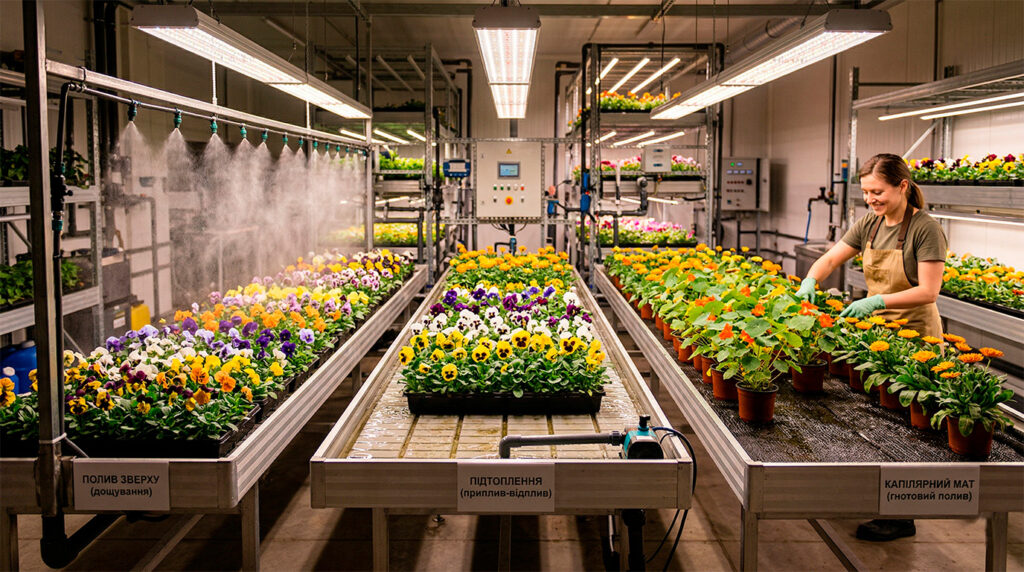
The word “hydroponics” covers dozens of different systems — from floating rafts to drip tape in substrate. But the goal is the same in all of them: deliver consistent nutrition to the plant and keep the root system healthy for as long as possible. Let’s get specific — how to irrigate edible flowers in pots and containers of 1–5 litres.
In this article:
Top Watering: Hand Watering or Drip Irrigation
The simplest irrigation approach — a standard watering can or an installed drip system. Suitable for most crops in containers of any size. But there are a few rules without which top watering becomes a problem.
Note: Drip tape is not suitable for watering plants in pots and containers. It never delivers a uniform output and cannot provide equal conditions to all plants. If you choose drip irrigation — use pressure-compensating drippers only.
Four Rules for Top Watering
1. Always water to drainage. After every irrigation, some solution must run out the bottom. This partially flushes the substrate and protects against salt build-up. Without drainage, salinisation is only a matter of time.
2. Water as the substrate dries. Ideally when substrate moisture has dropped 10–30% from maximum. The simplest way to track this is to regularly weigh one reference container. But never let the substrate dry out completely.
If the substrate did dry out — give a generous watering with at least 50% drainage runoff. Make sure the substrate is wetted evenly throughout the full volume. This is especially important with peat: after drying out, solution often simply runs down the container wall without wetting the main substrate body.
3. Monitor drain EC. Measure the EC of outgoing drain water at least once a week — ideally after every irrigation. If drain EC starts rising, the substrate is accumulating salts.
4. If drainage is impossible — alternate nutrient solution irrigations with plain tap water. For example: 2 nutrient / 2 plain water, or 3/1, or 4/2. The logic is simple: first you feed and slightly salt the substrate, then you flush it slightly. Balance is maintained. Important: use tap water, not distilled or RO — purified water can disrupt the plant’s mineral nutrition.
Flood-and-Drain (Ebb and Flow)
A more convenient method for larger containers. The principle: containers are placed on a tray or shelf into which nutrient solution is pumped — the substrate absorbs as much moisture as it needs, no more, no less. Irrigation uniformity is considerably higher than with top watering.
What to Watch
The main limitation of flood-and-drain is that the nutrient solution EC must not exceed the recommended level for the crop being grown. At elevated EC, substrate salinisation happens quickly and goes unnoticed.
Substrate quality also matters. During flooding, moisture must distribute evenly throughout the full container volume — which requires appropriate water-holding capacity, air porosity, and capillarity. Peat-perlite and coco-perlite mixes handle this well.
If the substrate in a flood-and-drain system has dried out — do not immediately flood it again. First water from the top, soften and wet the substrate evenly, then return to flood-and-drain. Dry substrate pulls moisture poorly, and flooding without pre-wetting carries a high risk of uneven saturation.
Solution Recirculation
Flood-and-drain most commonly uses recirculation — reusing the nutrient solution. This is convenient but requires regular full replacement: no less than once every two weeks. More often if there is a risk of fungal or bacterial infection developing.
Note: Stagnant nutrient solution between irrigation cycles is a direct path to fungal disease. Between flood cycles, solution must drain away completely. Ensure free drainage and do not leave plants standing in water.
Capillary Mat
A relatively new tool for city farms that is still underused. A capillary mat is a synthetic felt with high water-holding capacity: from 1 to 3 litres per square metre. Pots are placed directly on the mat, and it gradually releases stored nutrient solution to the plants.
The main advantage is that frequent watering is not needed. Saturate the mat thoroughly once, and it will supply the plants with moisture for an extended period. For producers who physically cannot water every day — this is a significant benefit.
The downside is the same as with flood-and-drain: potential uneven substrate wetting in the containers and gradual salt accumulation. Also critical: do not allow solution to stagnate in the mat — it becomes an environment for pathogens.
EC Control and Substrate Salt Accumulation
Regardless of the irrigation system chosen — EC monitoring is mandatory. It is the only way to catch salinisation in time and prevent root damage.
What to do if EC in drain water or substrate has risen:
- Run one generous irrigation with nutrient solution and high drainage runoff — this will flush out accumulated salts.
- Or run 1–2 irrigations with plain tap water — an effective and simple solution at moderate salinisation.
- Once EC normalises, return to the standard irrigation schedule.
Whichever irrigation system you choose — the goal is the same: the plant receives consistent nutrition, the root system can breathe, and there is neither drying out nor waterlogging. Everything else is an implementation detail.