
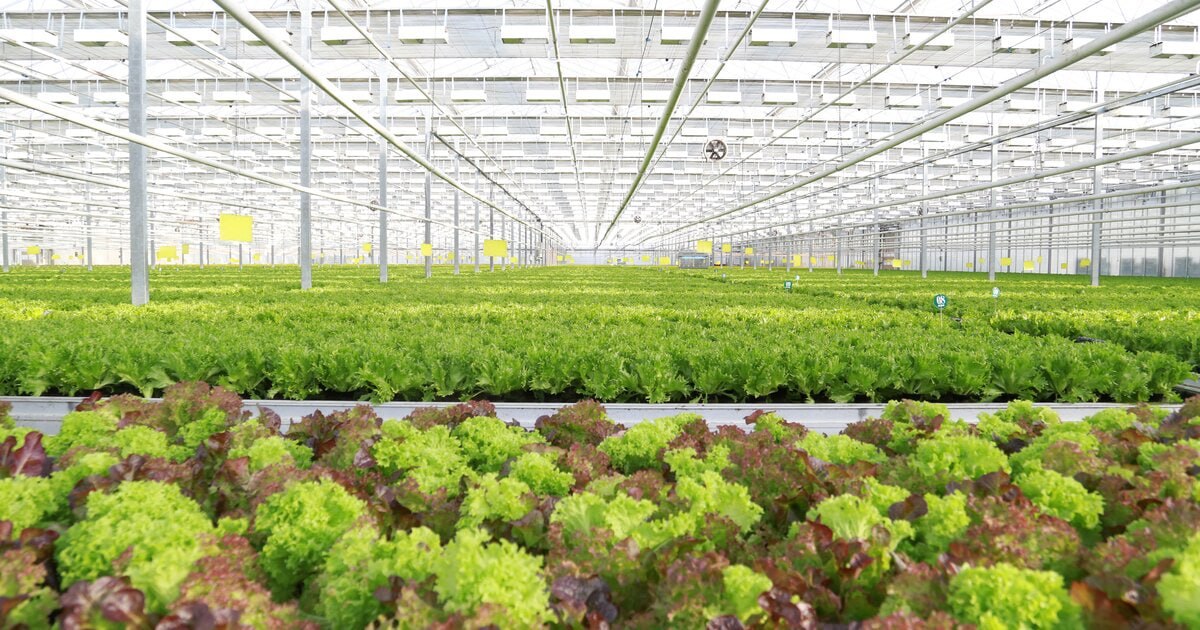
Lettuce is a crop that spoils not in the field, but after it. Most growers lose 15–25 % of marketable value not through disease or pests, but through poor handling in the first hours after harvest. Temperature, storage neighbours, and the cooling method matter more than any agrochemical protection.
Why Lettuce Spoils So Quickly
Lettuce is one of the most sensitive crops to post-harvest conditions. The moment a leaf is cut it begins consuming its stored moisture with no way to replenish it. Cells gradually lose turgor — that firm crunch buyers actually pay for. The process is irreversible: once a plant has lost 3–5 % of its mass to evaporation, no amount of cooling will restore its marketable appearance.
Respiration runs in parallel — the metabolic process by which cells “burn” their own sugars and organic acids. The higher the temperature, the faster the respiration, the faster the nutrient reserves are consumed, and the faster the leaves yellow and wilt. At +20 °C, lettuce respires 4–6 times faster than at 0 °C. That means every hour in a warm store after harvest literally consumes days of cold-room shelf life.
Mechanical damage during harvest is another factor that is routinely underestimated. Cut or bruised leaf edges begin to darken within hours. Damaged tissue sharply increases local respiration and releases more ethylene — triggering a cascade of unwanted reactions.
Ethylene — the Primary Enemy of Shelf Life
Among all the factors that shorten lettuce storage life, ethylene holds a special place. It is a gaseous phytohormone that in fruiting crops accelerates ripening; in leafy crops it triggers senescence and tissue breakdown. Lettuce is highly sensitive to ethylene: concentrations as low as 1 ppm (1 microlitre per litre of air) cause visible damage.
What Is “Russet Spotting” and How to Tell It Apart from Other Problems
The most recognisable symptom of ethylene damage on lettuce is so-called russet spotting — characteristic reddish-brown or rusty-coloured spots on midribs and at the base of leaves. It is important to understand: this is not a disease and not a nutrient deficiency — it is a physiological response to gas.
Not all brown spots on lettuce have the same origin. Ethylene damage produces a reddish-brown tint; excessive CO₂ in storage — above 3 % for whole heads — causes dark-brown sunken spots on the veins. In practice these symptoms are often confused, even though the causes and solutions are completely different. The first is solved by isolating from ethylene sources; the second requires ventilating the storage space.
Where Ethylene Comes From in a Production Facility
The sources are far more numerous than most growers realise:
- Propane forklifts and internal-combustion machinery — operated inside the warehouse or adjacent to storage areas
- Apples, pears, tomatoes, bananas — even a small quantity of these fruits stored alongside lettuce produces enough ethylene to cause damage
- Overripe or damaged lettuce in the same crate or room — it releases more ethylene and “infects” healthy product
- Mixed-load refrigerated transport
Important: Never store greens next to apples or bananas. These fruits emit substantial ethylene that causes leaves to yellow and deteriorate within hours, even at correct temperatures.
Beyond direct tissue damage, ethylene exposure reduces lettuce resistance to pathogens. Weakened leaves become significantly more vulnerable to bacterial rot and mould fungi — in particular Botrytis cinerea and bacterial soft rot (Erwinia spp.). So “a little ethylene” does not merely cause spots — it opens the door to disease.
Temperature and Humidity: the Numbers You Need to Know
Different lettuce types have substantially different storage requirements — and this matters in practice.
| Lettuce type | Optimal temperature | Relative humidity | Storage life |
|---|---|---|---|
| Romaine (cos) | 0 °C | above 95 % | up to 21 days |
| Leaf types (batavia, lollo, etc.) | 0 °C | above 95 % | up to 21 days |
| Iceberg (head) | 0 °C | above 95 % | 21–28 days |
| Iceberg at +5 °C | 5 °C | above 90 % | up to 14 days |
Note the iceberg paradox: at temperatures close to 0 °C, shelf life is 21–28 days, but raising the temperature to +5 °C cuts it to 14 days. The “no ethylene in the room” condition is mandatory for any of these figures to hold.
Fact: At +5 °C, romaine shelf life drops from 21 to 14 days. Five degrees of difference — half the time to sell. That maths directly affects logistics and pricing.
Humidity is no less important than temperature. Below 90 % relative humidity, leaf lettuce begins to wilt noticeably within 1–2 days. But excessive moisture with condensate pooling on leaves accelerates rot development. The ideal range is 95–98 % with continuous air circulation that prevents water from forming droplets on leaf surfaces.
The Critical Window After Harvest
Experienced agronomists put it simply: if the product is not cooled within the first hour after harvest, you have already spent several days of shelf life. This is not an exaggeration. Research shows that slow or delayed cooling cannot be corrected by subsequent ideal storage conditions. Heat stress received immediately after harvest leaves irreversible damage in cells.
Cooling Methods: What Actually Works
Not all cooling methods are equally effective for lettuce. The choice of technology directly affects cooling speed, moisture loss, and final shelf life.
Vacuum Cooling
The most widely used and effective method specifically for lettuce. The principle is simple: product is placed in a sealed chamber, pressure is reduced, and moisture on the leaf surface begins to evaporate at low temperature, carrying heat away. The entire product mass cools evenly and very quickly — in 20–30 minutes.
An important detail: research shows vacuum cooling is most effective when film packaging or ventilation holes in the crate allow free vapour escape. Hermetic sealing before vacuum cooling reduces the method’s effectiveness.
Hydrovacuum and Hydrocooling
A combined method that adds cold-water misting or direct immersion in ice water to the vacuum cooling process. Well suited for crops that are sensitive to moisture loss. For romaine and leaf lettuces, hydrocooling gives excellent results — fast cooling with moisture retention.
Iceberg also tolerates hydrovacuum cooling well and can even accept up to 5 % weight loss during vacuum cooling without any deterioration in quality or crunch.
Forced-Air Cooling
The simplest and most accessible method — product in a cold room is blown with cold air. For lettuce this is the least effective option: cooling is slower, and leaves lose more moisture than with vacuum or hydrocooling. If you lack specialist equipment, forced-air cooling is better than nothing, but minimise the time between harvest and the start of cooling as much as possible.
Tip: Given a choice, select vacuum cooling or hydrocooling for leaf lettuces — faster and moisture-preserving. Forced-air cooling as a fallback, but with mandatory humidity elevation in the room.
Modified Atmosphere and MAP Packaging
Controlled or modified atmosphere (CA/MAP) extends shelf life by altering the gas composition around the product. The approach differs fundamentally between whole heads and cut leaves.
For Whole Heads
Reduced oxygen — 1 to 3 % — at 0–5 °C slows respiration and weakens the negative effects of ethylene. There is an important limit: CO₂ above 3 % already harms whole-head iceberg, causing exactly those dark-brown spots that get confused with ethylene damage. Whole product requires precise regulation of both gases.
For Cut and Ready-to-Eat Lettuce
Different rules apply. Cut leaf surfaces darken far faster than intact tissue. To preserve cut lettuce, an atmosphere below 1 % oxygen with elevated CO₂ of 7–10 % is used. These conditions significantly inhibit enzymatic browning at cut surfaces. Research shows MAP packaging with a balanced atmosphere nearly doubles the shelf life of cut lettuce compared with standard-air packaging.
One nuance: elevated CO₂ can produce an off-flavour, particularly in romaine — it is less tolerant of CO₂ than iceberg. Packaging parameters must be matched to the specific product type.
Ethylene Absorbers
A separate tool: ethylene absorbers placed directly in the storage room or inside the packaging. A study cited by FAO, conducted in California, showed that using an ethylene absorber in lettuce storage significantly reduced russet spotting. The difference in market value between protected and unprotected storage was 20–25 % — more than enough to cover the cost of the device.
Common Mistakes in Storage and Transport
Most quality problems at the point of sale are the result of systematic process errors, not isolated incidents.
Mixed Storage
Storing lettuce alongside any active ethylene producers — apples, pears, tomatoes, bananas — guarantees accelerated spotting and yellowing. Even on separate shelves within the same room, the concentration is sufficient to cause damage. UC Davis explicitly recommends against storing different crops in the same room: besides ethylene, problems arise from incompatible temperature requirements, humidity levels, and volatile compounds.
Propane Forklifts in the Storage Zone
One of the most underestimated factors. A propane engine in operation emits a mix of gases including significant amounts of ethylene. Using such equipment inside a warehouse or immediately adjacent to storage and loading areas is a direct path to product damage before it even ships.
Delayed Cooling
Already covered above, but worth repeating: if more than 1–1.5 hours pass between harvest and the start of cooling at temperatures above +15 °C, the product has already sustained stress, and subsequent ideal storage only partially compensates. Planning the logistics from field to cold room is a direct part of agronomic work.
Temperature Fluctuations During Transport
Every warm-cool cycle during transport causes moisture to condense on leaves and sharply increases the risk of bacterial rot. The temperature regime in a refrigerated truck must be stable from loading to unloading.
The Economics of Shelf Life: What Poor Storage Actually Costs
Shelf life is not a technical detail — it is a direct component of production profitability.
Lettuce with spots or wilting sells at 20–25 % less than prime product — or is rejected by retail chains entirely. Since growing costs are identical, every lost percentage point is pure loss. At a production volume of one tonne per week, this can mean tens of thousands of hryvnias per month — earned in the field and lost in the warehouse.
Vacuum cooling equipment, ethylene absorbers, properly organised storage — these are investments that pay back within one or two seasons through reduced waste and higher sale prices. The competitive advantage in horticulture right now lies not only in growing a quality product, but in delivering it to the buyer in the same condition.
Key Takeaways
- The first hour after harvest is critical. Begin cooling as soon as possible — no later than 1–1.5 hours in warm weather.
- Ethylene at 1 ppm causes russet spotting. Isolate lettuce from apples, pears, tomatoes, and propane equipment.
- Dark-brown CO₂ spots and reddish-brown ethylene spots are different problems with different solutions. Do not confuse them.
- Optimal temperature for most lettuce types: 0 °C at 95–98 % humidity. Iceberg at +5 °C stores half as long as at 0 °C.
- Vacuum and hydrocooling outperform forced-air cooling — faster and with less moisture loss.
- MAP packaging for cut lettuce with low O₂ and elevated CO₂ doubles shelf life.
- Ethylene absorbers in storage yield a 20–25 % market value difference between protected and unprotected product.
Post-harvest strategy is as fully legitimate a production discipline as sowing or crop protection. Most growers invest heavily in growing but underestimate the final 24–48 hours before sale. That is precisely where product either retains its market value — or loses it. Vacuum cooling, isolation from ethylene sources, correct temperature and humidity, and proper packaging are not “extras for large operations” — they are the baseline tools of a competitive producer.