
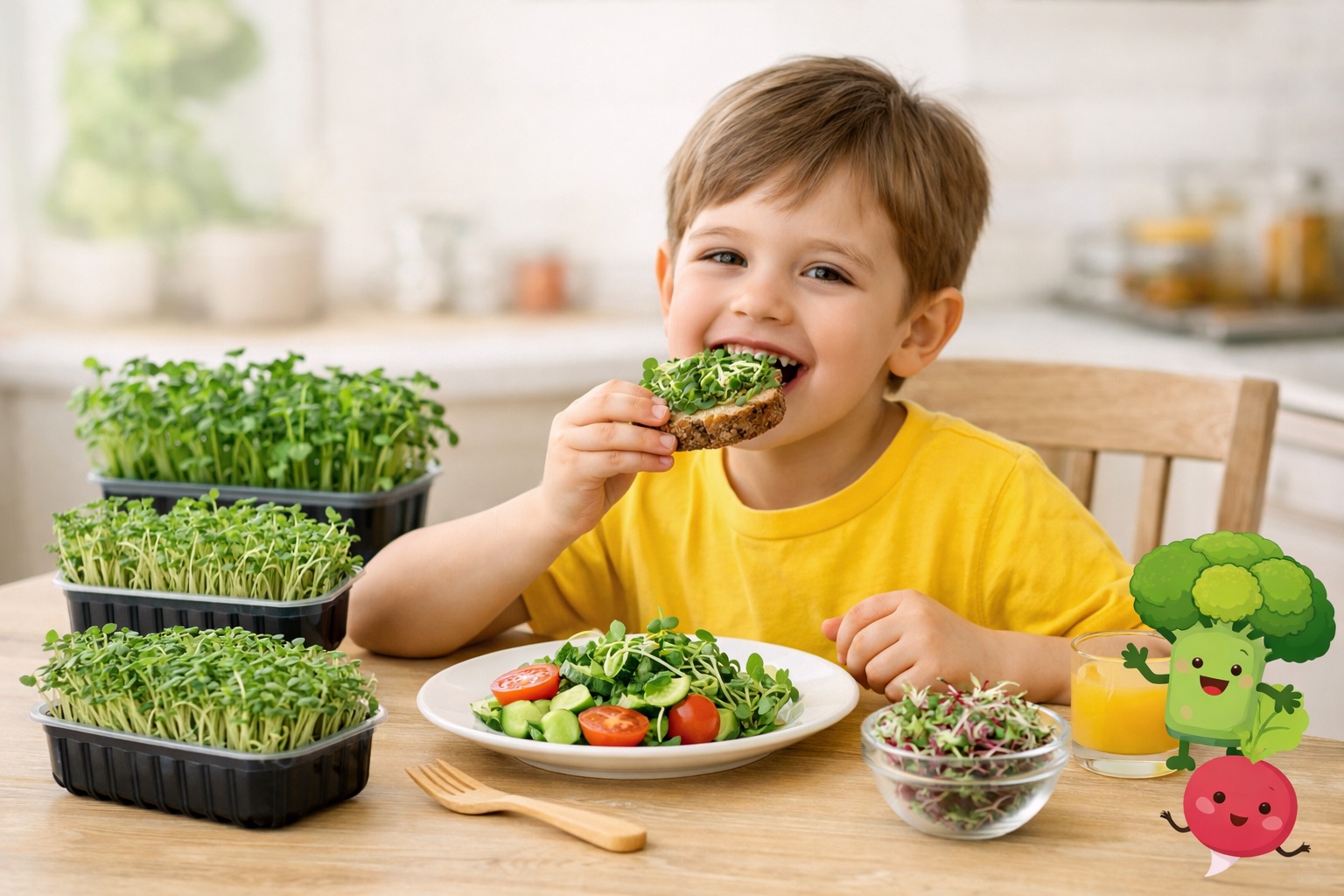
Parents tend to fall into two camps. Some say: “my child eats anything I put in front of them, including rocket.” Others: “we have spent three years trying to get a single lettuce leaf past them.” If you are in the second camp, this article is for you. Microgreens can turn out to be an unexpected ally — but there are a few things worth knowing before giving them to a child.
From What Age Can Children Eat Microgreens?
Short answer: no earlier than 12–18 months. Before that, a child’s digestive system is not yet ready for concentrated plant food with pronounced essential oils and fibre.
After 18 months, start with the mildest, most neutral-tasting varieties — literally a few stems. Not as a standalone dish, but as an addition to familiar food. Pea microgreens stirred into a purée, sunflower scattered over scrambled eggs — this way the child gets used to new flavours gradually, without stress.
After age 3 the range can expand. But sharp and pungent varieties — mustard, rocket, radish — are better held back until age 5–6. Their strong flavour from essential oils can put a child off greens altogether, making you start from scratch.
Which Varieties Suit Children — and Which Do Not
| Variety | Flavour | From what age | Notes |
|---|---|---|---|
| Pea | Sweet, mild | 18 months+ | Ideal first variety, children love it |
| Sunflower | Nutty, crunchy | 18 months+ | Delicious on its own |
| Corn | Slightly sweet | 2 years+ | Soft texture |
| Buckwheat | Neutral | 2 years+ | Works well in porridge |
| Broccoli | Mildly brassica | 3 years+ | Start with very small amounts |
| Rocket | Bitter-peppery | 5–6 years+ | Strong taste, not for young children |
| Mustard | Spicy | 5–6 years+ | Can put children off greens entirely |
| Radish Sango | Piquant | 5–6 years+ | Vibrant colour but sharp flavour |
A separate category — varieties best avoided or introduced very cautiously. Coriander has a distinctive flavour that children either love or strongly dislike, with unpredictable reactions. Flax has a slimy texture that puts off most children. Amaranth is visually striking but somewhat bitter — not suitable for young children.
And an absolute off-limits rule for any age: microgreens of nightshade plants — tomato, pepper, aubergine, potato. They contain solanine and are not edible at the microgreen stage regardless of the child’s age.
What Else to Avoid
Untreated seed only. “Garden” seed is often coated with fungicides and seed treatments — it is not edible for children or adults. Buy seed labelled “for microgreens” or “for sprouting.” The price difference is minor; the safety difference is fundamental.
Fresh and properly stored. Cut microgreens keep for 5–7 days in the refrigerator. Yellowed, slimy, or off-smelling — straight to the bin. For children, fresh only.
Rinse before serving. Even home-grown microgreens need a cold-water rinse immediately before eating.
Allergies. If a child is allergic to any plant from the same botanical family, be careful with the corresponding microgreen variety. For example, a buckwheat allergy means caution with buckwheat microgreens. Start with a minimal amount and observe.
How to Get Children to Eat Microgreens — Without Tears or Force
There is one principle that works far better than any clever trick: children eat what their parents eat and what looks appetising.
Involve them in growing. This is the single most effective approach. A child who sowed peas themselves, watered them every day, and watched them grow will eat them without any persuasion. Pea and sunflower microgreens grow on a windowsill in 10–12 days. For children from age 3, this is an engaging “science project.”
Start with sweet varieties. Pea is as sweet as young garden peas off the vine. Sunflower is crunchy and nutty. This is not the “bitter green stuff” children rebel against. With these varieties, the first attempt almost always succeeds.
Do not serve them separately. “Eat this green thing” is the worst strategy. Better: chop pea stems and mix into favourite pasta, scatter sunflower over scrambled eggs, place a few stems on pizza. Microgreens disappear into familiar food before the child has time to “make up their mind against it.”
Make it look beautiful. Children eat with their eyes. Vibrant Sango radish or green peas on a white plate are genuinely pretty. Let the child decorate their own plate — and they will want to try it themselves.
Do not force it. One failed attempt can close the subject for months. You offered, the child refused — do not push. Try a different variety, a different presentation, try again in a week.
Practical Starting Point: What to Grow with Your Child at Home
For a first experience: pea or sunflower. Both are unfussy, grow quickly, and have flavours children receive well.
What you need: a tray or small container, coconut substrate or a jute mat, seed (microgreens-grade only, not garden seed), a spray bottle of water. Soak pea seed for 8–12 hours, spread evenly on moist substrate, cover with a second tray for 3–4 days, then move to light. In 10–12 days: first harvest and a proud child beside you.
For full details on substrate selection, see our article on substrates for microgreens. Seeding rates for all crops are in the seeding norms table. The complete variety catalogue with flavour notes and growing tips is on the microgreens page.