

You have definitely seen it. Ads on Instagram, YouTube, Telegram. A smiling person in front of green shelves explaining how they transformed their life. “Started from zero,” “minimal investment,” “now earning ₴50,000 a month from 10 square metres.” And then — a button: “Buy the course.” We picked up a calculator and counted everything — from the first tray to the real wholesale price.
“Start-up Costs Are Minimal — A Few Thousand Hryvnias”
What the Course Seller Says
“All you need to start is some trays, seed, and a bit of space. Investment: from ₴2,000–3,000. First harvest and first income in two weeks.”
Sounds like a fairy tale. Let us use the calculator.
What the City Farmer Says
10 m² means 4–5 shelving units with 4–5 levels each — 20 working shelves. Each shelf holds 20 standard trays. Full capacity: 400 trays.
| Item | Calculation | Cost |
|---|---|---|
| Shelf trays/platforms | 20 pcs × ₴700 | ₴14,000 |
| Grow lights (2 per shelf) | 20 shelves × ₴1,420 | ₴28,400 |
| Tanks + drainage system | 5 units × ₴600 | ₴3,000 |
| Irrigation system + pump | 5 units × ₴1,500 + pump ₴3,000 | ₴10,500 |
| Ventilation (minimum) | Exhaust fan + installation | ₴3,000–5,000 |
| pH meter + TDS meter | Entry-level kit | ₴500 |
| Miscellaneous (scales, watering cans, ties) | Realistically more | ₴2,000 |
| Total (shelving units not included) | ₴61,400–63,400 |
Shelving units not counted — 4–5 units at ₴2,000–3,000 each adds another ₴10,000+. Premises not counted. Fit-out not counted.
“A few thousand to start” becomes ₴60,000+ just for basic equipment. That is a mid-range estimate — it can be higher.
“Just One Hour a Day”
What the Course Seller Says
“Microgreens require no constant attention. One hour in the morning and your day is free. The perfect passive income for busy people.”
What the City Farmer Says
400 trays need watering. Manual bottom-watering means lifting each tray off the shelf, submerging it in a large basin, returning it, topping up the water. A decent pace with practice: 2 minutes per tray.
400 trays × 2 minutes = 800 minutes = 13 hours and 20 minutes of watering every day. That is exactly why an automatic irrigation system is not an option for the lazy — it is a mandatory part of any working setup. Already factored into those ₴60,000+ above. The course seller did not mention that.
Add sowing, harvesting, packaging, and delivery — and you have a full working day. “One hour in the morning” is a beautiful fairy tale for people who have never grown a single tray of microgreens.
“Consumables Are Just a Couple of Thousand a Month”
What the Course Seller Says
“Monthly costs are minimal — seed, a bit of substrate. ₴2,000–3,000 and the business runs itself.”
What the City Farmer Says
Consumables per tray shipped: tray ₴2.50 + growing medium ₴7.50 + perforated bag ₴2.50 + label ₴2.50 = ₴15 for packaging alone. And that is before seed.
Now seed — and this is where course sellers either do not know or deliberately stay silent. The cost of seed varies by a factor of tens across different crops.
| Crop | Seed/tray | Yield | Cycle | Trays/month | Seed/month | Packaging/month | Total/month |
|---|---|---|---|---|---|---|---|
| Pea | 50 g | 100 g | 9–12 days | 1,000 | ₴2,250 | ₴15,000 | ₴17,250 |
| Mustard | 5 g | 50 g | 7–10 days | 1,500 | ₴450 | ₴22,500 | ₴22,950 |
| Broccoli | 3 g | 30–32 g | 8–10 days | 1,320 | ₴4,000 | ₴19,800 | ₴23,800 |
| Radish Sango | ~6 g | ~50 g | ~10 days | 1,200 | ₴10,400 | ₴18,000 | ₴28,400 |
Radish Sango is the favourite crop for beautiful photos in course ads. Purple, vibrant, expensive on the shelf. But seed costs ₴1,300/kg and yield per tray is half that of pea. “A couple of thousand a month” works only for pea at partial capacity — or it is a deliberate misrepresentation.
Seeding rates and real yield for all crops are in the UAorganic seeding norms table. Check any crop from the ads yourself.
“The Retail Price Is Your Revenue”
What the Course Seller Says
“Pea microgreens sell in supermarkets for ₴80 per 100 g. You have 400 trays of 100 g. 400 × ₴80 = ₴32,000 from one single cut. In a month you get 2.5 cuts. Do the maths yourself.” And people do the maths. And they are amazed by the numbers. And they buy the course.
What the City Farmer Says
Green Index is Ukraine’s only weekly monitoring service for real retail prices on microgreens — automated data collection from the online shelves of ATB, Silpo, Metro, Auchan, and Novus across 13 cities every week. Check the current prices for yourself — no fairy tales.
But here is the detail the course seller will never mention. A retail chain buys from the producer at 30–40 % below the shelf price — standard terms dictated by the chain, not the producer. HoReCa is willing to pay 10–20 % below retail — better, but with its own strict requirements on delivery schedules, freshness, and supply consistency.
And the final point no course seller will ever raise: when you start out, you are an ordinary retail buyer. Seed, trays, growing medium, bags — you buy everything at retail prices just like everyone else. An experienced city farmer buys everything wholesale from 10–20 kg of seed upward and from 1,000 trays up — at substantially different prices. But that requires serious turnover and capital first.
A Few More Details That Never Appear in Course Ads
Waste and write-offs: 7–10 %. In real production, a portion of trays always gets written off — mould, uneven growth, transport damage. At 1,000 pea trays per month that is 70–100 trays lost. You actually sell 900–930 trays, or 90–93 kg. Revenue immediately drops from ₴59,000 to ₴53,000–55,000.
Ventilation and automation. Microgreens need continuous airflow — without ventilation, mould and disease are inevitable. A minimum system — an exhaust fan with installation — adds ₴3,000–5,000 at start-up plus ongoing electricity costs. Irrigation automation is also not free, but without it you spend 13 hours a day on manual work.
How many restaurants you actually need to find. After write-offs you are selling ~225 trays per week. The average restaurant orders 4 trays at a time, a large one orders 8. To move the full volume you need 35–45 active clients ordering consistently every week. Finding, convincing, and retaining 35–45 restaurants is a full-time sales manager’s job — not “one hour in the morning.”
Logistics and transport. 35–45 delivery points across a city is at least 2–3 routes per week, several hours each. Microgreens live 5–7 days after cutting — no delays, delivery only fresh and precisely on time. The physical volume of 225 trays per week is a lot of boxes. A regular car is not suitable. Add fuel, maintenance, and driver time.
The Real Maths — No Embellishment
Best-case scenario: pea, 400 trays, full capacity, sold through HoReCa. Including 7–10 % write-offs.
| Item | Amount |
|---|---|
| Revenue (90–93 kg × ₴590) | ₴53,100–54,870 |
| Seed + packaging (pea) | −₴17,250 |
| Nutrients | −₴1,000 |
| Electricity (lights, pump, ventilation) | −₴3,500–4,000 |
| Water (reverse osmosis) | −₴500 |
| Fuel and logistics | −₴2,000–3,000 |
| Net profit | ~₴27,000–31,000 |
Far from ₴50,000? Yes. And this excludes amortisation of ₴60,000+ in one-time equipment costs, shelving units, premises rent, and assumes 100 % capacity from month one — which never happens in the first 3–6 months of real operations.
That said — a net profit of ₴27,000–31,000 per month is a real and worthwhile goal. But the path there takes time, requires proper investment, and involves daily work. Not a ₴10,000 course and not “passive income.”
So Why Do They Lie?
Because the course costs ₴5,000–15,000. Show the real numbers and most people do not buy. Show “₴50k from a windowsill with a few thousand investment” and they buy eagerly.
Microgreens as a business is real. But it is a genuine business with normal start-up investment from ₴60,000+, physical work, and 6–12 months before stable income. Not passive income for an hour a day and not “minimal investment.”
Real market prices every week — in Green Index. Seeding rates and yields for all crops — in the seeding norms table. Nutrient solution management — in the NPK calculator. The full crop catalogue — in the microgreens section.
And Finally — for Those Who Are Serious
At the scale described above, you are running a full sales and logistics operation — not “one hour in the morning.” And this is exactly where most beginner city farmers get lost: production is running, clients exist, but there is no system. Who ordered what, when to deliver, how much to sow for next week, which crop is running at a loss — it is all in someone’s head or scattered across a pile of spreadsheets.
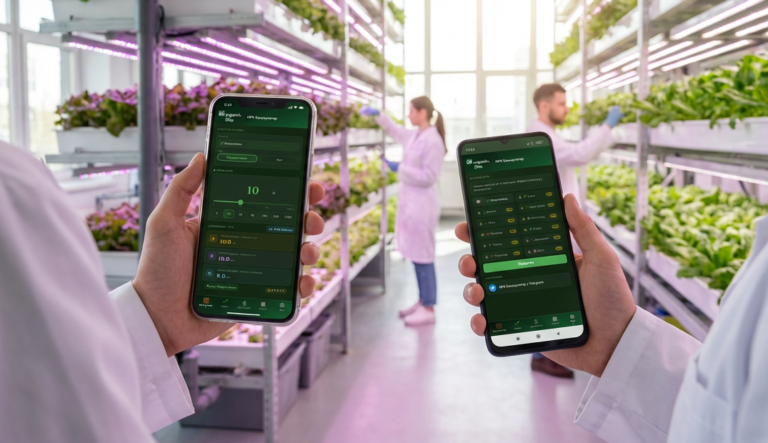
We know this problem and are already developing an ERP system specifically for city farms — a single tool that will unite production, logistics, stock, sales, and finances in one place. Plan a sowing and the system calculates costs immediately. Create an order and a delivery route forms automatically. Seed running low — you get a notification.
Follow our updates on social media to be first in line for free early access.
An updated learning section is also launching soon on UAorganic — free, with real numbers, and without ₴10,000 courses. Watch for updates.