
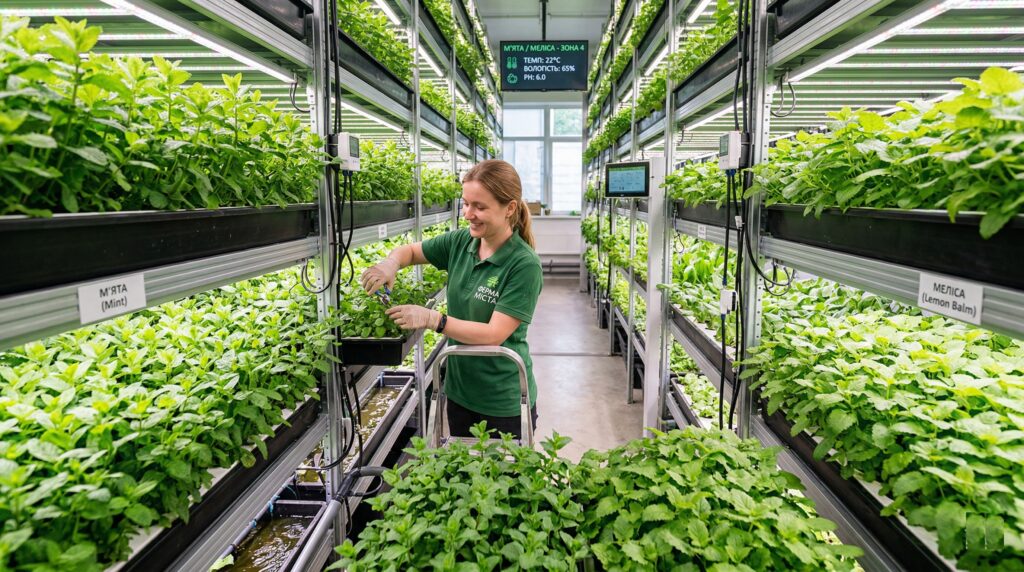
Mint and lemon balm are crops with strong demand and weak competition from field-grown supply. Yet city farms rarely grow them, treating them as difficult. The difficulties are real — but manageable, if you know a few key nuances from the start.
In this article:
Mint and Lemon Balm: What’s the Difference
Both crops belong to the Lamiaceae family and look somewhat similar — lemon balm is often confused with mint. But telling them apart is easy: mint always carries menthol notes in flavour and aroma; lemon balm has a lemon finish with no menthol.
Cultivated mint varieties are grown primarily to the mature-plant stage — it is the mature leaf that has the pronounced aroma required for dishes and drinks. Lemon balm is grown in all formats: microgreens, baby, and mature plant. The difference in approach comes from growth characteristics described below.
A Quick Guide to Mint Species
Peppermint (also called cold mint or English mint) — the most common cultivated species, a hybrid of water mint and spearmint. Japanese mint — maximum menthol aroma, high essential oil content. Spearmint — very mild aroma, less interesting for culinary use. Chocolate mint — combines menthol, chocolate, and lemon. Mexican mint (lofant) — sharp spicy scent with no menthol. Wild mint is actually oregano — no menthol flavour, though it is chemically present.
Why Mint Microgreens Aren’t Profitable
Mint germinates in 7–12 days and stays at the tiny seedling stage for up to 25 days. It requires a minimum of 12,000–15,000 lux. Germination rates rarely exceed 85–90%. Combine these three factors and the cost of goods for microgreens becomes disproportionately high.
For this reason, mint is grown straight through to a mature plant — only in this format does the crop become economically viable. Lemon balm is far more flexible: it is faster, germinates more evenly, and microgreens or baby lemon balm are perfectly profitable.
Substrate, Seeding Rate, and Germination
Substrate
Mint and lemon balm have a weak root system. Rockwool is theoretically suitable, but managing irrigation over such a long cycle is difficult — one overwatering or dry-out and the roots are damaged. A peat-perlite or coco-perlite mix is considerably more reliable. Organic substrate retains moisture better and gives the root more room to develop.
Note: Neither coco nor peat on its own contains enough macro- and micronutrients for a fast-growing crop in a small pot. These substrates are designed for large plants with developed roots drawing nutrition from a large volume. For Lamiaceae crops — minimal plain water, maximum nutrient solution from the very first irrigation.
Seeding Rates
| Crop | Format | Rate |
|---|---|---|
| Lemon balm | Microgreens / small baby (berry tray) | 0.2–0.25 g per tray |
| Lemon balm | Baby (salad pot) | 15–20 seeds per pot |
| Lemon balm | Mature plant | 10–15 seeds per pot |
| Mint | Mature plant | 5–10 seeds per pot |
Why can lemon balm be seeded more densely? It tolerates competition and easily forms a lush multi-stem cluster. Mint sown too densely is uneven — some plants lag significantly behind — so sow more sparsely.
Germination
The seeds are tiny and the germination period is long — so instead of a moist paper or a weight, use a 2 mm vermiculite cover. Simple and reliable.
Do not use plastic film during germination — after a week under film, condensation forms and triggers localised mould patches. A press weight also doesn’t work for the same reason: seeds can simply suffocate under a weight over a week of germination.
Optimal germination temperature: 24°C. Above 30°C, germination slows. Below 21°C, the timeline extends by several days.
Throughout germination, monitor substrate moisture. If it dries out — mist with nutrient solution at EC 0.8–1.0 mS/cm, pH 5.8–6.3. Nutrient solution, not plain water — the weak root needs nutrition from the start.
Move to light as soon as the sprout reaches 0.1–0.2 mm — don’t wait for the cotyledons to fully open.
Climate, Lighting, and Nutrition
| Parameter | Value |
|---|---|
| Daytime temperature | 21–23°C |
| Night temperature | 18–20°C |
| Air humidity | 60–65% |
| Photoperiod | 16 hours |
| Light intensity at substrate surface | min. 12,000–14,000 lux, optimal 16,000 lux (~120 W/m²) |
Pot density: for mature plants — 35–45 pots/m²; for baby lemon balm — up to 80 pots/m².
Nutrient solution EC: you can use 1.8–2.0 mS/cm throughout the entire cycle, or step up: 1.5 mS/cm for seedlings, 1.8–2.0 for mature plants. Mint and lemon balm are demanding in terms of solution concentration rather than specific composition — any standard vegetative profile works.
Pinching: How to Build a Bushy Plant
Over 50 days, lemon balm forms a nice, well-leafed bush. Mint is trickier: over the same period it produces attractive leafy “sticks” that won’t branch on their own. When this happens — the plant needs help.
Pinching schedule:
- After four pairs of true leaves have formed — remove the growing tip (the very top).
- Two lateral shoots develop from the axils of the top leaf pair.
- Once those lateral shoots have grown 2–3 pairs of leaves — pinch them the same way.
- The result: four independent shoots on one root — a properly formed, vigorous bush.
This bush can be transplanted into a 1.5–2 litre container and used for regular leaf harvests over several months — provided nutrition and substrate moisture are properly managed.
Cuttings: When It Makes Sense
Mint propagates readily from cuttings. If you find a plant with the right aroma — it can be cloned for exact replicas.
Cutting Protocol
Take cuttings from strong, healthy plants with multiple shoots — stem sections with 2–3 internodes. Cut the base at a 45° angle — this is non-negotiable and increases contact area with the substrate. After cutting, dust with rooting powder and insert 8–10 mm into the substrate.
Rooting substrate: organic (peat or coco) or vermiculite. Mint roots poorly in perlite.
Rooting conditions for 14 days: shield from direct light, daytime temperature 18–20°C, night 18°C, air humidity minimum 65–70%. If humidity drops — mist with plain water 3–4 times a day. Irrigate as the substrate dries, EC 1.0–1.2 mS/cm. After 14–18 days, transplant rooted cuttings into individual containers.
Note: Cuttings give one healthy generation of plants. Propagating from already-propagated cuttings is not advisable: vegetative reproduction accumulates viral load, and by the 2nd–3rd generation an outbreak becomes possible. Seed-grown plants are always healthier than those from cuttings.
Key points — in brief
- Mint — mature plant only. Microgreens are not viable due to slow start and poor seed germination rates.
- Lemon balm is more flexible: microgreens, baby, and mature plant — all formats work.
- Substrate — peat-perlite or coco-perlite. Irrigate with nutrient solution from day one, not plain water.
- Germinate under 2 mm of vermiculite, no film, no weight.
- Germination temperature 24°C, photoperiod 16 h, light intensity 16,000 lux.
- Mint requires pinching after 4 pairs of leaves — it will not bush on its own.
- Cuttings give one generation. After that — seed propagation only.
Conclusion
Mint and lemon balm are not the easiest crops for a city farm — but not as difficult as they seem. The main challenges are mint’s slow start, weak roots in both crops, and a tendency to stretch without pinching. All of this is solved with the right substrate, nutrient solution from day one, and timely canopy management. Master these details and you have a crop with strong margins and minimal market competition.