
You spot a fluffy white ball on a tray — straight into the bin. No deliberation. But do you know why it appeared in the first place, and what to do so it does not happen next time? Mould on microgreens is not just an inconvenience. It is a signal: somewhere in your process there is a gap.
What Mould Is — and Whether It Is Actually Dangerous
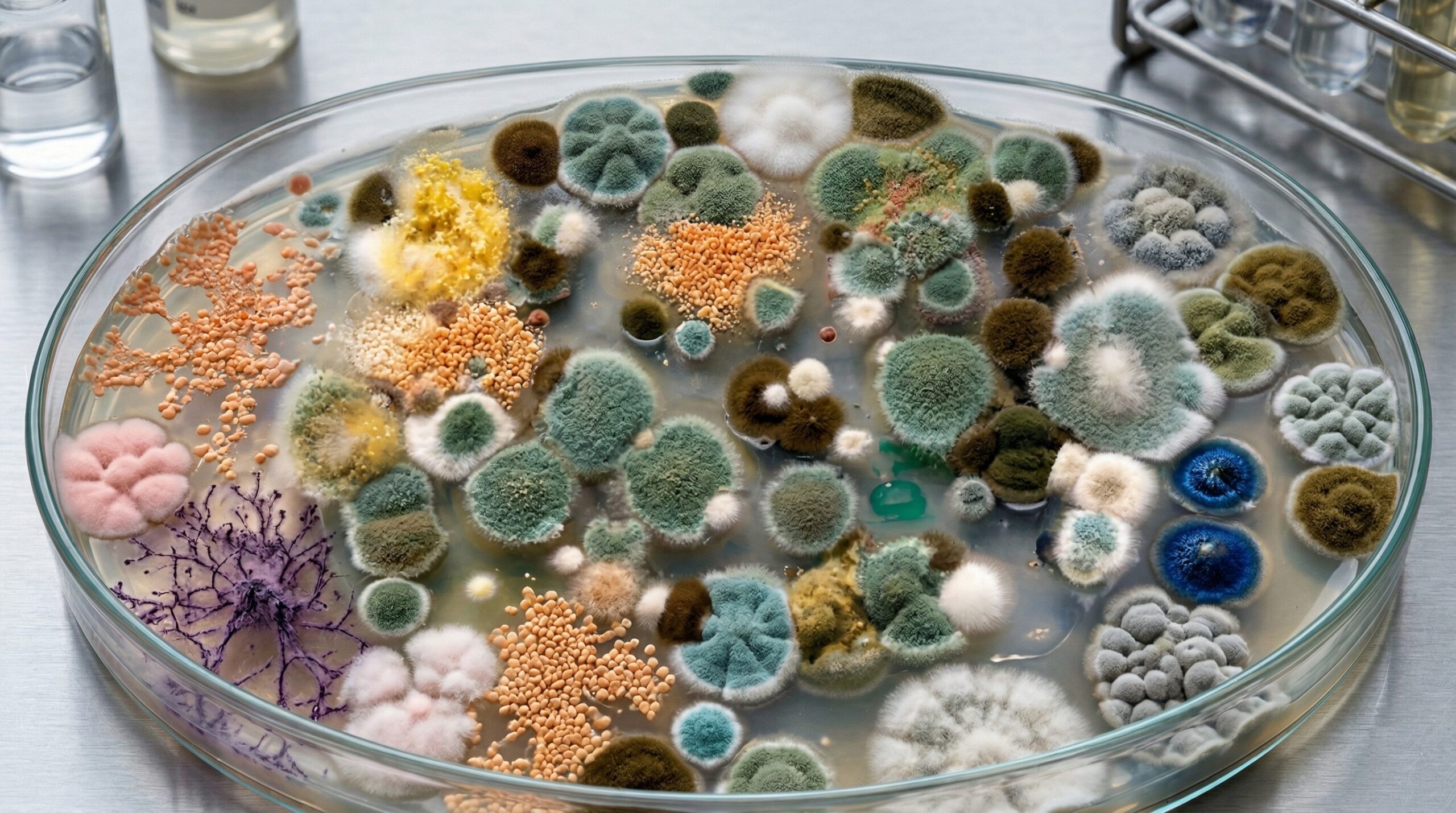
Mould is colonies of microscopic fungi. Those fluffy white or grey blobs you occasionally see on trays are their mycelium — characteristically tangled threads, sometimes with small spheres at the tips.
Most moulds are ordinary environmental residents. They are in the air, the water, the substrate. In a word, they are everywhere. The number of species genuinely pathogenic to humans is tiny. But even that tiny fraction is enough reason not to take any risk.
Important: A sowing affected by a fungal culture is unsafe — period. It does not matter whether there is “a little” or “a lot” of mould. It does not go to food. This is not over-caution; it is a basic food-safety standard accepted in most countries.
A useful analogy: imagine a café offering you pastries made from dough where a mouldy piece has been cut away. The rest is clean, right? Most people would refuse. The logic with microgreens is identical.
Three Reasons Mould Appears
For mould to grow on a sowing, three conditions must coincide simultaneously. Remove any one of them and there will be no colony.
1. Presence of a Pathogen
Fungal spores reach your farm via air, clothing, hands, substrate, and tools. Completely preventing their entry is impossible. But you can keep their numbers minimal — and at minimal numbers they simply have no chance to develop.
2. A Nutrient Medium
Fungi feed on organic matter. In a sowing that means dead seed that did not germinate, seed-coat residues, and root exudates sitting on the substrate surface. The higher the percentage of ungerminated seed, the more nutrient medium available for fungi. This is exactly why seed quality matters so fundamentally.
3. Favourable Environmental Conditions
Ideal conditions for most moulds: 22–25 °C and about 80 % humidity. That is precisely the temperature and humidity you maintain for germinating microgreens. Mould is therefore not an accident but a fully predictable risk that requires systematic management.
Environmental Control: Humidity and Airflow
This is the fastest lever you can pull today. Without control over room microclimate, mould will keep returning regardless of seed quality or disinfection.
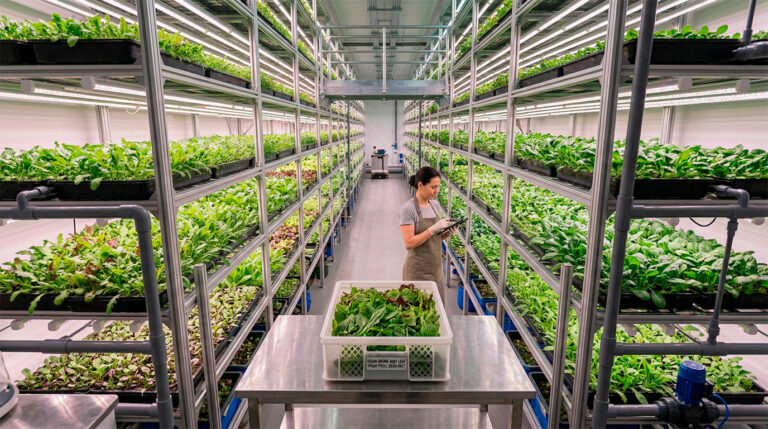
In the growing zone (outside germination) keep humidity at 55–65 %. Air must circulate actively throughout the entire volume — not just a fan in one corner, but genuine circulation.
The Germination Zone — a Different Story
Under a dome or in a dark germination zone, humidity naturally reaches 80 % — and that is normal. Airflow there is typically minimal. The key task in this zone is preventing condensate and standing water droplets on the plants and tray surfaces. A standing water droplet is the best possible environment for the rapid development of any microorganism.
Tip: If after removing a dome you see droplets on the ceiling or side walls, that is already a problem. Review your germination routine: perhaps you are covering too tightly or for too long.
Quality Seed — Half the Battle
Ungerminated seeds are the primary nutrient substrate for mould on your trays. Germination rate therefore directly affects the risk of mould. Poor seed = more organic residue = more food for fungi.
The good news: no reputable seed company knowingly sells material with depressed germination rates — it would hurt their reputation and sales too quickly. But there is a difference between “seed in general” and “seed for microgreens.” Buying from a market or random shop is a bad idea. Find a supplier who specialises specifically in this segment and can confirm germination rates.
How to Store Seed Correctly
Even excellent seed can be ruined by improper storage. Optimal conditions depend on the crop:
- Radish, cabbage, mustard, cucumber, squash, beetroot, spinach, pepper — 10–12 °C, humidity no higher than 60 %
- Onion, carrot, parsley, dill, pea, bean, lettuce, corn — 10–12 °C, humidity no higher than 50 %
Storage at room temperature is possible, but humidity control then becomes critical. The best packaging is tightly sealed zip-lock bags or unopened original packs. Peas and sunflower seed can be stored in cloth bags, but inspect regularly — these crops are prone to pest damage even before purchase.
Phytosanitation: Rules That Actually Work
Most fungal colonies arrive courtesy of the people working on the farm — on clothing, hands, and shoe soles. That is a fact, not overcaution. Changing into work clothing, sanitising hands, and swapping footwear are not “strict protocols for big factories” — they are the minimum for any city farm.
Facility Requirements
Walls and floors with no cracks or chips, washable finishes. Ceiling: no mould, no flaking paint. Exterior doors: closed when not in use. All materials and finished product: elevated off the floor, never on the ground.
Systematic cleaning and disinfection — not when the mood strikes, but on a schedule. With defined zones, products, and responsible persons. This sounds obvious, but the absence of a schedule is the most common cause of problems on small farms.
Entry Rules for Staff and Visitors
Into the growing zone: workwear and dedicated footwear only. Hair covering and gloves if available — mandatory. Before entry: wash hands and apply disinfectant (after changing clothes, not before). At the door: a disinfectant mat soaked in solution, or a sticky mat.
For visitors: disposable overalls, hair cover, shoe covers, and gloves. Keep them as far from plants as possible, with no contact with the sowings.
Warning: A phone, jewellery with complex shapes, and a watch all accumulate microorganisms from the metro, street, and home. Disinfecting an intricate ring is practically impossible. If a phone is essential, wipe the case regularly with plain alcohol.
Work Order on Shelves
All work moves in one direction: left to right, first aisle to last. Start with young sowings, then mature plants — never the reverse. Between moving from shelf to shelf, change or sanitise gloves. The same tool on different shelves: only after washing and treatment.
One more thing that rarely gets written about: shop-bought flowers are a genuine source of fungal spores. Even at home, a city farmer is better off without them.
How to Disinfect Trays and the Facility
Trays — Reuse Protocol
Single use is ideal. If reality dictates otherwise, follow this sequence:
- Scrub away all residue — mechanically, without chemicals
- Rinse with clean water
- Soak in disinfectant — 3–6 % hydrogen peroxide, hypochlorite, or copper sulphate solution — for at least two hours
- Rinse off residual disinfectant
- Dry completely — this is critical. Microorganisms can survive in a droplet of liquid, even one that contains disinfectant
Floor and Walls
For routine cleaning, a hypochlorite solution works well. A good option is Ecocide (pink powder, available at veterinary pharmacies) — mild, suitable for regular cleaning in the presence of plants.
For serious disinfection of an empty facility (no plants): peracetic-acid-based products such as Kickstart, Catril, or equivalents. These are more aggressive but deliver deep sanitation.
Farm Checklist — Review Your Setup Right Now
Environment
- Humidity in the growing zone: 55–65 %?
- Active air circulation throughout the full room volume?
- No condensate or standing droplets in the germination zone?
Seed and Substrate
- Seed from a specialist supplier with confirmed germination rate?
- Storage conditions — temperature and humidity — matched to the crop?
- Seed in sealed zip-lock bags or original packaging?
Phytosanitation
- Workwear and dedicated footwear for all staff?
- Disinfectant mat or elbow-operated dispenser at the entrance?
- Trays disinfected and fully dried before reuse?
- A cleaning and disinfection schedule in place?
- Walls and floor free of cracks, mould, and flaking surfaces?
Conclusion
Mould on a city farm is not failure and not bad luck. It is the result of specific conditions that aligned simultaneously. Remove even one of the three components — pathogen, nutrient medium, or favourable microclimate — and the problem disappears. Start with the simplest steps: ventilation, quality seed, hand and tray disinfection. Everything else is refinement that comes with experience and scale.