The cost of a mushroom block is usually worked out in dollars from American reports, or given as a formula without a single hryvnia. This article goes the other way: one specific oyster mushroom block, every cost line with a price you can check, and a total per kilogram of mushrooms. The block parameters come from a Ukrainian trial by Bandura and colleagues (2022), prices from listings on prom.ua and OLX in September and October 2026, and the power tariff and minimum hourly wage from official decisions. Each line is given as a range so you can plug in your own numbers. Prices are in Ukrainian hryvnias (UAH).
The block we are costing
Bandura and colleagues (Melitopol, Kyiv, North Carolina) grew oyster mushrooms in blocks of the kind Ukrainian commercial farms make. Substrate: sunflower hulls and barley straw at 1:3 after pasteurization, at 71.8% moisture. Spawn was 4.8% of wet weight, the bag was 33 by 90 cm, and a finished block weighed 12.43 kg on average.
Everything else follows from that. The block holds about 0.6 kg of spawn. There are 11.83 kg of wet substrate, and only 3.34 kg of that is dry matter; the other 8.5 kg is water. Yield is calculated from dry weight through biological efficiency (BE). In the trial, first flush BE ranged from 20% to 57%, depending on the grain in the spawn and on whether the room climate was controlled.
| First flush BE | When the trial got it | Mushrooms per block |
|---|---|---|
| 20% | worst grain mix in the spawn | 0.67 kg |
| 41.1% | best grain mix, uncontrolled room | 1.37 kg |
| 57% | best grain mix, controlled room | 1.90 kg |
Second and later flushes were not part of the trial, so everything below counts the first flush only. Each extra flush lowers the cost per kilogram, but this trial does not show by how much.
Prices: where the numbers come from
Listings are no substitute for statistics, but there are no open price statistics for spawn and straw. So I took several listings and show the spread.
| Item | Price | Source |
|---|---|---|
| Oyster mushroom grain spawn | UAH 125-450/kg; in 5-6 kg bags UAH 150-290/kg | prom.ua, Oct 19, 2026, eight offers |
| Baled straw | UAH 4-7/kg (a 10-15 kg bale for UAH 50-70) | OLX, three listings stating bale weight, Sept 2026 |
| Block bag | UAH 5-15 each | prom.ua, packs of 50 and 100 |
| Electricity | UAH 4.32/kWh | household tariff, extended to Apr 30, 2027 |
| One hour of labor | UAH 52.22 | minimum hourly wage from Jan 1, 2026 |
Sunflower hull listings give no units or refer to pellets, so I price the whole substrate as straw. One more caveat: I multiply the price by dry matter, while air-dry straw from a bale weighs a little more, so real straw spending will be somewhat higher.
Costing one block
| Item | Low option | High option |
|---|---|---|
| Spawn, 0.6 kg | UAH 89 (UAH 150/kg) | UAH 268 (UAH 450/kg) |
| Straw, 3.34 kg dry matter | UAH 13 (UAH 4/kg) | UAH 23 (UAH 7/kg) |
| Bag | UAH 5 | UAH 15 |
| Electricity for heating | about UAH 3 | about UAH 3 |
| Materials total | UAH 111 | UAH 310 |
I counted electricity as a lower bound. Hot water pasteurization, described in the article on how to start growing mushrooms, heats water with straw to 82 °C. Heating only the water that stays in the substrate, 8.5 kg, from 15 to 82 °C takes 0.66 kWh, or UAH 2.86. In practice you also heat the water in the tank and the tank itself, and some heat escapes into the air, so your meter will show more. But even five times that figure comes to about UAH 14, less than the bag in the high option.
The main point is visible straight away: spawn makes up 81% of materials in the low option and 87% in the high one. Straw, bag and power together barely reach UAH 40 even at the highest prices.
What a kilogram of oyster mushrooms from this block costs
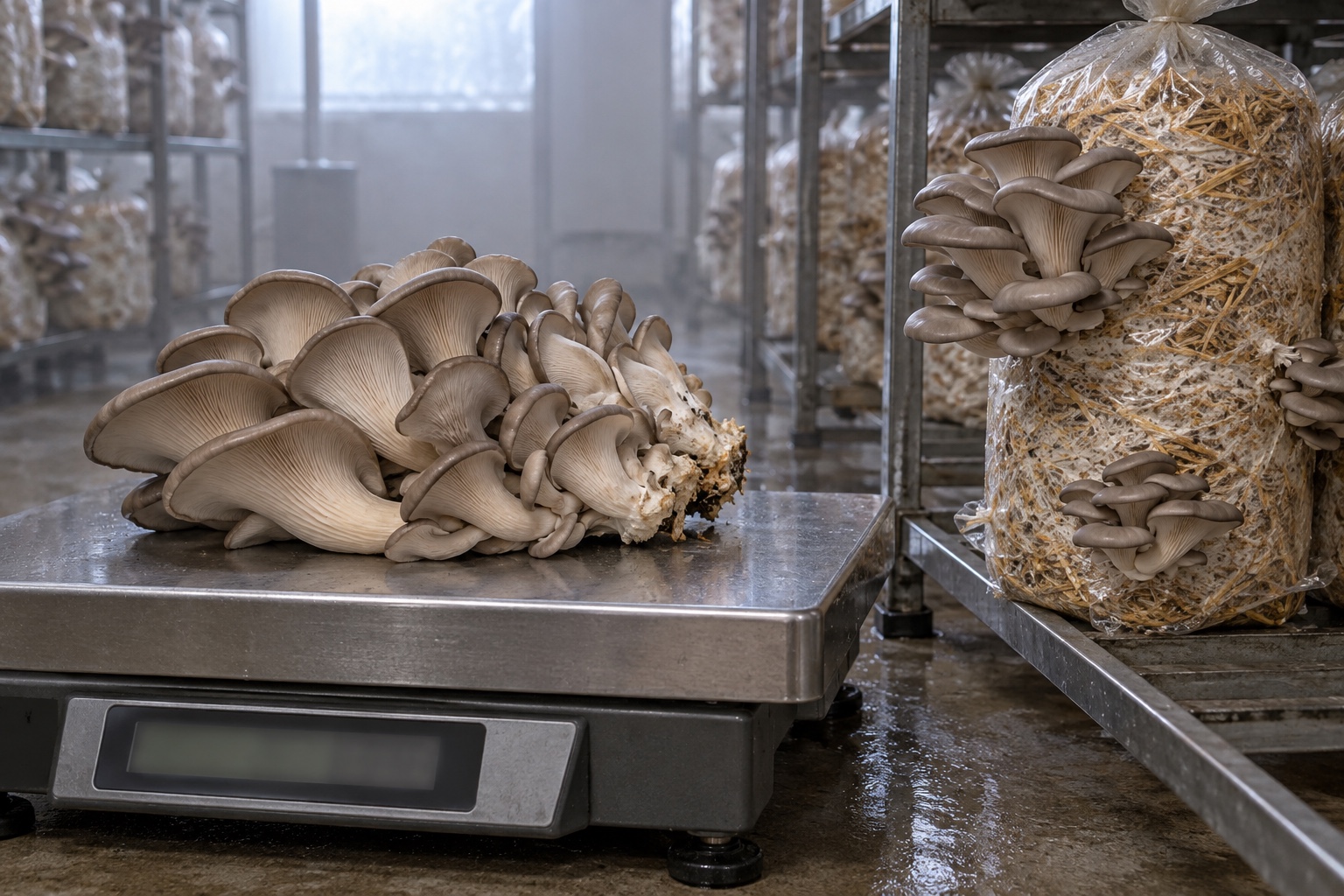
Divide materials by the first flush yield.
| First flush BE | Yield | Materials per kg, low option | Materials per kg, high option |
|---|---|---|---|
| 20% | 0.67 kg | UAH 166 | UAH 464 |
| 41.1% | 1.37 kg | UAH 81 | UAH 226 |
| 57% | 1.90 kg | UAH 58 | UAH 163 |
That is before labor and losses. I take labor from the Cornell data on five small farms covered in the article on three startup budgets: on average 1.23 hours of labor per kilogram of mushrooms. At the minimum hourly wage that is UAH 64 per kilogram. If you value your hour higher, plug in your own figure.
Contamination losses multiply everything. Some blocks will not produce, and the money for them is already spent. If one block in five is lost, a kilogram costs 1.25 times more; at 38%, as in the Kenyan plates from the grain spawn article, 1.61 times more.
Here is a middle line. A block at 41.1% BE, spawn at UAH 150, minimum wage, one block in five thrown out: (81 + 64) × 1.25 = about UAH 181 per kilogram. With spawn at UAH 450 under the same conditions you get (226 + 64) × 1.25 = about UAH 363.
What moves the cost the most
- Spawn price. Listings differ threefold, and this is the biggest line. Large bags are cheaper per kilogram. Making your own grain removes this line but adds work and losses; where the line between buying and making falls is covered in the article on making your own grain spawn.
- Spawn rate. The commercial 4.8% is about 0.6 kg per block. The Davis trial mentioned in the beginner article compared 12, 16 and 18%, and 12% gave a lower yield. On our block, 12% already means 1.42 kg, UAH 213-639 for spawn alone. Substrates and methods differ, so you cannot carry a rate from one trial to another, but work out what each extra percent costs before you inoculate.
- BE. Between the best and worst grain mixes the gap is almost threefold; between a controlled and an uncontrolled room, for the best mix, 41.1% vs 57%. Materials per kilogram drop from UAH 81 to UAH 58 in the low option without any change in prices.
- Losses. A multiplier of 1.25 or 2.0 matters more than any saving on bags.
What the calculation leaves out: rent, equipment, heating and humidifying the room, delivery. Capital costs are covered in the three budgets article, and the formula that turns substrate price and BE into a single multiplier is in the article on coffee grounds and cardboard.
How to cost your own block
- Weigh a finished block and write down how much spawn went into it.
- Measure substrate moisture and work out dry matter: substrate weight × (1 - moisture).
- Take prices from your own receipts: spawn per kilogram, straw per kilogram, the bag, and the meter reading before and after pasteurization.
- Weigh the first flush from each block. Divide by dry weight; that is your BE.
- Work out the share of blocks lost and multiply the cost by 1 ÷ (1 - share).
- Log the time for each batch. After three or four batches you will see your own hours per kilogram instead of someone else’s.
Mushroom block cost: the short version
- The 12.4 kg block from the Ukrainian trial: 0.6 kg of spawn, 3.34 kg of dry matter, 0.67-1.90 kg of mushrooms in the first flush.
- Materials per block at October 2026 prices: UAH 111-310. Spawn accounts for 81-87% of that.
- Power to heat the water in the substrate costs a few hryvnias at most; straw costs UAH 13-23.
- A kilogram of oyster mushrooms from the first flush: UAH 58 to 464 in materials alone, depending on BE and spawn price. Labor at the minimum wage adds about UAH 64 per kilogram.
- The strongest levers are spawn price, spawn rate, BE and losses. Bags and straw barely affect the result.