
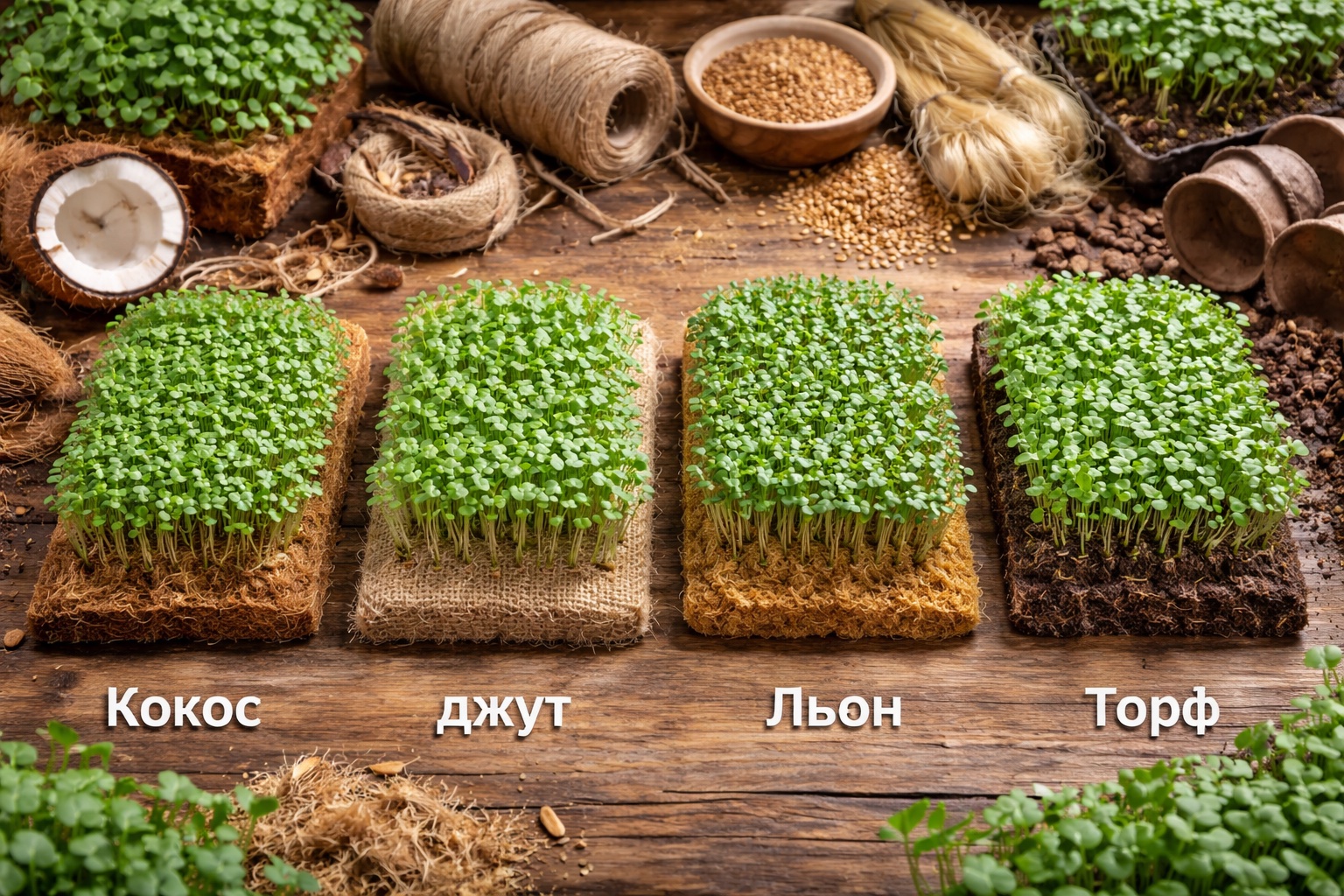
What a Substrate Is and Why It Matters
A substrate for microgreens is not soil in the conventional sense. Microgreens are harvested within 7–14 days, and during that time the plant lives almost entirely on the nutrients stored in the seed. The substrate performs just three functions: it holds the seed in place, retains moisture, and supplies the roots with air.
Choosing the right substrate is therefore not about “feeding” the plant — it is about balancing moisture and ventilation. Too wet — mould. Too dry — seeds do not germinate. Too dense — roots suffocate.
Linen Mat
The most popular choice among growers who produce microgreens regularly — both at home and for sale.
A linen mat is a thin non-woven pad made from natural flax fibres. Seed is sown directly on the surface; it absorbs water well and distributes moisture evenly, and roots penetrate the structure with ease.
Advantages
- Clean and convenient — greens do not get contaminated, no washing needed before eating
- Even moisture without pooling
- Easy to gauge watering — the mat signals visibly when it has dried out
- Suitable for almost all crops: rocket, radish, mustard, sunflower, pea
Disadvantages
- More expensive than coconut coir at high volumes
- Single-use — not reused after harvest
Best For
Anyone growing for personal use or small-scale sales. The optimal starting point for a beginner.
Jute Mat
The same principle as linen, but the material is jute (a tropical plant). Properties are very similar: good moisture retention, natural, clean at harvest.
The difference is minor: jute is slightly stiffer than linen, which can make germination of fine seed (basil, cress) slightly harder. For large seed — sunflower, pea, radish — it works excellently.
Best For
A good alternative to linen if linen is hard to find. For large-seed crops, a fully equivalent substitute.
Coconut Coir
Coconut coir is ground and pressed coconut husk. It is sold as bricks that are soaked in water before use (1 kg brick → up to 15 litres of fluffed substrate).
This is the most popular option among commercial producers — inexpensive at scale, consistent, and retains moisture well.
Important: coconut coir contains no nutrients. The plant feeds entirely from the seed — for microgreens this is sufficient — but the substrate must be properly moistened before sowing.
Advantages
- Economical at high volumes
- Stable pH (~6.0), rarely causes mould
- Holds both air and moisture simultaneously
- Suitable for large seed: sunflower, pea, wheat, radish, broccoli
Disadvantages
- Requires preparation (soaking, buffering)
- Contaminates greens — washing before eating is necessary
- Less convenient at home — loose material, messy on the table
Best For
Farmers and growers producing regularly at volume. For home use it is less convenient due to the need to wash the greens.
Peat
Peat is a classic garden substrate, but it performs worse for microgreens than any of the options above.
The problem is unstable pH and a tendency to clump. Peat either dries out very quickly or becomes acidic. It also carries its own microflora, which can be unpredictable — the risk of mould is higher than with coir or mats.
Best For
Practically nobody, for microgreens. If peat is the only option, mix it with perlite 3:1 to improve aeration. But a better move is to switch to coconut coir or a mat from the start.
Mineral Wool and Grow Wool
A specialist substrate for hydroponics and commercial growing. Wool contains nothing — no nutrients, no organic matter. The plant is held only by moisture and roots.
Upside: near-zero mould risk, excellent marketable appearance (greens stay clean). Downside: expensive, requires precise irrigation control, and is not compostable after use — it is waste.
Best For
Commercial farms where perfect presentation and controlled conditions are the priority.
Which Substrate to Choose: the Short Answer
Growing at home for yourself → linen or jute mat. Clean, convenient, no extra steps.
Starting small-scale sales → linen mat or coconut coir. The mat is more convenient; coir is cheaper once you are moving 20–30+ trays a week.
Commercial farm → coconut coir or mineral wool. Calculate unit cost: at high volumes the price difference becomes significant.
Fine-seed crops (basil, cress) → linen mat. Fine seed is harder to lay evenly on coir, and uneven sowing is a real risk.
Key Takeaways
- Substrate choice does not affect flavour or nutritional value — only ease of use
- Linen and jute mats are the most convenient option for most growers
- Coconut coir is the best value at high volumes but requires washing the greens
- Peat is not recommended for microgreens