
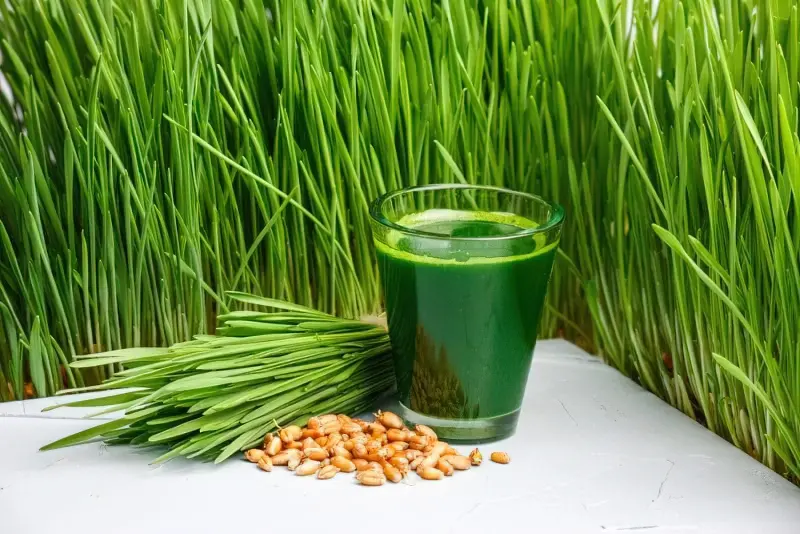
Wheatgrass is the freshly pressed juice or green mass of young wheat sprouts harvested on day 7–10 after germination. No marketing here: what is actually in the composition, how much to drink, when the benefits are real, and when to hold back.
Quick summary
• Wheatgrass — wheat sprouts cut at 10–15 cm height.
• Starting dose: 15–20 ml of juice in the morning on an empty stomach.
• Key nutrients: chlorophyll, iron, B vitamins, enzymes.
• Contraindications: coeliac disease, active peptic ulcer, pregnancy.
• Powder and dried wheatgrass — more convenient but weaker than fresh juice.
1. What Wheatgrass Is — a Precise Definition
Wheatgrass refers to young sprouts of common soft wheat (Triticum aestivum), harvested before the second stem appears — typically on day 7–10. At this growth phase the plant accumulates maximum chlorophyll, enzymes, and micronutrients; after jointing, most of these compounds are redirected to grain development.
Wheatgrass is consumed in three forms:
- Fresh juice — the most nutrient-dense form, but requires a juicer and fresh sprouts.
- Wheatgrass powder — convenient for travel, long shelf life, but some enzymes are destroyed during drying.
- Dried wheatgrass in capsules or tablets — the lowest concentration of active compounds.
Important: Wheatgrass and wheat sprouts are not the same thing. Sprouts are what germinates in 2–3 days, with no green leaf yet. Wheatgrass is the green grass at 7–10 days, with developed chlorophyll.
2. Wheatgrass Composition: What Is Actually in 30 ml of Juice
30 ml of fresh wheatgrass juice — the standard “shot” — contains approximately:
| Component | Details |
|---|---|
| Chlorophyll | ~70 mg — the primary pigment responsible for the green colour and part of the detoxification effect |
| Iron | ~1 mg (≈6–7% of daily requirement) — in non-complexed form; absorbed better in an acidic environment |
| Vitamin C | ~3–5 mg — much less than in citrus; degrades during storage |
| B vitamins (B1, B2, B6) | Present, but in moderate amounts — not a primary source |
| Vitamin E | ~0.5 mg — antioxidant activity |
| Enzymes (protease, amylase) | Active in fresh juice only; destroyed by heat and drying |
| Amino acids | 17 types including essential — but in small absolute quantities |
| Calories | ≈5–8 kcal per 30 ml — negligible |
On the “equivalent of 1 kg of vegetables” claim
This is a marketing phrase that spread in the 1970s. No verified study has confirmed that specific ratio. Wheatgrass is beneficial, but it does not “replace a kilogram of vegetables” — it complements a diet, it does not substitute for one.
3. Benefits of Wheatgrass: What Is Confirmed and What Is Exaggerated
Wheatgrass is heavily promoted as a superfood, but the evidence varies significantly.
✅ There are real grounds to speak of:
- Antioxidant effect — chlorophyll and vitamin E neutralise free radicals. Confirmed in vitro and partially in animal models.
- Anti-inflammatory action — small human studies showed a reduction in inflammation markers with regular consumption.
- Digestive support — enzymes in fresh juice ease food breakdown when taken with meals.
- Chlorophyll source — chlorophyll binds certain carcinogens and heavy metals in the GI tract, confirmed by research.
⚠️ Exaggerated or unproven:
- “Blood cleansing” — chlorophyll does not enter the bloodstream in significant quantities; the liver and kidneys handle detoxification on their own.
- “Replaces blood transfusion” — the chemical similarity of chlorophyll and haemoglobin does not make them functionally equivalent.
- “Treats cancer” — no clinical confirmation. Studies are limited and do not support such claims.
- “Boosts immunity” — a generic phrase with no specific mechanism or proven effect in humans.
4. Fresh Juice, Powder, or Dried Wheatgrass: Which to Choose
| Form | What to know |
|---|---|
| Fresh juice | Maximum enzymes and chlorophyll. Requires a juicer (ideally masticating) and fresh sprouts. Store no longer than 24 hours in the fridge. |
| Wheatgrass powder | Travel-friendly. Enzymes partially destroyed during drying, but minerals and chlorophyll are preserved. Mix into water or a smoothie. Dose ≈ 1 tsp (3–5 g). |
| Dried wheatgrass (capsules) | Lowest concentration. Convenient for those who cannot tolerate the taste of juice. Check the chlorophyll content on the label — not the “number of tablets.” |
| Frozen juice | A good alternative to fresh. Freezing preserves most nutrients. Ready-portion ice cubes are practical and convenient. |
Bottom line on forms: If you have access to fresh sprouts — fresh juice. If not — quality powder from a reliable producer that states the chlorophyll content. Capsules are the least effective form.
5. How to Take Wheatgrass: Doses and Timing
Recommended Introduction Schedule
- Weeks 1–2: 15–20 ml of fresh juice in the morning on an empty stomach (or 1 tsp of powder). Give the body time to adjust to the enzymes and chlorophyll.
- Weeks 3–4: increase to 30 ml. Most studies and practitioners report effects at this level.
- Beyond (optional): up to 60 ml per day — no more. Higher doses do not produce proportional benefit and may cause nausea.
When and How to Drink
- Best in the morning on an empty stomach, 20–30 minutes before eating: enzymes are more active in an empty stomach.
- An evening dose — 2 hours after a meal — is also acceptable. Not critical.
- Chase with water immediately after to soften the intense flavour.
- Mix with apple, carrot, or ginger juice — milder taste, no reduction in absorption.
Why nausea occurs
Nausea in the first few days is a normal reaction to the enzymes and the sudden influx of chlorophyll. It usually passes by day 3–5. If it persists, halve the dose and increase more slowly.
6. How to Store Wheatgrass Juice
- Fresh juice — drink immediately. Maximum enzymes within the first 15 minutes after pressing.
- Refrigerator — up to 24 hours in a tightly sealed glass bottle (not plastic — plastic accelerates oxidation).
- Freezing — in portion-sized ice-cube trays. Thaw in the fridge, not in a microwave. Preserves most minerals and some vitamins; enzymes are affected.
- Do not heat above 42 °C — enzymes begin to denature at this temperature.
- Powder — in a dry, dark place, tightly sealed. Do not handle with damp hands.
7. How to Grow Wheatgrass at Home: Step-by-Step
What you need: wheat grain for sprouting (not feed grain — it is often treated), a tray, substrate, a spray bottle of water.
- Soak wheat grain in clean water for 8–12 hours at room temperature.
- Drain. Rinse the grain and leave in the container for another 12–24 hours for germination to begin — grains start to sprout.
- Spread sprouted grain in a single even layer on a tray with substrate: coconut fibre, a jute mat, or a thin layer of soil. Cover with a thin layer of substrate or a damp cloth for the first 2 days.
- Water twice a day with the spray bottle — evenly, without letting water pool.
- On day 3–4, remove the covering. Provide diffuse light or a grow light at 12–14 hours per day.
- On day 7–10, sprouts reach 10–15 cm. Cut with scissors 1–2 cm above the substrate. A second cut will be weaker — most growers do not use it.
Common mistake in home growing
Overwatering + poor drainage = mould on the substrate (not on the grass itself). Solution: a tray with drainage holes or a drainage layer, bottom watering, good air circulation.
8. Contraindications and Precautions
Do not use if you have:
- Coeliac disease or confirmed gluten intolerance — wheatgrass contains gliadin, a gluten protein component.
- Active peptic ulcer (stomach or duodenum) — enzymes irritate the mucosa.
- Pregnancy and breastfeeding — due to insufficient safety data; consult a doctor first.
- Children under 3 years — risk of microbial contamination in fresh juice.
- Anticoagulant therapy (warfarin) — high vitamin K levels can alter the drug’s effect.
People with compromised immunity (chemotherapy, HIV, post-transplant) should use only pasteurised or powdered wheatgrass, not fresh juice. Fresh juice may contain pathogenic bacteria.
9. Frequently Asked Questions
Wheatgrass and Coeliac Disease — Is It Safe?
No. Wheat sprouts contain gliadin — a protein fraction of gluten. People with coeliac disease must avoid wheatgrass even in small doses. Alternatives: barley grass or spirulina.
Wheatgrass Powder — Real-World Results
Most positive feedback concerns improved digestion and increased energy after 4–8 weeks of regular use. The “detox” and “immune boost” effects are subjective and may reflect an overall improvement in dietary habits rather than the wheatgrass itself.
Can You Drink Wheatgrass Every Day?
Yes, daily consumption of 20–30 ml is safe for most people. Breaks are not required, though some practitioners recommend a 5-days-on, 2-days-off schedule to “rest” the enzyme system.
Dried Wheatgrass — Is There Any Benefit?
Yes, but less than from fresh juice. Minerals, chlorophyll, and some vitamins are preserved with correct low-temperature drying. Enzymes are not. If choosing powder, look for “cold-pressed” or “low-temperature dried” on the label.
Wheatgrass for Weight Loss — Does It Help?
There is no direct fat-burning effect. Indirectly it may help: through improved digestion, reduced sugar cravings in some people, and replacing unhealthy snacks. But if the rest of the diet is poor, wheatgrass will not compensate.
Summary
Wheatgrass is not a cure-all and not a “superfood that replaces everything.” It is a concentrated plant product with real but moderate effects: antioxidant protection, digestive support, a source of chlorophyll and micronutrients.
It works best as part of a balanced diet — not instead of one. Start with small doses, listen to your body, and do not exceed 60 ml per day of fresh juice.
Where to Buy and How to Grow
Fresh sprouts: farmers markets, health food stores, home growing.
Powder: specialist shops and online — look for cold-pressed or low-temperature dried.
Seed for growing: agricultural suppliers or online — ensure it is labelled “for sprouting,” not feed grain.