
Spring brings not only the first greens and long-awaited warmth — it also wakes the whitefly. In greenhouses and city farms it never truly disappears, but as temperatures rise it reproduces so fast that a single unnoticed female can become a colony of hundreds of thousands within two or three months. This article covers why this pest is so dangerous, how to catch it early, and what actually works against it.
Why Whitefly Is So Dangerous: Biology of the Pest
The greenhouse whitefly (Trialeurodes vaporariorum) is a tiny 1–2 mm insect with characteristic white wings coated in a waxy bloom. It almost looks charming — a little white moth. That apparent harmlessness often dulls a grower’s vigilance, and the critical window for effective control is lost before they realise what is happening.
Three species are common in Ukraine: greenhouse, tobacco, and cabbage whitefly. For protected cultivation and city farms, the greenhouse species is the main enemy — it treats a tunnel or grow room as a permanent home and reproduces year-round without pause.
Reproduction Maths That Should Unsettle You
Whitefly thrives at exactly the conditions we work hard to maintain for our crops: 21–27 °C and 60–75 % relative humidity. One female lays 130–150 eggs per month, and half of those hatch into females ready to reproduce within 7–10 days. Do the arithmetic: two months after a single female appears you have more than 4,000 egg-laying females; one month later, around 275,000. The pest produces 10–16 generations per season.
Field note: “There was no whitefly — well, maybe a little… Then suddenly every plant was covered.” That is a textbook outbreak description from growers. The reason is pure maths: for the first 3–4 weeks the population grows invisibly, then it explodes.
Six Development Stages — the Core Difficulty
The whitefly life cycle passes through six stages: egg, four larval instars, and adult (imago). All stages can be present on the same plant simultaneously. This makes control critically difficult: most modern insecticides are effective against only one or two stages. Kill the adults and new ones emerge from larvae within days. Kill the larvae and the eggs are untouched. That is exactly why a single spray almost never delivers results.
Adults are further protected by a waxy coat that impedes contact pesticides. Late-instar larvae are almost motionless and pressed tightly against the underside of leaves — another surface that is hard to reach with a spray solution.
Damage Caused by Whitefly
Whitefly damage is multi-layered, which compounds the problem.
Adults and larvae suck cell sap. Leaves yellow, plants fall behind in growth, and yields drop. At first it is barely noticeable, but at high population densities the picture becomes clear: leaves curl, yellow and dry out, and the plant weakens and stalls.
Two extra problems come with the territory:
- Larvae excrete a sugary honeydew on which sooty mould quickly develops. The black coating blocks photosynthesis and ruins the marketable appearance of the crop.
- Whitefly transmits dozens of plant viruses — tomato, tobacco, and cucumber mosaic, potato virus X, and many others. Even a small population can introduce a virus that destroys an entire batch long before you notice the pest.
Important: The greatest danger is not the direct sap-sucking damage but virus transmission. A handful of infected individuals can ruin a full production run well before you spot the population at all.
Monitoring: Catch the Pest Before It Catches You
The cardinal rule is not to wait for whitefly to announce itself. By the time a grower notices a “cloud” of insects flying up when plants are touched, the population has already hit a critical size and control becomes significantly harder.
Visual Plant Inspection
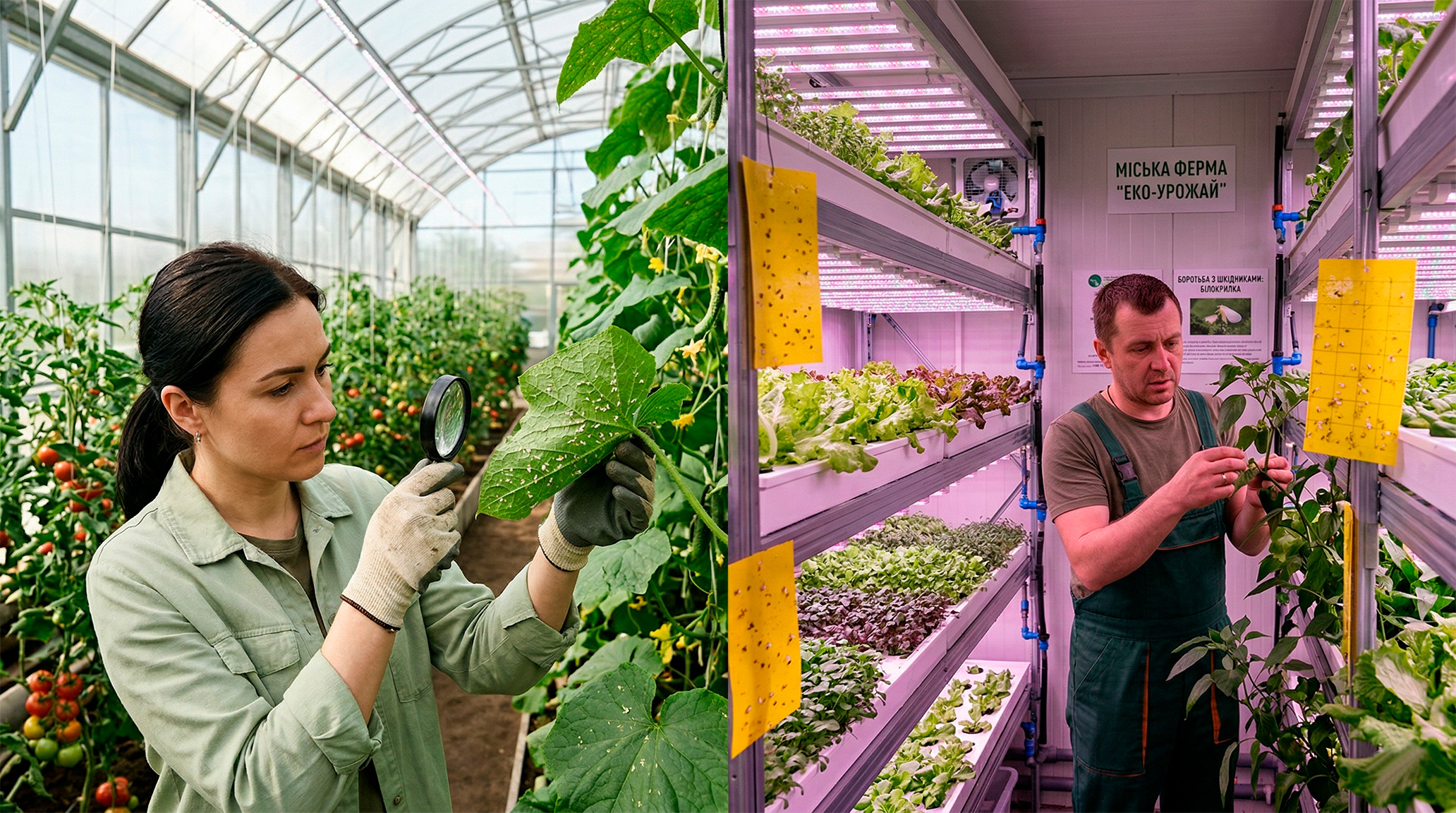
Walk every plant at least once a week. Pay particular attention to the underside of leaves: that is where eggs are laid and where immobile larvae concentrate. Eggs look like tiny semi-transparent granules; early-instar larvae are nearly colourless and easy to miss. Adults are white “moths” that fly up when the plant is touched.
In large greenhouses, one dedicated scout per 2 hectares is standard practice — a person whose only job is to walk the crop daily and log pest presence. A city farm does not operate at that scale, but the principle holds: weekly systematic inspection is not optional, it is mandatory.
Yellow Sticky Traps — a Non-Negotiable Tool
Yellow is a magnet for adult whitefly. Hang A4-format traps above shelves or crop rows; cut them into smaller rectangles if needed. Key points:
- Traps are not just monitoring — they are an active control method: up to 30 % of adults get caught on them.
- Replace traps regularly; do not let the adhesive dry out. A non-sticky trap only misleads you into thinking there is no pest.
- Count the catches per trap each week. Tracking the trend lets you react to population growth before it becomes an outbreak.
Tip: If more than 10–15 individuals appear on a single trap in one week, it is time to act — do not wait for the population to grow further.
Prevention: What to Do Before the First Pest Appears
The most effective whitefly control begins before the first individual shows up.
Control Your Microclimate
Whitefly loves stagnant air and shady spots. Ensure regular greenhouse ventilation — airflow significantly reduces pest comfort and slows spread.
New plants go into quarantine. Any new planting material entering the greenhouse is a potential whitefly carrier. A quarantine inspection — and a preventive treatment if there is any suspicion — is non-negotiable.
Remove plant debris. Whitefly overwinters in crop residues and can re-enter the greenhouse from the waste of the previous cycle. Thorough clean-up after every growing cycle is not merely hygiene — it is a pest-control measure.
Watch planting density. Dense plantings are a favourite habitat: low airflow, high humidity, shade. If you push density for yield, factor in the elevated pest risk.
Chemical Control: Treatment Schedules and Products
Once the pest is present, chemistry is unavoidable. But the approach must be systematic, not haphazard. A few principles without which treatments will not work:
Principles of Effective Spraying
Rotate products from different chemical groups. Whitefly mutates rapidly and builds resistance to insecticides — even biopesticides such as Fitoverm or Vertimec. One season of incorrect use is enough to establish a multiply-resistant population that nothing in your kit will touch.
Account for all development stages. Because all stages are present simultaneously, you need products that cover different ones. “Adults + eggs/larvae” is covered by combined treatment programmes.
Spray the underside of leaves thoroughly. That is where the pest lives. If you only hit the top surface, effectiveness will be minimal.
Always add a spreader-sticker. It improves spray coverage, increases contact with the waxy insect cuticle, and extends the protective effect. Any spreader at 3 ml per 10 L solves the problem.
Products and Schedules
For small initial infestations:
Fitoverm at the maximum labelled rate (refer to the dose, not the crop). Knocks down adults. 2–3 applications at 5–6 day intervals to catch newly hatched whitefly.
Teppeki (flonicamid) — 5 g per 10 L. A systemic and translaminar product that spreads quickly through the leaf tissue and provides long-lasting protection. Works across all stages. Keep it in your “emergency kit” — at the first sign of infestation, this is the first choice. 2–3 applications at 5–6 day intervals.
For established infestations — a rotation programme:
Block 1 (2 applications, 5-day interval): 10 L mix — Teppeki 5 g + Oberon 5 ml (acts on eggs and larvae) + spreader 3 ml.
Block 2 (2 applications, 5-day interval): 10 L mix — Fitoverm at maximum rate + Admiral 5 ml (also acts on eggs and larvae) + spreader 3 ml.
Final block (1–2 applications): Oberon at working rate — clears residual larvae on leaves.
Important: We are growing food, so choose insecticides with the lowest impact on human health and always observe the pre-harvest interval. Vertimec, for example, is effective on adults (7 ml per 10 L), but has a strong sharp odour that persists on plants for 2–3 days — factor that into your harvest and sales scheduling.
On Resistance: Why You Cannot Rely on a Single Product
Prolonged use of insecticides from the same chemical group inevitably builds resistant populations. Whitefly holds the record for resistance acquisition among greenhouse pests. Practical rule: no product can be applied more than twice in a row within a season. After that, switch to an agent with a different mode of action. This is not a recommendation — it is the condition for effective pest management.
Biological Control: Beneficial Insects as an Alternative to Chemistry
For operations aiming to minimise chemical load — or those that have already encountered resistance — biological control is increasingly relevant. The principle is simple: introduce natural enemies of whitefly into the greenhouse.
Encarsia formosa
A microscopic parasitoid wasp that lays its eggs inside whitefly pupae. The Encarsia larva feeds on the host and destroys it from within. Effective specifically against pupal stages — the ones chemistry barely touches. It is introduced preventively, before mass infestation develops. On its own it is not sufficient against heavy infestations; combine with other methods.
Macrolophus caliginosus
A generalist predatory bug. Destroys whitefly, thrips, and tomato leafminer at all development stages. Greenhouse practice data show that at a pest density of 6–10 individuals per leaf and a predator-to-prey ratio of 1:5, the whitefly population dropped below the damage threshold within one month. Optimal conditions for the predator: 25–27 °C, 70–85 % humidity.
Entomopathogenic Fungi
Biopesticides based on Beauveria bassiana (Boverin), Aschersonia aleyrodis, and Verticillium lecanii (Verticillin) work through direct spore contact with the insect body. Effective on adults and larvae. Advantages: safe for humans and no resistance development. Disadvantages: require high humidity and temperature for fungal growth; effect appears after 5–7 days.
Tip: If you plan to shift to biological control, start by introducing beneficials preventively before any pest appears. Against heavy infestations, first reduce the population with chemistry to a low level, then release the beneficials. Never combine beneficials with chemical insecticides — allow at least a 5-day gap between sprays and releases.
Special Considerations for Microgreens and Baby Leaf
On microgreens, whitefly damage is minimal — the crop grows so quickly that the pest simply cannot complete a full reproductive cycle before harvest. Trays leave for the customer before the population has time to build. If you see a few adults on microgreens, they honestly look rather harmless and rarely trigger complaints from buyers.
There is one important caveat: microgreens can act as a reservoir from which whitefly migrates to other crops in the same space. If baby leaf, full-size greens, or edible flowers are growing nearby, general population control is necessary.
Chemical treatments in practice are applied mainly to baby leaf, mature greens, and flowers. Always factor the product’s pre-harvest interval into your cut and sales schedule.
Spring risk is elevated. As temperatures rise and day length increases, all insect activity multiplies — even in closed environments. Plants and insects “sense” seasonal rhythms even without direct outdoor exposure. In spring, double the monitoring frequency.
Key Takeaways
- One female produces around 275,000 descendants in three months — respond immediately; there is no “I’ll check in a few days”.
- Six development stages present simultaneously — use combination products and 2–3 applications at 5–6 day intervals, never a single spray.
- Yellow sticky traps are a permanent fixture: both monitoring tool and active control measure at once.
- Rotate products from different chemical groups — otherwise you breed a resistant population that nothing will touch.
- Beneficials (Encarsia, Macrolophus, entomopathogenic fungi) are a real and effective alternative to chemistry when introduced correctly.
- Always spray the underside of leaves — that is where the pest lives.
- Whitefly damage to microgreens is minimal, but population control is still needed because it migrates to other crops.
Whitefly is not a death sentence. Large greenhouse operations manage it successfully even where conditions are ideal for the pest year-round. The main tool is discipline: regular monitoring, sticky traps, and no delays when the first individuals appear. Act while the population is small — chemical load stays minimal and results stay maximal.