
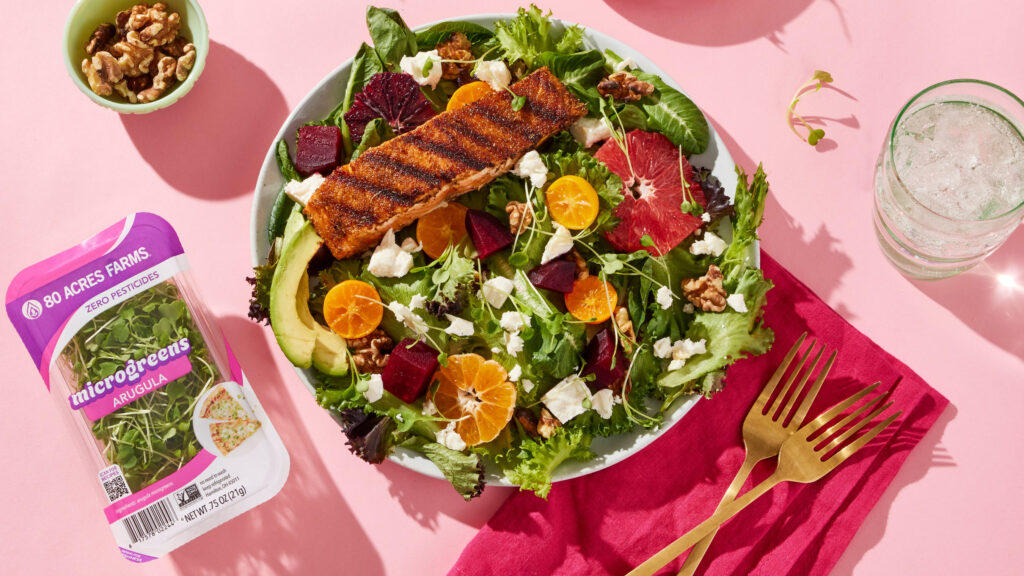
When microgreens land on Walmart shelves, it is a signal that the product has definitively left niche status. That is exactly what happened at the start of 2026: vertical farm 80 Acres Farms announced a major expansion of microgreens sales across the United States.
What is being sold and where
From January 2026, 80 Acres Farms microgreens appeared in Albertsons, Safeway, Walmart, H-E-B, Meijer, Mariano’s, and several other large retailers — more than 17,000 points of sale in total. In parallel, the farm supplies microgreens to restaurants through U.S. Foods, one of America’s largest distributors.
The company currently offers seven varieties of microgreens for retail and foodservice, including broccoli, sunflower, pea, and several proprietary mixes.
Why 80 Acres Farms grew so fast
The key is the GroLoop technology platform, developed by subsidiary Infinite Acres. It is a closed-loop system that integrates hardware, software, and climate control into a single production process. The farm runs on 100% renewable electricity and uses 95% less water per kilogram of product than a conventional field.
In 2025 the company merged with Soli Organic — and now controls both vertical indoor production and organic open fields. This allows it to cover different price segments and offer a broader range to retailers.
What this means for the microgreens market
When major chains add microgreens to their standard range, it stabilises the market. More buyers, higher demand, greater consumer awareness. For small producers it is a double-edged sword: competition grows, but so does the overall market.
A lesson for Ukrainian producers
Entering large retail chains requires supply consistency — difficult for a small farm without automation. But the niche of local supplier to restaurants, hotels, and catering remains wide open. You do not need 17,000 outlets — 10–15 regular clients is enough.