

People buy greens at the farmers market for two reasons: they are local, and they are supposed to be cleaner. Both ideas have been tested. A review of 83 studies on farmers markets found no difference in microbial contamination of fresh produce between markets and other sources. And when you look at what actually puts people in the hospital after eating leafy greens, it is viruses and bacteria, with pesticide residue barely visible in the data. Here are the numbers, where they come from, and what to do with them at the stall.
What turns up in farmers market greens
The broadest summary is a 2017 Canadian knowledge synthesis of 83 studies on food safety at farmers markets, most of them from the United States. Where market food was compared with other sources, market chicken more often carried Campylobacter and Salmonella. For fresh produce there was no difference in either direction.
Individual market surveys look similar. Generic E. coli is common, pathogens are rare. Generic E. coli is mostly harmless by itself; it signals that fecal matter reached the leaf. The indicator and the manure question are covered in our piece on organic produce and pathogens.
| Where, year published | What was sampled | Generic E. coli | Pathogens |
|---|---|---|---|
| Alberta, Canada, 2009 | 673 samples from 36 markets: lettuce, spinach, carrots, green onions, tomatoes, strawberries | 8.2% of all samples, 27.1% of spinach, 0 in tomatoes and strawberries | no Salmonella, O157:H7 or Campylobacter; Cryptosporidium in 1 spinach sample |
| Vancouver, 2015 | 68 lettuces from 5 markets | 13% | no virulence genes in the E. coli isolates |
| Pennsylvania, 2017 | 54 kale, 52 lettuce, 46 spinach | 28%, 29% and 17% | Listeria spp. in 2%, 4% and 7%; 3 of 10 Listeria isolates from meat and greens were L. monocytogenes |
| Los Angeles, Orange County, Seattle, 2015 | 133 bunches of basil, cilantro and parsley from 13 markets | 24.1%; 12% above the UK guideline for ready-to-eat food | Salmonella in 1 parsley sample |
| Northern California, 2015 | 242 samples of Asian vegetables from 21 vendors at 6 markets | 20% | Salmonella in 6.6%, mostly cilantro and squash leaves |
| Northern California, 2020 | 128 produce samples from 44 markets | 31.3% | no Salmonella; pathogenic E. coli was not tested |
The percentages are not comparable with each other: different methods, seasons and crops. Two things hold across the whole table, though. Leafy greens and herbs carry contamination more often than tomatoes or strawberries. And a market address guarantees nothing: two of the six surveys found Salmonella.
Why local does not mean inspected
In 2011, 15 people in Oregon got sick with E. coli O157:H7. Six were hospitalized, four developed hemolytic uremic syndrome, and two died. The source was strawberries from one farm, sold at roadside stands and farmers markets. Deer did the contaminating: every positive field sample contained deer feces. The investigators singled out regulatory exemptions for locally grown produce as part of the problem.
The exemption is written into the Produce Safety Rule. A farm is exempt from most of it (21 CFR 112.5) if its average annual food sales over the previous three years are under $500,000, adjusted for inflation, and more than half go to qualified end-users. That means consumers, or a restaurant or retail store in the same state or within 275 miles of the farm. In other words, the legal definition of local is also the exemption from the water, manure and hygiene rules. What the farm owes the buyer instead is its name and full business address at the point of sale (112.6). How the law works overall is in what FSMA changed.
A 2013 survey in Georgia, Virginia and South Carolina shows what happens on those farms: 226 farmers and 45 market managers responded. More than 56% of the farmers use manure. Of those, 34% use raw manure or raw mixed with compost, and over 26% wait fewer than 90 days between applying raw manure and harvest. Over 27% irrigate with water that has never been tested, and 16% wash produce with it. Over 42% of market managers have no food safety standards at all, and only 2 to 11% ask farmers about conditions on the farm. In the Canadian review, the average share of vendors seen washing their hands was 4%.
The other side matters too. In 2018, romaine from the Yuma growing region caused 210 illnesses in 36 states: 96 hospitalized, 27 cases of hemolytic uremic syndrome, 5 deaths. The outbreak strain turned up in irrigation canal water. A long supply chain carries one contamination event across the country. Market outbreaks are smaller. The Canadian review counted 12 outbreaks and case reports linked to farmers markets from 1994 to 2016, with 411 illnesses, 38 hospitalizations and 2 deaths in total. That does not reassure me much. A small outbreak is easier to miss and less likely to be traced back to a particular stall.
In Ukraine, plant products sold at an agri-food market go through the market laboratory first. What that lab does with greens and what Order No. 1279 requires of sellers is in selling microgreens at a market in Ukraine.
Pesticides or pathogens: what people fear and what makes them sick
In 2019, EFSA surveyed 27,655 people across the then 28 EU countries. Pesticide residue was among the top food concerns for 39% of them; food poisoning from bacteria for 30%.
Illness data rank things differently. CDC attributed US foodborne illness to food commodities using outbreak data from 1998 to 2008. Leafy vegetables came first: about 2.2 million illnesses a year, 22% of the total, plus 14% of hospitalizations and 6% of deaths. Of those 2.15 million illnesses, 1.95 million were viral, 188,000 bacterial and about 9,000 chemical.
That picture is incomplete in both directions. CDC could count chemical causes only from reported outbreaks, so they are likely undercounted. And outbreak data only see acute illness. Long-term exposure to small doses does not show up there; that is what maximum residue levels and government monitoring are for. How many European samples exceed those levels, and why the Dirty Dozen measures the wrong thing, is in our Dirty Dozen breakdown.
Is there less pesticide at the market? The direct comparison I found is from China: 1,588 vegetable samples from Zhejiang province, three neonicotinoids. The mean combined level, expressed as imidacloprid equivalents, was 168 µg/kg for farmers market vegetables, 134 for supermarkets and 76.9 for organic farms. All three groups stayed within safe intake limits. These numbers do not transfer to any other market, but they do not support the idea that market produce is free of pesticides either.
| Pesticide residue | Bacteria and viruses | |
|---|---|---|
| How it harms | dose builds up over years, and the limit has a safety margin | one serving is enough: for O157:H7 that means a handful of cells |
| What illness data show for leafy vegetables | about 9,000 illnesses a year, all chemical causes combined | 1.95 million viral and 188,000 bacterial |
| Market vs store | higher at markets in the Chinese sample | no difference across 83 studies |
| What helps in the kitchen | washing removes some surface residue; a baking soda soak removes more | washing reduces but does not disinfect; only heat is reliable |
My answer to the headline question: for raw leafy greens, bacteria and viruses matter more. Pesticides are worth watching, but limits, monitoring and a varied diet protect you from them. The only thing that protects you from Salmonella in a salad is how that salad was grown, washed, chilled and handled.
Microgreens at the market: a different set of risks
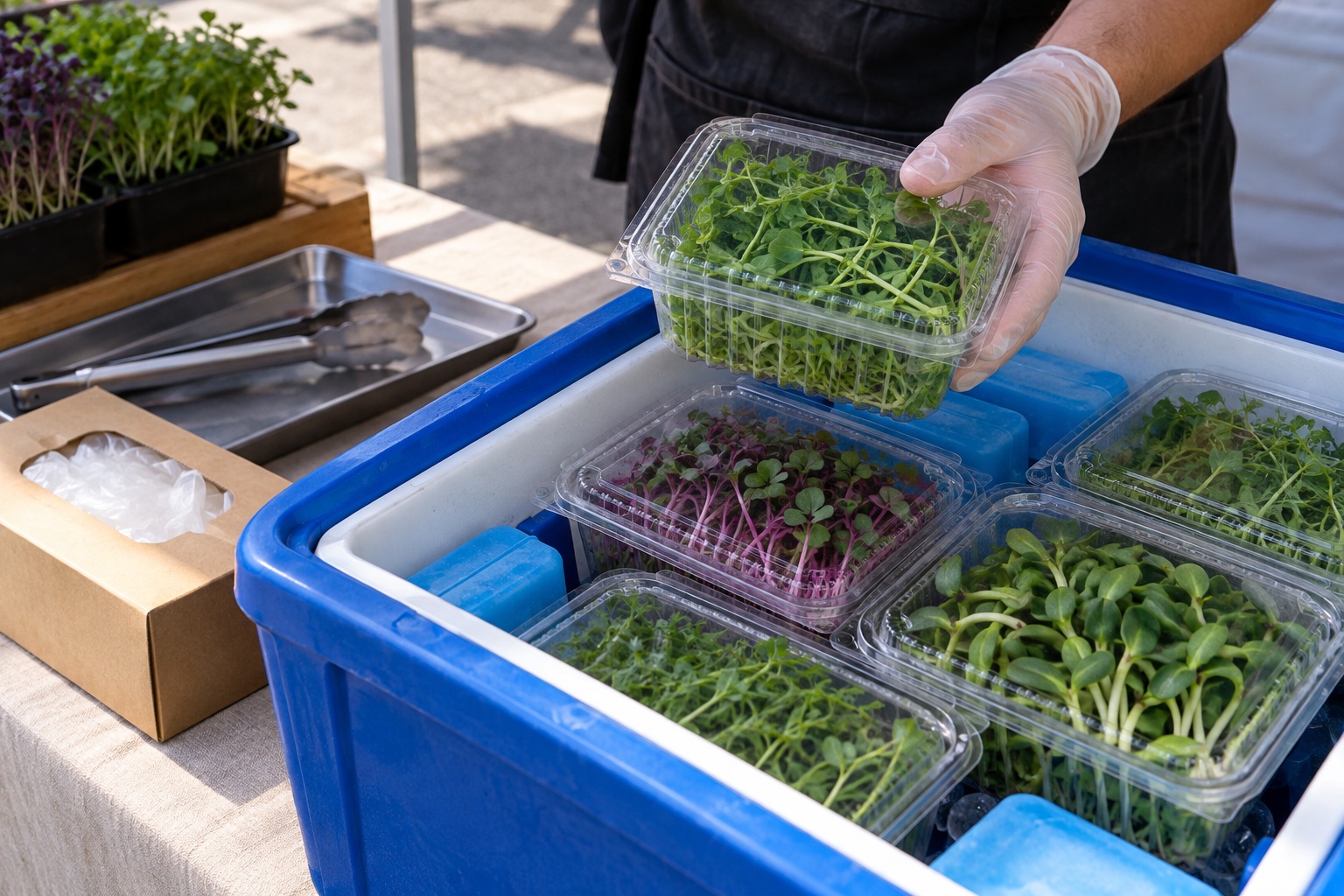
Microgreens grow indoors on trays and are cut above the growing medium. There is no manure and no deer, so the main field sources drop out. What remains is seed, water and hands. Seed is behind sprout outbreaks; why microgreens carry less risk than sprouts, but not zero, is covered in sprouts vs microgreens. How growers disinfect seed before sowing is in the seed disinfection wiki.
Hands matter more than they seem. In the same CDC data, the largest share of viral illness, 35%, was attributed to leafy vegetables. Norovirus only multiplies in people, so people put it on the leaf: whoever cuts, packs and sells. More on norovirus and doses in the infectious dose piece. At a market, the same vendor often handles cash and greens with the same hand, and the hand-washing rate there was 4%.
For microgreens from a market I would watch two things. A closed container with a harvest date goes through fewer hands than greens scooped out of a crate. And cut microgreens keep in the cold, so a box that has sat in the sun since morning loses to one kept in a chilled cooler.
What to check at the stall
- Water. Ask what the greens are irrigated and washed with: a well, a pond or city water, and whether it has been tested. In the US survey, one farmer in six washed produce with untested water.
- Manure and timing. The question from the organic piece about aged compost and the interval before harvest works for any farm, organic or not.
- Cold. Leafy greens and microgreens sitting in the sun on a hot day are a worse choice than the same greens in a cooler.
- Hands and cash. Tongs, gloves or a sealed pack are good signs.
- For microgreens: a harvest date and lot number on the container, where the seed came from and whether it was disinfected.
- At home: rinse under running water and keep cold. Who should skip raw greens and sprouts altogether is in the food safety guide.
Key points
- Across 83 studies, farmers market produce was no different in microbial contamination from produce sold elsewhere.
- Market surveys found generic E. coli in 8 to 31% of samples, and Salmonella in two of six surveys.
- In the US, a local farm with under $500,000 in sales is exempt from most of the Produce Safety Rule. The Oregon strawberry O157:H7 outbreak shows how that can end.
- A long supply chain is no protection either: Yuma romaine caused 210 illnesses in 36 states.
- Leafy vegetables cause about 2.2 million US illnesses a year, 1.95 million of them viral. Chemical causes account for about 9,000.
- For raw greens, water, manure, cold and hands matter more than where you buy them or pesticide residue.


