
How much does a bunch of basil cost in Odesa vs. Kharkiv — and why can the difference reach 4–5×? Where is microgreens cheaper: METRO, Silpo, or a local market? We are publishing Green Index for the first time — a monthly price monitoring report for fresh greens, microgreens, and salad mixes in Ukrainian supermarkets. March 2026 was the first reporting month — and it already revealed some interesting patterns.
What Is Green Index and How We Calculate It
Green Index is a monthly monitoring of retail prices for fresh greens, microgreens, and salad mixes in Ukrainian supermarkets. We track prices across chains in various cities — Kyiv, Kharkiv, Odesa, Rivne, and others — and analyze what has changed, where the best deals are, and what market trends are forming.
The key comparison metric is price per 100 grams. Comparing a 30 g pack with a 200 g pack without recalculating is like comparing apples and oranges. The unit price is what reveals real value.
Who this report is for: consumers — to shop smarter; urban farmers — to understand market benchmarks; retailers and media — to keep a finger on the pulse of Ukraine’s greens market.
March 2026 is the first monitoring month. Data includes dozens of items from METRO, Auchan, NOVUS, Silpo, WineTime, EcoMarket, Chudo Market, ATB, Torba, Ideal, Kosmos, Tavria V, and others.
Basil: From 27.9 to 248 UAH — What Are We Paying For
Basil is one of the most informative products for market analysis. It exists simultaneously as a mass-market item (a bunch in any supermarket) and a premium product (a pot from a farm brand). The price difference here is striking.
Price Geography: Odesa vs. Kyiv
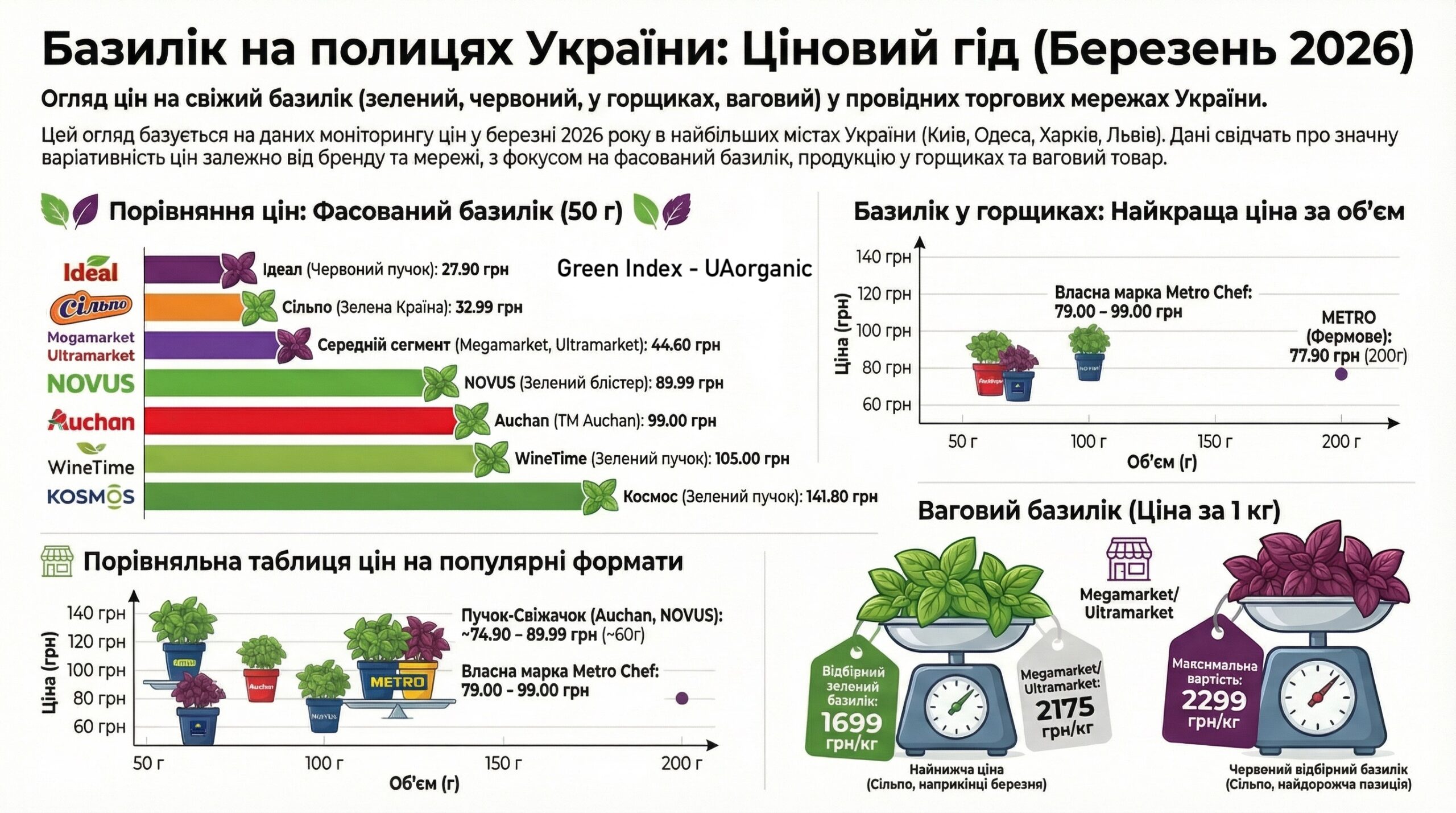
The cheapest basil was found in Odesa — the “Ideal” chain sells a bunch (30–50 g) for 27.9 UAH, which is approximately 55.8 UAH per 100 g. By comparison, at WineTime and NOVUS in Kyiv, red basil costs 105–124 UAH for 50 g — meaning 210–248 UAH per 100 g. That is 4–5× more expensive than the Odesa bunch.
Consumer tip: If you’re looking for a specific brand — check several chains. The difference on the same product between stores can reach 20–25%.
Best Value per 100 g
Large packaging is your friend. When evaluating value by volume, packs from 90 to 200 g come out on top:
| Product | Pack | Chain | Price per 100 g |
|---|---|---|---|
| “Super Zerna” (radish microgreens) | 200 g | Auchan | 26.1–27.0 UAH |
| FOP Pankova A.V. (mustard/broccoli/sunflower) | 200 g | WineTime | 45.0–48.5 UAH |
| “Zeleny Chef” (pea) | 90 g | Ideal, Kosmos, Tavria V | 51.0–56.7 UAH |
And the Most Expensive?
At the other end of the price spectrum — the “Mikrohrin” brand at METRO with a unit price of 133–145 UAH per 100 g, and unbranded microgreens at Megamarket and Ultramarket — up to 150–158 UAH per 100 g. This is a category for those who shop without looking at price tags.
Fact: The gap between the cheapest and most expensive microgreens on the market is over 6× per 100 g. The composition can be identical — for example, sunflower or radish.
Salad Mixes: Best Value Ranking
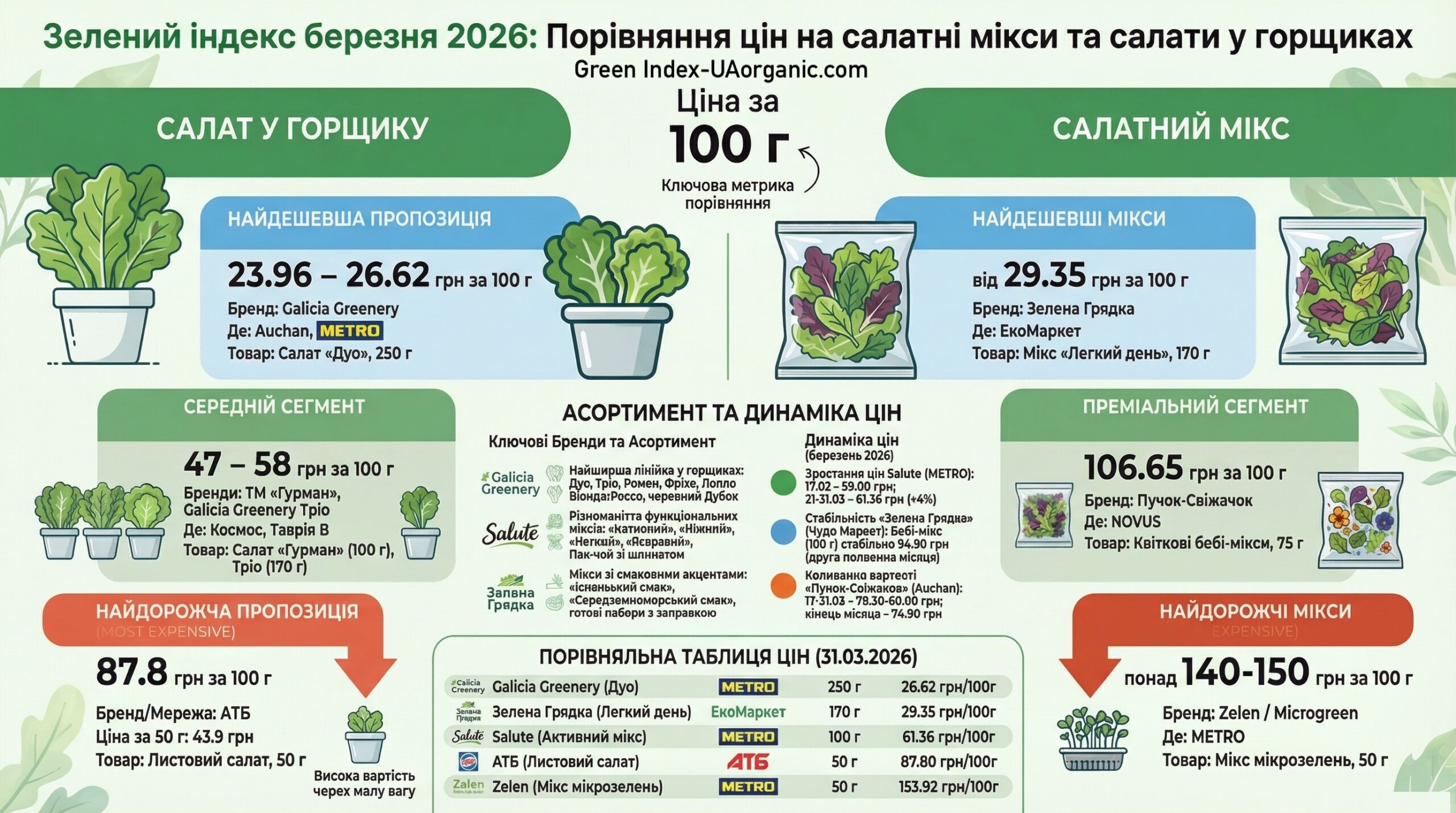
The salad mix market is surprisingly diverse. It includes large agro-holdings, farm sole proprietors, and store private labels. As of March 31, 2026, prices ranged widely — from 29 to over 150 UAH per 100 g.
Most Common Brands on Shelves
Among brands most frequently found in stores: “Puchok-Svizhachok” (wide lineup — baby mix, pomegranate, nut, energy mixes), Salute / Salute Mix (active, light, tender, bright options), “Zelena Hryatka” (Spanish taste, Mediterranean, light day, baby mix), Metro Chef (METRO’s own brand — Asian, floral, baby mix, mixed bunch), Auchan (own label), Fit & Easy and Good for Life.
Best Value Mixes Ranking (price per 100 g, as of 31.03.2026)
| Product | Pack | Chain | Price per 100 g |
|---|---|---|---|
| 1 — “Zelena Hryatka” Spanish Taste | 200 g | EcoMarket | 19.95 UAH |
| 2 — Galicia Greenery “Duo” | 250 g | Auchan, METRO | 23.96–26.62 UAH |
| 3 — Metro Chef “Floral Mix” | 125 g | METRO | 27.99 UAH |
| 4 — Metro Chef “Mixed Bunch” | 220 g | METRO | 29.5 UAH |
| 5 — “Zelena Hryatka” Light Day | 170 g | EcoMarket | 29.35 UAH |
| 6 — “Salat Mix” | 180 g | Torba (Rivne) | 30.5 UAH |
The main savings principle: buy large packaging. In almost every category, going from 50–75 g to 170–250 g saves 30–50% per 100 g.
Potted Lettuce: Three Price Tiers
A separate category — potted lettuce. Here too there is a wide range:
- Budget segment (23.96–26.62 UAH per 100 g): Galicia Greenery “Duo” (250 g) at Auchan and METRO — the best deal of the month.
- Mid-range (47–58 UAH per 100 g): TM “Gurman” and Galicia Greenery Trio at Kosmos and Tavria V.
- Premium (106.65 UAH per 100 g): “Puchok-Svizhachok” Floral Baby Mix (75 g) at NOVUS.
Price Dynamics: What Got More Expensive, What Got Cheaper
During the second half of March, most items held stable prices. But there were movements in both directions.
Price Increases
- Potted mint (NOVUS, Kyiv): rose from 129.0 to 139.0 UAH — plus 10 UAH or +7.8% in two weeks.
- Cilantro (50 g bunch, “Vasha Zelen”, Tavria V, Kharkiv): rose from 60.5 to 70.6 UAH — plus 10 UAH or +16.7%.
- Green For You “Kids Mix” (50 g, Chudo Market, Kharkiv): rose from 37.9 to 39.9 UAH — small but noticeable increase.
Price Decreases
- “Zelena Hryatka Light Day” salad mix (170 g, Chudo Market, Kharkiv): dropped from 64.9 to 54.9 UAH — minus 10 UAH or -15.4%. A welcome end-of-month discount.
Key Takeaways for March
- Prices are stable: most items (basil, packaged microgreens, potted salads) did not change price for two weeks — a positive market signal.
- Geography matters: the basil and greens price difference between Odesa and Kyiv can reach 4–5×. METRO, by contrast, maintains a uniform price policy across cities.
- Large packaging is always better value: going from 50 g to 170–250 g saves up to 50% per 100 g — for both mixes and microgreens.
- Brand ≠ quality × price: the most expensive microgreens cost 6× more than the cheapest — with similar composition. Read the label, don’t just trust a familiar name.
- Where to find value: EcoMarket (salad mixes), Ideal (Odesa, microgreens and basil), METRO (large packs, Metro Chef own brand) — best deals of the month per 100 g.
What’s Next
Green Index will be published monthly. In April we will expand geographic coverage, add more regional chains, and do month-over-month comparison — to see whether the cilantro and mint price growth continues, and whether new players emerge in the microgreens segment.
If you are an urban farmer or producer — Green Index helps you understand where your product sits in the price window and where there is shelf space to enter. If you are a retailer or journalist — feel free to reference our data, we welcome sharing.
Follow updates — the next report is coming in May. Subscribe to our social media so you don’t miss it.