
Flavor profile
Taste & aroma
Sweet, clean, fresh - the taste of a young carrot root without earthy notes. Fresh, herbal-carrot aroma.
the taste of a young carrot root without earthy notes. Familiar, understandable, pleasant for all age groups
Fresh, herbaceous-carrot, ethereal - exactly the smell that is felt when picking young carrots from the garden, distinct but not sharp, reveals itself with a light touch.
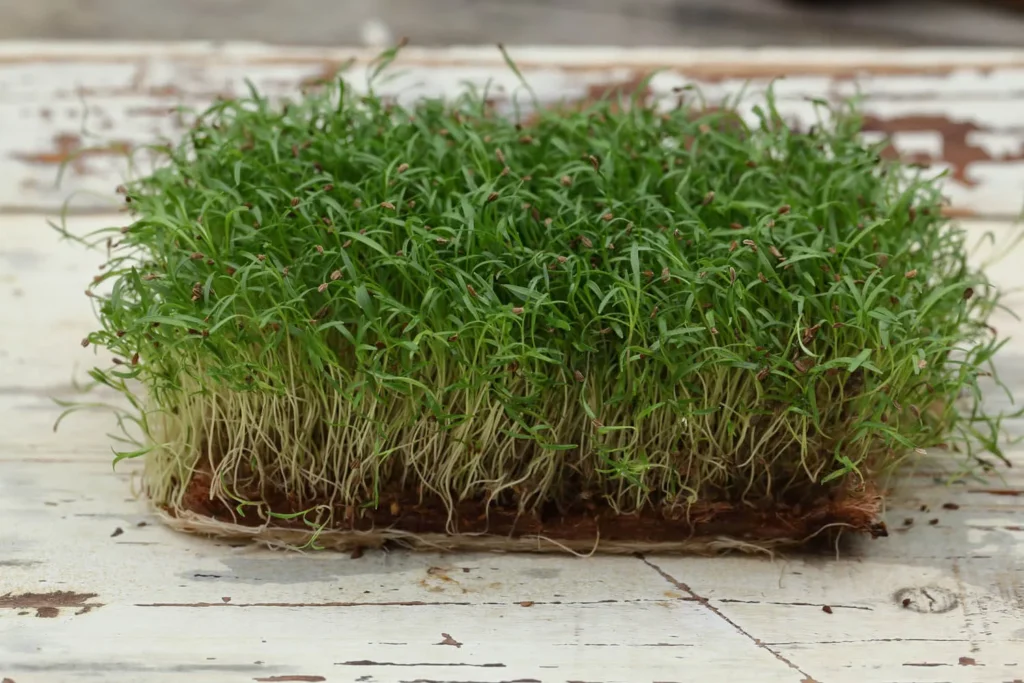
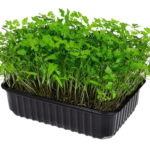
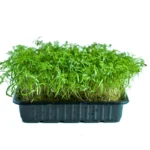
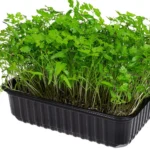
Extremely delicate, "fluffy", almost weightless. Thin pinnate leaves are like dill, but much softer and more elegant
Ripening and optimal harvest time
The first real carved "feathery" leaves, the aroma is as fresh as possible, the taste is clean and sweet - the optimal moment.
The leaves grow, the aroma of essential oils intensifies, a slight bitterness may appear.
The taste becomes more grassy and bitter, the decorative value decreases.
Why flavor may vary batch to batch
Carrots are slow and capricious microgreens. The taste depends primarily on the stage of cultivation: on the 12-14th day a characteristic carrot note appears - before this, the sprouts smell neutral. At warm cultivation (+22°C and above) carrots are often bitter. At coolness (+16...+18°C) the taste is sweeter and more pronounced. This is one of the most difficult crops for microgreens — it requires experience.
Culinary use
How to use
Carrot is a great culinary accent. Add fresh at the end of cooking or directly on the plate.
Pumpkin cream soup
three or four sprigs of microgreen carrots in the center of the plate + a drop of olive oil — a restaurant serving is ready
Carrot soup or puree
carrot microgreens as an "author's touch" — the aroma enhances the taste of the main dish
Baked salmon or cod
a few stems next to the fish — elegant and effortless
Risotto
on top as a final accent — openwork greenery contrasts with the creamy texture of the risotto
Salad with carrots and orange
carrot microgreens enhance the theme of the dish and add textural contrast
Children's plate
Carrot "grasses" make an ordinary dish interesting for a child
Perfect pairings
The aroma of carrot tops "prepares" the olfactory receptors for the taste of the dish
Feather leaves next to fish is a classic combination of French cuisine
Children who refuse to gnaw hard carrots are often excited to eat these "fun grasses" with a soft texture
- Do not add to hot dishes during cooking - the delicate texture is instantly destroyed by heat; only on top before serving
- Do not expect a dense texture or crunch - carrots will not give either; it is about aroma and appearance
- Do not use in dishes where volume or hearty greens are needed - for this there are alfalfa, peas or sunflower
Home storage
How to store
Carrot keeps longer than most microgreens. Follow simple rules to keep it fresh for up to 10 days.
Keep at +2...+5°C in the refrigerator. The term is up to 10 days. A colder mode than for most microgreens — carrots retain their flavor better at lower temperatures.
Place in an open container or plate, cover with a damp paper towel. Don't seal — without air, greens yellow faster.
Don't wash until ready to eat. Wet greens spoil much faster. Rinse just before serving.
Pro tip: **Grower Handy Tip:** Carrots are a niche crop with the lowest yield and longest cycle in the catalog. Cultivate for a specific client — a restaurant or catering, where prettiness is appreciated. Unprofitable for the mass market. The price category is premium, sell "by the bundle", not by weight.
Nutrients & health
Benefits & composition
Carrot is valued for its rich vitamin-mineral composition and bioactive compounds typical of microgreens.
Like most microgreens, carrot contains a concentrated amount of nutrients relative to its weight — many times more than the mature plant.
| Protein | 2.0 g — building material for cells |
|---|---|
| Calories | ~30 kcal |
| Vitamins | A |
| Minerals | Potassium, Calcium |
- People with allergies to plants of the umbrella family (parsley, celery, dill, chervil, cilantro) should be careful - carrots belong to the same family and can cause a cross-reaction.
This information is general in nature and is not medical advice. Composition data: USDA FoodData Central.
Worth knowing
There are microgreens of carrots
Carrot microgreens are one of the richest plant sources of beta-carotene in microgreens format. Beta-carotene is absorbed better in combination with fats - a few drops of olive oil on cream soup with carrot microgreens is both a restaurant recipe and a nutritionally justified solution.
Essential oils that
Essential oils that give a characteristic carrot aroma (terpenes, falcarinol) are in the highest concentration precisely in the phase of a young leaf.
Antioxidants and biologically active substances
Microgreens are a concentrated source of antioxidants — compounds that are being studied in the context of protecting cells from oxidative stress. Regular consumption of a variety of microgreens is part of a balanced plant-based diet.
Antioxidants and biologically active substances
Microgreens are a concentrated source of antioxidants — compounds that are being studied in the context of protecting cells from oxidative stress. Regular consumption of a variety of microgreens is part of a balanced plant-based diet.
Carrot: how to grow — step-by-step guide
Growing parameters, agronomy, common mistakesGrowing parameters
Small, ribbed, rich in essential oils (umbrella)
Step-by-step guide
Seed preparation
Carrot do not soak. Umbrella seeds contain essential oils that repel water when soaked and can inhibit germination. Always sow dry.
Sowing
- Moisten the substrate evenly and abundantly - it should be well wet.
- Spread the seeds evenly. The norm of 2.5–3 g is less than it seems. With thickened sowing, weak sprouts will not throw off the shell, suffocated by their neighbors.
- Spray the surface with a "fog" from a sprayer - the seeds should be well wet.
Key point: carrots require 100% humidity at the start. If the substrate dries out in the first days, some of the sprouts die: the roots at the start are thinner than a hair and cannot tolerate even short drying.
Clamp - up to 1 kg
Light pressure fixes the small seeds and helps the sprouts shed the shell when breaking through the substrate. Do not overload: heavy pressure breaks the tender carrot sprouts.
Darkness (Blackout) — 5–6 days
Carrots are one of the slowest crops to start with. The first sprouts appear on the 4-5th day. The unevenness of the steps is normal for umbrellas.
Conditions:
- Complete darkness
- Temperature: +18...+22°C
- Stable high humidity all the time is a critical condition. Check the substrate daily, if necessary, moisten from above with a sprayer
- Additional bottom watering
Fighting with "helmets": the seed coat of the carrot is hard and often remains on the tips of the tender leaves, sticking them together. Solution:
- In the last 24 hours of the blackout, sprinkle liberally on top and cover with a film - "greenhouse effect"
- Spray again before taking out into the light
- If the "helmets" have not come off, cover with film for another day
A sign of readiness: most of the sprouts have shed their sheath, height 2–3 cm.
Important: if you take it out of the darkness on the 3rd day, the sprouts will be short, and the "helmets" will dry tightly to the leaves - it is almost impossible to remove them later. Take your time.
Vegetation in the light — 10–14 days
Carrots grow slowly and gradually. The first days in the light are still indistinct steps without a decorative effect. Openwork pinnate leaves, for the sake of which everything is done, appear only on the 12th–14th day.
Lighting: standard, 16 hours a day. Carrots do not need particularly intense light - they are green regardless of lighting. But in very weak light, it stretches and weakens.
Watering: moderate, regular, lower. Due to the long cycle, there is a risk of souring the substrate with overflow or mold with insufficient ventilation. The substrate should be evenly moist - neither "swamp", nor dry.
Ventilation: moderate With a long cycle, stagnant air provokes mold growth of the substrate.
Watering
- Water it 1 time a day (in the morning), at +22°C and above — twice
- Bottom or shallow top watering - the substrate should not dry out
- Carrots are very slow - in 10 days, the substrate has time to dry out several times
- A sign of lack: delicate openwork leaves begin to dry from the tips → water and increase humidity
Storage
| Uncut in tray | Fridge +4...+6°C | up to 3 weeks |
|---|---|---|
| Cut in container | Refrigerator | up to 7 days |
| Room temperature | 1–2 days |
Harvest
- Fully opened pinnate ("nettle") real leaves appeared
- The aroma of carrot tops is distinctly felt when touched
- Height 5–7 cm
- The leaf is still tender, without bitterness
With sharp scissors, not with a knife, the stems are thinner and more delicate than mine. Cut to the root.
Very carefully, just before serving. Weak finely dispersed "mist" from a sprayer or careful immersion in cold water. Thin leaves are easily deformed by a strong jet. Do not rub or squeeze. Dry with a light shake.
Seasonal adjustments
- Mold: the main risk with a long cycle — in heat and humidity, mold appears before a real leaf has time to form
- Ventilation: open the tray 1-2 times a day for the first 5-7 days - ventilation is critical for a long cycle
- Watering: the substrate dries out faster, but overflow during heat is more dangerous - water moderately in the lower way
- Collection: shorten the cycle by 1-2 days - in the heat, the leaf becomes coarser and loses its tenderness faster
- Aroma: at a higher temperature, essential oils are less concentrated — carrots are more aromatic in winter
- Thermostat: at +16°C and below germination worsens — heating the substrate significantly improves the uniformity of seedlings
- Cycle: extends up to 22 days - put in the schedule with a margin
- Aroma: when cool, the concentration of essential oils is higher - winter carrots are more aromatic and richer in taste
Water pH and EC
The optimal range for Carrots: 6.0–7.0. Carrots grow optimally in a neutral environment. The Umbrella family is generally not picky about pH in the short cycle of microgreens.
Optimal range: 1.0–1.8 mS/cm. Moderate mineralization is ideal. A longer cycle (10-14 days) means a greater effect of EC on the result - avoid very hard water.
Experienced grower tips
Scissors, not a knife
Carrot stalks are thin and tender - my knife tears them. Sharp scissors give a clean cut without damage. This is also important for storage: an even cut stays fresh longer.
Patience is the main skill for carrots
The first 12 days, it's hard to believe that something interesting will come out of these tiny sprouts. On the 13th–14th day, "magic" happens — the openwork leaf opens and turns the indistinct greenery into a restaurant garnish. Do not cut early.
Sell together with chives as a "classic soup duo"
Carrot + onion is a classic combination for decorating cream soups. Restaurants buy both crops together every week. Offer as a set.
100% humidity at the start is your main tool
Most failures with carrots occur due to drying out of the substrate in the first 3–5 days. If you have a hygrometer, install it in the growth chamber. If not, check the substrate twice a day.
The "greenhouse effect" at the end of the blackout is mandatory, not optional
Unlike Swiss chard or beets, where this is an auxiliary measure, for carrots this is standard procedure. Film + abundant hydration in the last 24 hours is the only reliable way to get rid of "helmets" systematically.
Agronomy notes and common mistakes
- Sowing: No soaking. Very high density. Carrot seeds are small — even distribution is critical.
- Clamp: Without clamping - small seeds.
- Temperature: +18...+22°C. Carrots do not need heat - a moderate temperature is ideal.
- Watering: 1 time a day, if necessary twice. A very slow cycle requires constant moisture control.
- Ventilation: moderate Carrots are not susceptible to mold with proper watering.
- Premature exposure to light (before the 5th day) → Short sprouts, "helmets" tightly dried to the leaves → Withstand full 5–6 days in the dark; if you try to remove the helmets too soon, nothing will work
- Drying out of the substrate at the start → Sprouts do not come out, part of the seeds died → 100% humidity all the time blackout; check daily
- Overflow with a long cycle → Acidification of the substrate, mold for 10–12 days → Moderate lower watering; the substrate is moist, but without standing water
- Soaking seeds → Reduced germination → Carrots - never soak; essential oils repel water
- Expecting a lot of weight → Disappointment at 25 g from the box → Carrots are sold "by appearance", not by weight; the right positioning is a better premium
- Cut to the appearance of a carved leaf → Inconspicuous mass without a decorative effect → Wait for the first carved leaves — 12–14 days; before the product is not ready
Variety selection
Classic carrot
Nantes, Shantane, Karotel
The most common choice. Carrot aroma, delicate carved leaves, stable germination.
Colored carrots
Purple, Yellow, White
A decorative option with an unusual stem color. The taste is similar, but sometimes the aroma is brighter.
Що далі?
More crops in the catalog
Explore similar and contrasting flavors — from basil to amaranth