
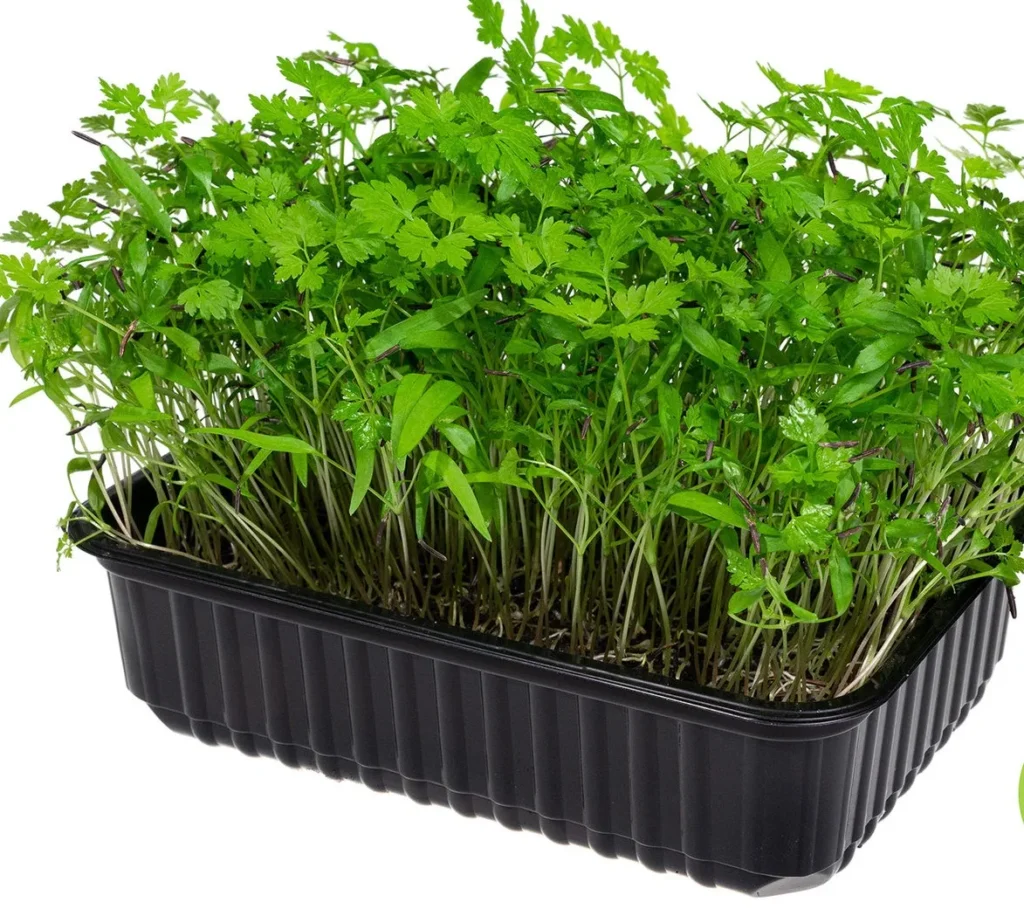
Flavor profile
Taste & aroma
Sweet, aniseed, fresh - it is barely perceptible and rather emphasizes freshness than dominates. Light, spicy aroma.
it is barely perceptible and rather emphasizes freshness than dominates. No bitterness, no harshness
Light, spicy, anise-herbal. It opens when the leaf is lightly kneaded. The aroma is the main thing for which chervil is appreciated: it fills the dish without any additional ingredient.
Extremely delicate, lacy. Thin carved leaves literally melt in your mouth
Ripening and optimal harvest time
Cotyledons and the first real leaves, the aroma is clean and fresh, the texture is delicate.
The lacy leaf is formed, the aroma is at its peak, the optimal moment of collection.
The aroma begins to concentrate, the stem hardens, the leaf becomes less tender.
Why flavor may vary batch to batch
The aniseed aroma of chervil is formed mainly due to tarragon (methylchavicol). The intensity depends on the temperature: at cool cultivation (+16...+18°C) the aroma is thinner and more citrusy. At warm (+22°C and above) - sharper and more pronounced, but the plant quickly "goes out into an arrow". Chervil is a cool-loving culture.
Culinary use
How to use
Chervil is a great culinary accent. Add fresh at the end of cooking or directly on the plate.
French omelette
add to the plate immediately after cooking - the heat of the omelette will "reveal" the aroma of chervil, but will not destroy it
Salmon or tuna tartare
chervil as the main green ingredient — its freshness and anise note emphasize the marine taste of the fish
Cream soup of mushrooms or pumpkin
a few whole stalks on top and a few drops of olive oil - a restaurant serving in 10 seconds
Butter with chervil
mix chopped chervil with soft butter, cool - use with bread, fish or steak
Canapes with salmon or ricotta
a few sprigs of chervil on top instead of dill is another level of sophistication
Cold cream sauces
chervil whipped with cream, sour cream or cream cheese - sauce for fish, vegetables, eggs
Perfect pairings
The classic French omelet with chervil is a dish where a minimum of ingredients gives a maximum of taste
Added on top or to a creamy sauce after removing from heat
A few stems on top — and the dish looks and smells different
- Do not add to hot dishes during cooking - the aroma will disappear completely
- Do not use in dishes with intense spices - the delicate profile of chervil simply will not be heard against the background of garlic, chili or curry
- Do not replace dill where chervil is needed - the tastes are completely different, despite the external similarity with some umbrella crops
Home storage
How to store
Chervil keeps longer than most microgreens. Follow simple rules to keep it fresh for up to 10–12 days.
Keep at +4...+6°C in the refrigerator. The term is up to 10–12 days. Chervil is sensitive to temperature changes - keep away from the refrigerator door.
Hermetic container at +4...+6°C. The term is up to 5–7 days. The delicate structure of the leaves makes chervil less easy to lay than denser crops. Use as fresh as possible. Do not wash before use - moisture accelerates the withering of tender leaves. ---
Don't wash until ready to eat. Wet greens spoil much faster. Rinse just before serving.
Pro tip: **A practical tip for the grower:** Chervil is a niche product for the restaurant segment. The long cycle (18–24 days) and low yield (20–30 g) make it expensive to produce. It justifies itself when supplying restaurants of French and Mediterranean cuisine, where chervil is a classic ingredient. For the mass market — less profitable than fast crops.
Nutrients & health
Benefits & composition
Chervil is valued for its rich vitamin-mineral composition and bioactive compounds typical of microgreens.
Like most microgreens, chervil contains a concentrated amount of nutrients relative to its weight — many times more than the mature plant.
| Protein | 2.5 g — building material for cells |
|---|---|
| Calories | ~36 kcal |
| Vitamins | C |
| Minerals | Potassium, Calcium, Magnesium, Iron |
- People with allergies to plants of the umbrella family (parsley, carrots, dill, cilantro, celery) should be careful - chervil belongs to the same family and can cause a cross-reaction.
- Pregnant women are advised to use it in moderation, as with most essential oil herbs.
This information is general in nature and is not medical advice. Composition data: USDA FoodData Central.
Worth knowing
Chervil is traditionally included
Chervil is traditionally included in the classic French herb mix fines herbes (along with parsley, dill and chives). Chervil essential oils gently stimulate digestion and are traditionally considered tonic.
Culture is the source
The culture is a source of vitamin C and vitamin K. It is light and not heavy on the body — "greens that tone, not burden."
Antioxidants and biologically active substances
Microgreens are a concentrated source of antioxidants — compounds that are being studied in the context of protecting cells from oxidative stress. Regular consumption of a variety of microgreens is part of a balanced plant-based diet.
Antioxidants and biologically active substances
Microgreens are a concentrated source of antioxidants — compounds that are being studied in the context of protecting cells from oxidative stress. Regular consumption of a variety of microgreens is part of a balanced plant-based diet.
Similar crops
Similar by taste microgreens
If you are looking to complement or replace Chervil:
Chervil: how to grow — step-by-step guide
Growing parameters, agronomy, common mistakesGrowing parameters
Thin, oblong (umbrella)
Step-by-step guide
Seed preparation
Chervil belongs to the umbrella family — its seeds contain essential oils that can inhibit germination. Soaking is not necessary, but a short one — 2-4 hours in room temperature water — can speed up and flatten the stairs somewhat.
Important: do not soak for longer than 4 hours - umbrella seeds suffocate when soaked for a long time. If soaking, rinse before sowing.
An alternative to soaking: abundant moistening of the substrate before sowing and increased humidity in the first days — gives a similar effect without the risk of overwetting the seeds.
Sowing
- Moisten the substrate evenly and well - it should be generously moist.
- Spread the seeds evenly. The norm of 4 g for oblong seeds of umbrellas is a sufficiently dense carpet without thickening.
- Lightly sprinkle the surface with water after sowing.
Chervil seeds are oblong and have a sharp "nose". After spreading, lightly press it with your finger or the back of a spoon to the wet substrate - so that the "spout" is in contact with the moisture, and not sticking out in the air. This improves contact and accelerates the swelling of the shell.
Clamp — 1 kg
A clamp for chervil is needed to fix oblong seeds in the substrate and for faster root growth. Rate: 1 kg — standard for umbrellas.
Darkness (Blackout) — 5–7 days
Chervil is one of the slowest crops at the start. The shoots are uneven: some sprouts appear on the 4th day, others on the 7th. This is normal for umbrellas.
Key condition: temperature +16...+18°C. Chervil is a cold-loving culture. At a temperature above +22°C, germination slows down, the plant weakens and stretches. This is a fundamental difference from most microgreens.
Conditions:
- Complete darkness
- Temperature: +16...+18°C — strictly, not higher than +22°C
- Stable high humidity: chervil needs uniform humidity of the substrate all the time of darkness. Drying out at any stage — and some of the seeds will not come off
Fighting with "helmets": the seed coat of chervil often remains on the cotyledons. Solution: in the last 1-2 days of darkness, increase the frequency of moistening - spray from above several times a day. High humidity softens the shell. Before exposing to light, spray liberally and let it sit for a few more hours under pressure.
A sign of readiness: most of the sprouts have shed their sheath, height 3–4 cm.
Vegetation in the light — 10–14 days
The chervil grows slowly and at this stage - it is here that its main decorative and taste value is formed: a lacy carved leaf.
Temperature: store at +16...+20°C. At a higher temperature, the chervil is elongated, the stem becomes thin, the aroma is less pronounced.
Lighting: standard, without excessive intensity. Chervil does not need bright light for its color (it is always green), but in very low light it stretches out and becomes less fragrant.
Watering: regular, moderate, lower. A long cycle requires a stable regime — neither drying out nor overwetting. The substrate should be evenly moist all the time.
When to cut: Take your time. The main decorative value of the chervil is the first real lace leaf. Cutting before it appears means getting a regular round cotyledon without a "restaurant" look.
Watering
- Water it 1 time a day (in the morning)
- Bottom or careful top watering - chervil is delicate
- A cool and moist environment is ideal for chervil
- A sign of lack: tender leaves begin to dry and curl → water and cool the room
Storage
| Uncut in tray | Fridge +4...+6°C | up to 3 weeks |
|---|---|---|
| Cut in container | Refrigerator | up to 7 days |
| Room temperature | 1–2 days |
Harvest
- The first real carved leaf with a characteristic lacy edge appeared
- The aroma of essential oils is distinctly felt when touched
- Height 8–12 cm
- The stem is still tender and has not had time to become woody
Sharp knife under the root. The tender stem is easily crushed with a blunt instrument.
Rinse in cold water just before serving, being very careful not to bruise the delicate lace leaves. Dry with a paper towel without pressing or simply shake off the water.
Seasonal adjustments
- Soaking: reduce by 2–3 hours from the standard - the seeds are active in the heat
- Ventilation: open more often in the blackout phase to avoid excess moisture
- Watering: increase the frequency - the substrate dries faster at a higher temperature
- Expect: shortening of the cycle by 2–3 days, a more tender stem
- Soaking: increase by 2-3 hours from the standard - cold water is absorbed more slowly
- Placement: keep the trays in a warmer place (next to the battery, but not close to it)
- Watering: use water at room temperature—cold slows growth
- Expect: lengthening the cycle by 2-4 days, denser and more fragrant result
Water pH and EC
The optimal range for Kervel: 5.5–7.0. Chervil is unpretentious to pH. A cool temperature is more important than the chemical parameters of the water.
Optimal range: 1.0–1.8 mS/cm. Moderate mineralization is ideal. At a cool temperature, the substrate dries slowly - the risk of salting is minimal.
Experienced grower tips
The cold is an ally, not a problem
Chervil is one of the few crops where a low temperature (+16°C) gives a better result than the standard +20°C. If there is an opportunity to grow in a cool place, use it.
A winter shelf is an ideal place for chervil
When the rest of the crops suffer from the cold, chervil gives the best results. Plan its production for the autumn-winter season.
Sell together with parsley as a "French duo"
Chervil and parsley are a classic combination of fines herbes. Restaurants buy both crops together — convenient for the chef and profitable for the grower.
A lace sheet is the main selling point
Collect several photos of the chervil with an expressive carved leaf and show it to restaurant customers. The appearance of culture is a stronger argument than any description.
Do not rush to bring it to light
Even if most of the sprouts are already ready on the 5th day, keep them in the dark for another 1-2 days with plenty of moisture — this will help the remaining "helmets" to fall off on their own and save manual work.
Agronomy notes and common mistakes
- Sowing: No soaking. Medium-high density. Small seeds.
- Clamp: Without clamping.
- Temperature: +12...+18°C. Kervel is a real "cold lover". At +22°C it is already uncomfortable.
- Watering: 1 time a day. When it is cool, the substrate dries more slowly - check daily.
- Ventilation: moderate Tender sprouts do not like strong drafts.
- High temperature (above +22°C) → Weak, elongated sprouts, bad aroma, thin, uneven shoots → Maintaining +16...+18°C is a mandatory condition, not a recommendation
- Long soaking (more than 4 hours) → Seeds suffocate, germination decreases sharply → Soaking for no more than 2–4 hours or without it at all
- Drying out of the substrate → Irregular germination, part of the seeds did not germinate → Stable high humidity throughout the cycle of darkness and vegetation
- Early cut (before the appearance of a true leaf) → Round cotyledon without decorative effect → Wait for the first lacy leaf — it is the commercial product
- "Harmets" on the letter → The shell clamps the cotyledons, the marketability is lost → Increase the frequency of moistening in the last days of darkness; copious sprinkling before taking to the light
- Overflow with a long cycle → Decay of the stem at the base after a week → Bottom watering, the substrate is moist, but without standing water in the tray
Variety selection
Common chervil
Brussels, Curly
Standard selection. Anise aroma, delicate feathery leaves, even germination.
Curly chervil
Mosso Curly, Frize
A more decorative form of leaves. The taste is identical, but it looks more spectacular on the plate.
Що далі?
More crops in the catalog
Explore similar and contrasting flavors — from basil to amaranth