
Flavor profile
Taste & aroma
Spicy, sweet, licorice - citrus lightness, then Thai - dense, enveloping spiciness. Intense, complex aroma.
citrus lightness, then Thai — dense, enveloping spiciness. The taste does not dissolve in the dish, but leads it
Intense, complex - star anise, tarragon, clove. Essential oils are revealed even when touching the stem. The characteristic anise smell makes the culture immediately recognizable. A full-fledged aroma is formed only with sufficient lighting and a temperature above +23°C — grown in the cold or darkness smells more neutral.
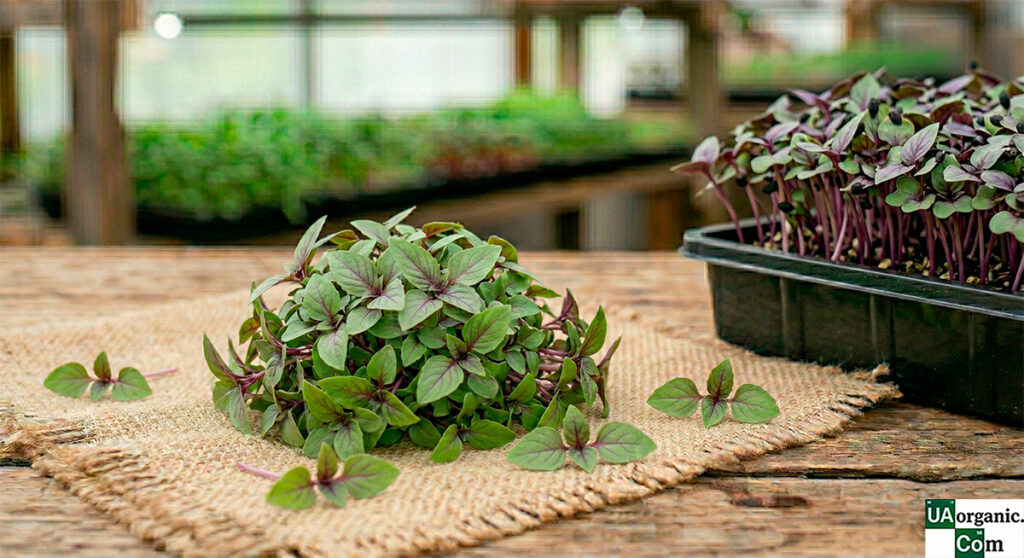
The leaves are small, slightly denser than those of lemon or purple basil. The stem is thin but springy, with a characteristic dark purple color that is a sign of proper cultivation
Ripening and optimal harvest time
Cotyledons, the taste is clean and unsaturated, the aniseed note is barely noticeable.
The first real leaves have formed, the aroma and taste are at their peak, the stem has acquired a dark color.
The taste becomes sharper, the aniseed note becomes bitter, the texture becomes harder.
Why flavor may vary batch to batch
The dark color of the stem and the saturation of the anise aroma directly depend on the intensity of lighting and the temperature regime. At a temperature below +20°C or weak light, the plant remains green and has almost no characteristic smell. This is the most important quality factor for Thai basil—a batch grown under optimal conditions and a "stressed" batch are two different cultures in terms of taste and appearance.
Culinary use
How to use
Thai Basil is a great culinary accent. Add fresh at the end of cooking or directly on the plate.
Pho Bo or Pho Ga
put a handful of stems in a plate before serving - the broth will extract the aroma by itself, no need to cut anything
Ramen with egg and nori
Thai basil instead of green onions - the anise note complements the richness of the broth
Wok with noodles
add the stems 30 seconds before the end of cooking or after removing from the pan - the aroma will be preserved
Spring rolls
leaves together with mint and cilantro as a classic Asian trio of herbs in the filling
Duck breast carpaccio
a few stalks on top instead of a mix of ordinary greens — and the dish acquires an Asian accent
Thai curry
fresh basil on the finished dish balances the saturation of coconut milk and the spiciness of the curry paste
Perfect pairings
Spring rolls, ramen, curry are the best combinations
Hot broth reveals the aroma of Thai basil, but does not destroy it - add to the plate after serving
The anise-clove profile is revealed in sweet and sour and soy-sesame sauces better than ordinary basil
- Do not add to a hot pan during cooking - essential oils will evaporate, leaving only the taste of cooked grass
- Do not combine with delicate flavors (fish carpaccio with white fish, creamy sauces with a neutral taste) - the anise note dominates and interrupts the subtle notes
- Do not replace it with ordinary basil in Italian dishes - the profiles are incompatible
Home storage
How to store
Thai Basil keeps longer than most microgreens. Follow simple rules to keep it fresh for 5–7 days.
Do not put in an ordinary refrigerator - at +4°C the leaves darken and black spots appear in just a few hours. Keep at room temperature (not lower than +18°C) or at +10...+12°C. The term is 5–7 days. Cut just before serving.
Hermetic container, inside - a sheet of paper towel to absorb condensate. Store at +10...+12°C (upper shelf of the refrigerator away from the freezer). The term is 2-3 days. At +4°C - no more than a day, and only in a tightly closed container. Do not wash before use - moisture accelerates the darkening of the leaves. ---
Don't wash until ready to eat. Wet greens spoil much faster. Rinse just before serving.
Pro tip: **A practical tip for the grower:** Thai basil is best sold alive in a tray. Cut does not last long and is vulnerable to cold. If the client is ordering for an event, it is better to ship it 1-2 days in advance and give a recommendation to store it at room temperature, not in the refrigerator.
Nutrients & health
Benefits & composition
Thai Basil is valued for its rich vitamin-mineral composition and bioactive compounds typical of microgreens.
Like most microgreens, thai basil contains a concentrated amount of nutrients relative to its weight — many times more than the mature plant.
| Protein | 3.0 g — building material for cells |
|---|---|
| Calories | ~23 kcal |
| Minerals | Potassium, Calcium, Magnesium, Iron |
- People taking blood thinners should discuss the amount of vitamin K-rich greens with their doctor—not because basil is harmful, but to consider overall intake.
- Estragole in large amounts is the subject of safety research. In culinary quantities, the risk is not confirmed, but pregnant women should use it sparingly.
- The specific smell of anise is a persistent taste reaction: those who cannot tolerate the smell of sambuca or pectusin, most likely will not appreciate this culture.
This information is general in nature and is not medical advice. Composition data: USDA FoodData Central.
Worth knowing
Thai basil is
Thai basil is a source of vitamin K, which is involved in maintaining the normal state of bone tissue and blood clotting processes. The culture also contains vitamin A in the form of beta-carotene, a pigment that provides the orange-green shade of young leaves.
Thai essential oils
Essential oils of Thai basil - estragole and eugenol - are traditionally used in Asian cooking not only as a flavoring, but also as part of a variety of food. That is why in the countries of Southeast Asia, these greens are often served with fatty and spicy dishes.
Culture is the source
The culture is a source of Iron and Calcium — trace elements that are more easily absorbed from fresh greens in combination with products containing vitamin C.
Antioxidants and biologically active substances
Microgreens are a concentrated source of antioxidants — compounds that are being studied in the context of protecting cells from oxidative stress. Regular consumption of a variety of microgreens is part of a balanced plant-based diet.
Similar crops
Similar by taste microgreens
If you are looking to complement or replace Thai Basil:
Thai Basil: how to grow — step-by-step guide
Growing parameters, agronomy, common mistakesGrowing parameters
Small, mucilaginous
Step-by-step guide
Seed preparation
Thai basil do not soak. This is not forgetfulness in the technological map - it is fundamental. The seeds contain mucous membranes (mucilage), which turn into a gel when in contact with water. Soaked seeds stick together in one lump, become uneven when sowing and germinate much more slowly.
The seed must be dry at the time of sowing.
Sowing
- Moisten the substrate evenly - it should be moist, but without puddles. Excess water from below is in the tray, not in the substrate.
- Spread the seeds evenly over the surface. Optimum density — seeds should not lie in two layers.
- After scattering sprinkle water liberally on top from the atomizer. This is the key point: the seeds will secrete mucus and "stick" to the substrate. This contact ensures that the root will go down, and the seed will not roll over during ventilation.
If you sprinkle Thai basil on a dry substrate without sprinkling on top, the seeds will migrate with any air movement and collect in uneven clumps. A heavy sprinkling after sowing locks the seed in place thanks to the mucilage - that's how it should be.
Start (without clamping)
Weight (clamp) for Thai basil prohibited — small seeds sink into the substrate and rot instead of sprouting upwards.
Instead of clamping, we use the greenhouse effect:
- Cover the box with transparent film or a dome to keep 100% humidity around the seeds
- Ventilate once a day 1 minute: carefully remove the film, let the air change, cover again. This is enough to renew the air and not enough to dry out.
Starting temperature: +23...+26°C is mandatory. This is a tropical species, and below +20°C it "falls asleep": sprouts appear after 7–10 days instead of 3–4, and some of the seeds die. A draft with an open window is also a stress.
Darkness (Blackout) — 4–5 days
In the dark, the sprout stretches up, forming a straight and long internode of the stem. Conditions:
- Temperature +23...+26°C — no compromises
- 100% darkness: cover with a second box or move to a dark place
- Airing once a day for 1 minute
- Bottom humidification: add water to the tray if the substrate starts to dry out
A sign of readiness for transfer to the light: sprouts actively stretch upwards, height 3–4 cm, color — yellow-cream (normally, it turns green in the light).
Vegetation in the light — 8–12 days
This is the most important stage for product quality. This is where it is formed:
- Green leaf color (chlorophyll)
- Violet color of the stem (anthocyanins) — a marketing and taste marker of quality
- A full-fledged aniseed aroma
Lighting: intensive, 16 hours a day. In low light, the plant turns green, but the stem remains green instead of purple, and the aroma is weaker. LED phytolamps with a blue-red spectrum give a better result for the development of anthocyanins.
Watering: only the lower one - through the pallet. The root drinks well, but the top layer of the substrate must remain relatively dry to avoid mold at the base of the stem.
Temperature: store at +23...+26°C. Falling below +18°C at night - the plant gets stressed, the leaves become transparent-glass and fall off.
If the purple color of the stem does not appear after 4-5 days in the light, increase the light intensity or move the boxes closer to the lamp. Anthocyanins are synthesized precisely in response to the ultraviolet component of light.
Watering
- Water it 1-2 times a day ONLY bottom watering
- Thai basil is the most drought-resistant among basils
- A little less sensitive to short droughts, but bottom watering is always a priority
- A sign of lack: the aroma of anise/eugenol weakens, the leaves become dull → water
Storage
| Uncut in tray | Fridge +4...+6°C | up to 3 weeks |
|---|---|---|
| Cut in container | Refrigerator | up to 7 days |
| Room temperature | 1–2 days |
Harvest
- A pair of true leaves is formed (not only cotyledons).
- The stem is elastic and dark (purple or dark green in less lit batches)
- The aroma of sweet licorice is noticeable when lightly touching the stem
With a sharp knife or scissors, above the level of the substrate. A blunt tool cuts the stem - a dark spot appears on the cut, which accelerates wilting.
Thai basil is washed immediately before serving, not in advance. Rinse in cold water at room temperature (+18...+20°C), dry slightly with a paper towel. Water directly from the tap (cold, +8–10°C) is a temperature shock, after which the leaves darken in a few minutes.
Seasonal adjustments
- Ventilation: twice a day during a blackout — heat and humidity under shelter increase the risk of mold
- Watering: increase the frequency of bottom watering - the substrate dries out faster
- Vegetation: watch more carefully, the cycle may be shortened by 2-3 days
- Placement: away from direct sunlight and heat sources
- Expect: accelerated growth, but a more tender stem and the risk of overheating above +28°C
- Temperature: critically important — below +18°C at night stops development and provokes leaf necrosis. Thermal mats under the boxes (+25°C) solve the problem
- Placement: rack away from windows and exterior walls — cold surfaces cool the substrate
- Expect: prolongation of the cycle by 3–5 days, with sharp night changes — the risk of leaf damage
Water pH and EC
The optimal range for Thai basil: 6.5–7.0. Sensitive to an acidic environment - at a pH below 6.0, the aroma weakens and growth slows down. Hard tap water is fine.
Optimal range: 1.5–2.5 mS/cm. Thai basil is a little more picky about nutrition than green. When growing on a substrate, EC is not critical, but in hydroponics, optimal nutrition contributes to the accumulation of essential oils.
Experienced grower tips
The glue effect is your friend
Thai basil "sticks" to the substrate thanks to mucilage — and this is an advantage. After being sprayed with water, the seed no longer moves. This favorably differs from small seeds without mucus, which collect in piles with any movement of air.
Light readiness test without unnecessary manipulations
If the sprouts rest against the film or shelter from below, they are ready to come out into the light. No need to count the days: focus on the height (3-4 cm) and the density of the seedlings.
Two steps to maximum purple
For the first 2-3 days in the light, keep the box as close as possible to the lamp (10-15 cm for LED). Then move back to the standard distance. Such a "shock dose" of UVA accelerates the synthesis of anthocyanins and gives a more saturated color of the stem.
Watering with room temperature water
For Thai basil, it is important not only not to overcool the room, but also not to water it with cold water. Let the water settle at room temperature — and there will be no temperature stress during watering.
Mixture with other Asian cultures
Thai basil looks good and is sold in ready-made Asian mixes along with cilantro and shiso. Consider the difference in cycles: shiso grows longer, cilantro is similar in time. Plan crops with the expectation of simultaneous harvesting.
Agronomy notes and common mistakes
- Sowing: No soaking. Very high density.
- Clamp: Without clamping.
- Temperature: +24...+28°C. The most heat-loving among basils — it grows poorly below +22°C.
- Watering: ONLY the lower one. But slightly more drought tolerant than green basil.
- Ventilation: Mandatory and active.
- Soaking seeds → Seeds stick together in a gel, uneven sowing, seedlings are thin and uneven → Sow only dry. If necessary, wash off the mucus and dry it - but it is better to start again with dry seeds
- Press with a load → Seeds sink into the substrate, rot, mass death of sprouts → Remove the load, replace it with a dome made of a lid or film
- The temperature is below +20°C → Very slow germination (7-10 days instead of 3-4), glassy leaves, falling off → Move to a warmer place, eliminate drafts
- Weak lighting → Stem green instead of purple, weak aroma → Increase intensity or duration of lighting
- Watering from above on adult plants → Mildew in the substrate at the base of the stem → Switch to exclusively lower watering through a tray
- Storage at +4°C → Black spots on the leaves after 2–6 hours (tissue necrosis from the cold) → Store at +10...+12°C or at room temperature
- Insufficient ventilation under the dome → Condensate drips on sprouts, mold on the surface of the substrate → Ventilate once a day for 1 minute, no more and no less
Variety selection
Basil of this variety
profile grade
A standard choice for microgreens. Even germination, pronounced aroma, stable germination.
Alternative varieties
organic seeds
Suitable for organic production. Without treatment with fungicides - seeds without color coating.
Що далі?
More crops in the catalog
Explore similar and contrasting flavors — from basil to amaranth