
Flavor profile
Taste & aroma
Mint, basil, spicy - this is the complexity of the taste of shiso. Spicy, fresh aroma.
this is the complexity of shiso's taste. Intense, but not harsh: a few leaves are enough to change the character of the dish
Spicy, fresh, with distinct notes of anise and basil. It opens when touched or cut - just like lemon balm, only more "Asian" and deeper.
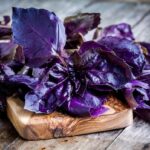
Tender, juicy. The leaf is thin, slightly corrugated at the edges - smaller than that of basil
Why flavor may vary batch to batch
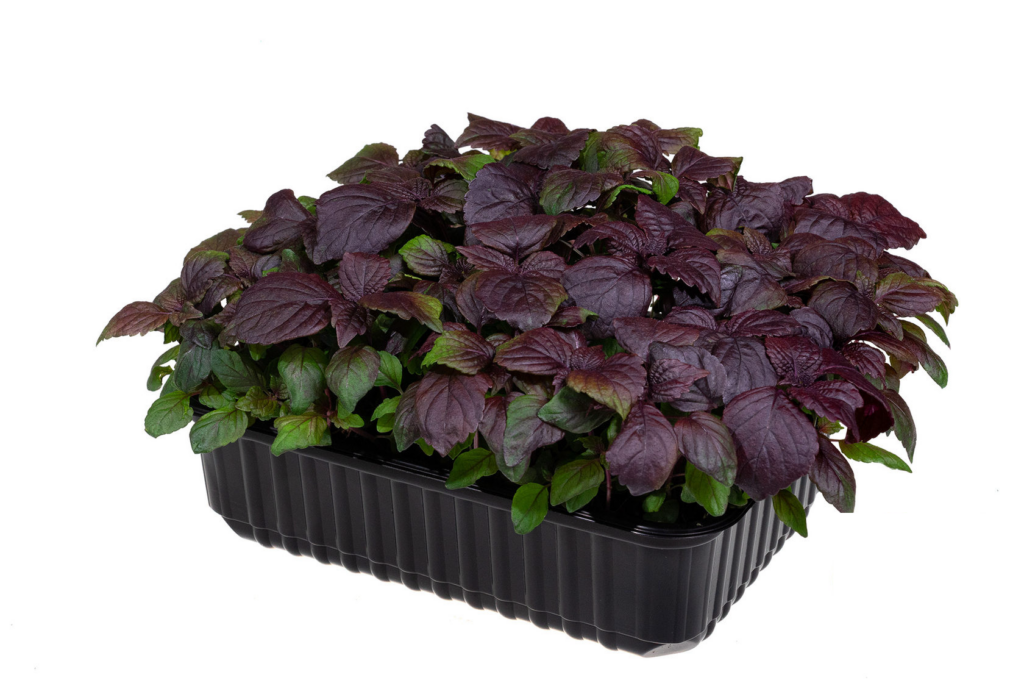
The dark purple color of shiso - anthocyanins - are synthesized exclusively at bright lighting. In low light, the leaves remain green or gray-brown - this is a deficiency, not a feature. The aroma (perylaldehyde and linalool) is formed when at a temperature of +20...+24°C and good lighting. When it is cool below +16°C, sprouts grow sluggishly and almost without a characteristic smell.
Culinary use
How to use
Shiso (Red Perilla) is a great culinary accent. Add fresh at the end of cooking or directly on the plate.
Poke bowl
shiso on top of fish + avocado + tamari sauce — an authentic Japanese accent
Salmon or tuna sashimi
2-3 shiso leaves nearby - like in a real Japanese restaurant
Beef or salmon tartare
the shiso is finely chopped and mixed with the filling - a fragrant accent inside
Author's lemonade
water + lemon + shiso + a little sugar, infuse for 20 minutes — a purple-pink drink with an unusual aroma
Mojito with shiso
shiso instead of mint + rum + lime + soda — a level more complicated than the classic
Rice bowl or onigiri
shiso in the filling or on top — like in Japanese home cooking
Perfect pairings
Shiso is traditionally served with raw fish and is an integral part of Japanese gastronomic culture
The aroma of shiso in the drink is an unexpected and memorable note
The spiciness and slight bitterness contrast with the richness of the meat
- Do not use as the main greens in large portions - the intense taste dominates and overwhelms everything around
- Do not subject to long-term heat treatment - the aroma evaporates, the color darkens
- Do not store in a normal refrigerator at +4°C — shiso, like basil, darkens and loses turgor from the cold
Home storage
How to store
Shiso (Red Perilla) keeps longer than most microgreens. Follow simple rules to keep it fresh for up to 7 days.
Room temperature or a cool place +10...+15°C — away from the refrigerator. Cut just before serving.
Place in an open container or plate, cover with a damp paper towel. Don't seal — without air, greens yellow faster.
Don't wash until ready to eat. Wet greens spoil much faster. Rinse just before serving.
Pro tip: Like basil, shiso does not like cold below +10°C. If you do not have the opportunity to store at +10...+12°C, sell live in a tray or cut immediately before ordering.
Nutrients & health
Benefits & composition
Shiso (Red Perilla) is valued for its rich vitamin-mineral composition and bioactive compounds typical of microgreens.
Like most microgreens, shiso (red perilla) contains a concentrated amount of nutrients relative to its weight — many times more than the mature plant.
| Protein | 2.5 g — building material for cells |
|---|---|
| Calories | ~34 kcal |
| Vitamins | A |
| Minerals | Potassium, Calcium, Iron |
- Shiso in culinary amounts (as a condiment or garnish) is safe for most people
- People taking blood thinners — because of the vitamin K content, should stick to a moderate amount and consult a doctor
- Those who do not like anise, licorice or mint - the specific taste of shiso may be uncomfortable
This information is general in nature and is not medical advice. Composition data: USDA FoodData Central.
Worth knowing
Anthocyanins
pigments that give shiso its dark purple color. They belong to the class of flavonoids and are traditionally considered antioxidants. The concentration of anthocyanins in red shiso is one of the highest among green crops.
Rosmarinic acid
an antioxidant characteristic of the stinging nettle family (to which shiso belongs). In Asian herbal medicine, shiso is traditionally associated with anti-inflammatory and anti-allergenic effects.
Vitamin A (beta-carotene)
is contained in shiso in a noticeable amount — ~260 μg per 100 g. It is better absorbed in combination with a small amount of fat.
Vitamin K
present in shiso in significant concentration — characteristic of leafy greens.
Similar crops
Similar by taste microgreens
If you are looking to complement or replace Shiso (Red Perilla):
Shiso (Red Perilla): how to grow — step-by-step guide
Growing parameters, agronomy, common mistakesGrowing parameters
Small, ethereal
Step-by-step guide
Seed preparation
The seeds are small, ethereal. Without soaking - sow dry.
Before sowing, make sure that the temperature in the room is stable at +23...+26°C. If there is no heat, do not start: the seeds can lie without sprouts for 2-3 weeks and then give uneven, weak sprouts.
Sowing
- Evenly moisten the substrate - the surface is even and well saturated with moisture
- Spread the seeds very evenly - 0.2–0.3 g it is very little, every seed counts
- Moisten carefully with a "mist" from a fine atomizer
- Cover with a film or dome - immediately after sowing
Seeds of 0.2-0.3 g are literally several dozen seeds for the entire tray. For even distribution, mix the seeds with a small amount of dry vermiculite and sow the mixture - the vermiculite is clearly visible and allows you to control the uniformity.
Greenhouse effect — instead of darkness and pressure
Weight press forbidden — tender shiso sprouts are mechanically damaged by any pressure.
- Cover with film or a transparent dome
- Goal: 100% humidity and stable heat (+23...+26°C)
- The substrate should not dry out - check daily
If the room is cool, put the shiso tray in a warm place: next to the battery (but not close to it), on top of the refrigerator, or in a heated micro-greenhouse. Heat is more important for shiso than for any other microculture.
Darkness / Greenhouse — 5–7 days
Shiso does not need complete darkness - a film and diffused light are enough.
What is normal:
- The first sprouts on the 4-6th day at the right temperature
- Uneven germination - shiso germinates in waves, some seeds may appear later
What is NOT normal:
- Absence of seedlings on the 8th–10th day at +23...+26°C → check the quality of the seeds
- Absence of seedlings at a temperature below +20°C → the seed "falls asleep". Move to a warmer place
Watering: when drying - very careful spraying with "mist". Not a jet.
Vegetation in the light — 14–21 days
Lighting is a key parameter for color:
- LED phytolamps: 16–18 hours per day, close distance
- Strong lighting = rich dark purple color
- Low light = green or dirty brown leaf with no marketable value
Temperature: +23...+26°C during the entire cycle. Shiso is a heat-loving culture originally from Asia. When it drops below +20°C, growth slows down sharply.
Watering: moderate lower through pallet. The root system develops slowly - do not water it.
Ventilation: moderate Without sharp drafts - tender stems break.
Watering
- Water it 1-2 times a day (in the morning - mandatory)
- Bottom watering is better - shiso essential oils can oxidize when the leaves get wet
- Shiso is heat-loving: at +22°C and above, control the humidity twice a day
- A sign of lack: purple-green leaves fade and curl slightly → water through tray
Storage
| Uncut in tray | Fridge +4...+6°C | up to 3 weeks |
|---|---|---|
| Cut in container | Refrigerator | up to 7 days |
| Room temperature | 1–2 days |
Harvest
- Real serrated leaves with a pronounced dark purple color are formed
- When touched, the spicy aroma of shiso is distinctly felt
- Height 5–8 cm
Carefully with scissors or a sharp knife. Greens are very light and delicate.
Immediately before use or sale.
Seasonal adjustments
- Ideal season: +23...+26°C is the natural optimum for shiso, the cycle is shortened to 19–22 days
- Dome: watch the humidity under the dome in the heat - it can dry out faster than you think
- Color: bright lighting in summer enhances purple pigmentation - you can use natural light
- Watering: reduce the rate, but more often - under the dome at +26°C, condensation is deceptive, the root may dry out
- Ventilation: open the dome 1-2 times a day - even at ideal temperatures, excess CO₂ slows growth
- Critical temperature: below +20°C, shiso will not grow or will give single shoots - without heating, cultivation is impossible
- Solution: a micro-greenhouse with heating, a thermostat or a warm shelf — stable +23°C throughout the cycle are mandatory
- Cycle: at +20–22°C it stretches to 25–30+ days; during temperature fluctuations, the seed "falls asleep" and does not wake up
Water pH and EC
The optimal range for shiso: 6.0–7.0. A neutral or slightly acidic environment is optimal. At a pH below 5.5, growth slows down and the color fades.
Optimal range: 1.0–1.5 mS/cm. Shiso is undemanding to nutrition. Excess nitrogen can reduce anthocyanin concentration—keep EC moderate.
Experienced grower tips
The exclusive justifies the price
The cycle of 19–28 days and the minimal yield (~10–20 g) make shiso expensive to produce. Position as a premium product for Japanese restaurants and gourmets - not for mass sale. The price per gram is one of the highest in the assortment.
A live tray is the only correct format
Like lemon balm, shiso keeps much better in a live tray than when cut. Restaurants can cut a few leaves at the time of serving - this is higher quality and lower losses.
Heat = color = money
The difference between pale and deep purple shiso is only in temperature and lighting. The investment in heating and a powerful lamp pays off with the price paid for a true black and purple product.
Double sowing every 14 days
Due to the long cycle, shiso requires a well-thought-out schedule. Two trays with an interval of 14 days — and you always have a ready product for regular customers.
Agronomy notes and common mistakes
- Sowing: No soaking. High-very high density. Small seeds evenly.
- Clamp: Without clamping.
- Temperature: +22...+28°C. Shiso is heat-loving. It almost does not grow below +18°C.
- Watering: 1–2 times a day, lower. At +26°C, it is mandatory twice.
- Ventilation: It is important. Shiso is susceptible to mold under heat stress without ventilation.
- Low temperature (<+20°C) → Seeds "fall asleep", there are no seedlings for weeks → Stable +23...+26°C throughout the cycle
- Weight press → Tender sprouts are damaged → Only film or dome — without any weight
- Weak lighting → Green or brown leaf instead of purple → Powerful phytolamps are mandatory for commercial color
- Drying under the dome → Seeds die at the germination stage → Check humidity daily
- Storage at +4°C → Darkens and withers in 1–2 days → +10...+12°C or sell live
- Expecting a quick result → Disappointment and premature ejaculation → 19-28 days is a normal cycle for shiso
Variety selection
Shiso is green
Perilla frutescens var. crispa ao-jiso
The classic flavor is anise with mint and basil. A standard choice for Japanese cuisine.
Shiso is purple
Perilla frutescens var. purpurea aka-jiso
Expressive purple-burgundy color. The taste is a little richer, the appearance is more impressive.
Що далі?
More crops in the catalog
Explore similar and contrasting flavors — from basil to amaranth