
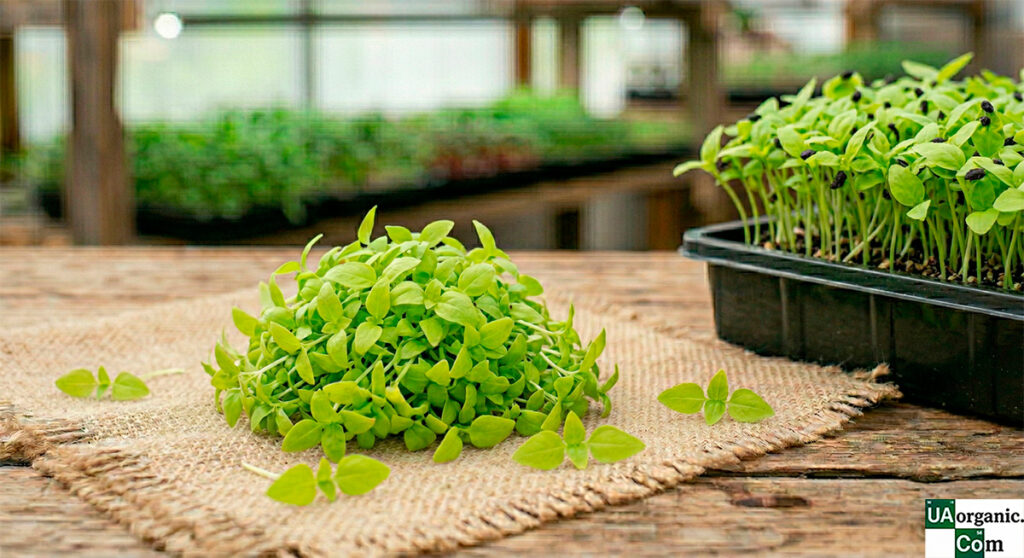
Flavor profile
Taste & aroma
Sweet, citrusy, fresh - there is no sharp clove note, instead you feel something between lemon verbena and fresh grass. Intense but pleasant aroma.
there is no harsh clove note, instead there is something between lemon verbena and fresh grass
Intense, but pleasant - lemon, lemongrass, light camphor. It is formed thanks to citral and limonene essential oils. An important detail: a full-fledged aroma is revealed only with sufficient lighting during cultivation. In low light, it smells like grass without a citrus note.
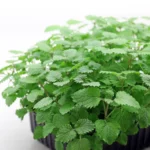
Delicate leaves, slightly lighter than classic basil. Soft, without wax coating
Ripening and optimal harvest time
Cotyledons and first leaves, the taste is clean and fresh, the citrus note is bright.
Real leaves are formed, the aroma is the most complete, the balance between spice and citrus is optimal.
The aroma can become sharper, herbal bitterness appears.
Why flavor may vary batch to batch
Citral and limonene — essential oils responsible for the lemon aroma — are synthesized more actively in bright light and at a temperature of +23...+26°C. Lemon basil grown in low light or in the cold smells of neutral greenery without a characteristic citrus note. This is the most important quality factor for this culture.
Culinary use
How to use
Lemon Basil is a great culinary accent. Add fresh at the end of cooking or directly on the plate.
Salmon carpaccio
instead of lemon juice - a handful of lemon basil. The same citrus accent, but with volume and texture
Panna cotta or ice cream
a few stems on top before serving — looks minimalistic and restaurant-like
Fruit salad
mix with strawberries, mango or peach, sprinkle with honey - basil unites all flavors
Lemonade
put in a pitcher and let it steep for 10 minutes. The aroma of lemongrass without too much trouble
Pasta with seafood
add after serving - the stems will slightly wilt from the heat, the aroma will open
Bruschetta with ricotta
ricotta + honey + lemon basil is a simple and spectacular option for serving
Perfect pairings
Lemon basil is a natural pair with any fish
Here the lemon basil is revealed most brightly
Better than the classic option for summer dishes
- Do not add to hot dishes during cooking - essential oils evaporate when heated, leaving only a grassy aftertaste
- Do not combine with very sharp flavors (garlic, hot paprika) - the citrus note is lost
- Do not store cut at +4°C — the leaves blacken as quickly as classic basil
Home storage
How to store
Lemon Basil keeps longer than most microgreens. Follow simple rules to keep it fresh for 5–7 days.
Do not put in a regular refrigerator - the leaves turn black from cold burns at +4°C. Keep at room temperature or at +10...+12°C. The term is 5–7 days. Cut just before serving.
Open container at +10...+12°C (upper shelf of the refrigerator away from the freezer, or wine refrigerator). The term is 3-4 days. At room temperature - no more than a day.
Don't wash until ready to eat. Wet greens spoil much faster. Rinse just before serving.
Pro tip: Like green basil - sell alive in a tray. Under normal conditions of the refrigerator, cut lemon basil loses its appearance in a few hours.
Nutrients & health
Benefits & composition
Lemon Basil is valued for its rich vitamin-mineral composition and bioactive compounds typical of microgreens.
Like most microgreens, lemon basil contains a concentrated amount of nutrients relative to its weight — many times more than the mature plant.
| Protein | 3,1 г g — building material for cells |
|---|---|
| Calories | ~31 kcal |
| Vitamins | K, A |
| Minerals | Potassium, Calcium, Magnesium |
- People with individual sensitivity to citrus essential oils — limonene can cause a reaction in sensitive people; start with a small amount
- People taking blood thinners — due to the vitamin K content in leafy greens, should stick to a moderate amount and consult a doctor
This information is general in nature and is not medical advice. Composition data: USDA FoodData Central.
Worth knowing
Citral and limonene essential oils
give lemon basil a characteristic aroma and are traditionally associated with refreshing properties. It is the high concentration of these compounds in young greens that makes microgreens more aromatic than adult leaves.
Vitamin K
contained in the leafy green basil — it is traditionally associated with the support of blood vessels and blood clotting processes.
Vitamin A (beta-carotene)
present in green leaves is a plant source of this vitamin, which is traditionally associated with healthy skin and vision.
Low calorie
(~31 kcal per 100 g) makes lemon basil an interesting addition to the diet for those who monitor their calorie intake.
Similar crops
Similar by taste microgreens
If you are looking to complement or replace Lemon Basil:
Lemon Basil: how to grow — step-by-step guide
Growing parameters, agronomy, common mistakesGrowing parameters
Small, mucilaginous
Step-by-step guide
Seed preparation
Lemon basil seeds - mucus-forming, as with all basilisks. When in contact with water, it is covered with a gel shell, which fixes the seed on the substrate and retains moisture.
Soaking is prohibited. Soaked seeds stick together and uniform sowing becomes impossible. Sow only dry.
Sowing
- Moisten the substrate - moist, but without puddles on the surface
- Sprinkle evenly dry seeds in a thin layer
- Spray abundantly from the sprayer - a white transparent gel will appear around the seeds
- After moisturizing do not move the seeds — slime sticks to the substrate and fixes the position
After sowing, sprinkle the surface with a thin layer of fine vermiculite. It retains moisture near the seeds and inhibits the growth of algae, which readily appear on an open, moist substrate during a long growing cycle.
Greenhouse effect
Weight press forbidden — the slimy seed will stick to the cover and, when removed, will pull out the entire crop.
- Cover the tray with transparent film or a dome with a gap from the seeds
- Goal: 100% humidity until fully rooted
- When to shoot: when the sprout took root and threw off the seed coat - the 4th-5th day. It is impossible to remove the film earlier: the mucus will dry out and the sprout will die
Darkness (Blackout) — 4–5 days
Temperature — +23...+26°C. Lemon basil is even more heat-loving than classic: at +18°C, growth almost stops, rotting begins.
What is normal:
- Uneven steps - basil sprouts slowly and in waves
- The white gel around the seed is normal, do not wash it off
What is NOT normal:
- Dark spots or smell → dehydration or cold. Ventilate, raise the temperature
- The seeds do not germinate on the 5th day → it is either too cold or too dry when sowing
Vegetation in the light — 8–12 days
Lighting is a key factor for fragrance:
- LED phytolamps: 16–18 hours a day, distance 20–25 cm
- Natural light: not enough for the synthesis of essential oils - the aroma will be weak
- A minimum of 4000–5000 lux for a full-fledged lemon aroma
Temperature: +23...+26°C is mandatory during the entire cycle. This is the most important parameter after lighting.
Watering: only the bottom through the pallet. Lemon basil leaves are more delicate than green leaves - drops of water cause black spots instantly.
Ventilation: moderate, without drafts. A sharp movement of air dries the leaves.
Rub a leaf and smell your hand. If you feel a clear lemon, the aroma is formed and the greens are ready to be harvested. If it smells like grass, leave it under the lamp for another 1-2 days or move it closer to the light source.
Watering
- Water it 1-2 times a day ONLY bottom watering
- Lemon basil is even more sensitive to moisture on the leaves than green
- Moderate humidity and heat are a must-have combination
- A sign of lack: the tender leaves curl slightly, the lemon aroma weakens → pour through the tray
Storage
| Uncut in tray | Fridge +4...+6°C | up to 3 weeks |
|---|---|---|
| Cut in container | Refrigerator | up to 7 days |
| Room temperature | 1–2 days |
Harvest
- A pair of real leaves with a characteristic shape is formed
- With a light touch - a clear lemon aroma (the main sign of readiness)
- The stem is elastic, not watery
With a sharp knife above the level of the substrate. Try not to touch the leaves again - the essential oils partially evaporate during mechanical contact, and the leaf darkens from damage.
Do not water for 12 hours until the cut — dry greens are stored much better.
Just before serving.
Seasonal adjustments
- - The aroma is formed faster and brighter in the heat: can be cut 1-2 days earlier
- - The risk of the substrate drying out between waterings is higher: monitor more often
- - At +28°C and above, the mucous membrane can: ferment - reduce the time under the dome to 3-4 days
- - Cultivation at a temperature below +20°C is not: recommended — the result will be unsatisfactory
- - Solution: a heating mat (heat mat) under the trays is the most effective way to ensure the required temperature of the substrate in winter
- - Even with warm air, the substrate can be: colder than the surface — heat mat solves exactly this problem
- ---
Water pH and EC
The optimal range for lemon basil: 6.5–7.0. Like all basils, the lemon variety is sensitive to an acidic environment — at a pH below 6.0, the aroma weakens and growth slows down. Regular tap water is fine.
Optimal range: 1.5–2.0 mS/cm. Lemon basil does not require intensive nutrition. An excess of nitrogen (EC above 2.5) gives juicy, but less aromatic sprouts - essential oils are concentrated better with moderate nutrition.
Experienced grower tips
Aroma is the only reliable indicator of readiness
Don't count the days - touch the leaf and smell it. A bright lemon means "ready". Grass without citrus is still under the lamp.
Compared to green basil, the cycle is shorter
Under the same conditions, lemon basil is ready 3-5 days earlier. It is convenient to plan crops in rotation.
A heat mat is a must-have tool
For any basil in winter, this is not an option, but a necessity. Heating the substrate to +5°C completely solves the problem of the temperature minimum.
Mix with lemon balm
Lemon basil + lemon balm in a 50/50 ratio is an interesting citrus-mint mix for desserts and drinks. Both cultures have similar agricultural techniques, but lemon balm is more resistant to lower temperatures.
Do not touch the leaves more than once
During harvesting, packaging and transportation, mechanical contact with lemon basil leaves accelerates darkening and loss of aroma. Minimal contact — maximum quality on the counter.
Agronomy notes and common mistakes
- Sowing: No soaking. Very high density.
- Clamp: Without clamping.
- Temperature: +22...+28°C. Similarly, green basil needs heat.
- Watering: ONLY the lower one. Similar to green basil.
- Ventilation: Mandatory and active.
- Soaking seeds → Clumps together, uneven sowing → Sow only dry - no exceptions
- Weight press → All the seed sticks to the cover → Only the film or dome
- The temperature is below +20°C → Pale leaves, growth arrest, black stem → Ensure +23...+26°C is mandatory
- Top watering → Black spots on the leaves → Only bottom irrigation through a tray
- Weak lighting → There is no lemon aroma, it just smells like grass → Phytolamps, at least 4000–5000 lux
- Storage at +4°C → Blackens in a few hours → Store at +10...+12°C or sell alive
- Touching leaves when cutting → Dark spots, faster loss of aroma → Cut carefully, minimal contact with leaves
Variety selection
Basil of this variety
profile grade
A standard choice for microgreens. Even germination, pronounced aroma, stable germination.
Alternative varieties
organic seeds
Suitable for organic production. Without treatment with fungicides - seeds without color coating.
Що далі?
More crops in the catalog
Explore similar and contrasting flavors — from basil to amaranth