Flavor profile
Taste & aroma
Spicy, sweet, aniseed - basil microgreens are more intense than adult leaves, because essential oils are concentrated in young tissues. Intense, perfumed aroma.
basil microgreens are more intense than adult leaves, because essential oils are concentrated in young tissues. A small amount gives a powerful taste effect
Intense, "perfumed", immediately recognizable. Fills the space when opening the package. The aroma is the main value of this culture - it persists even after cutting, if the greens are not overheated and not washed in advance.
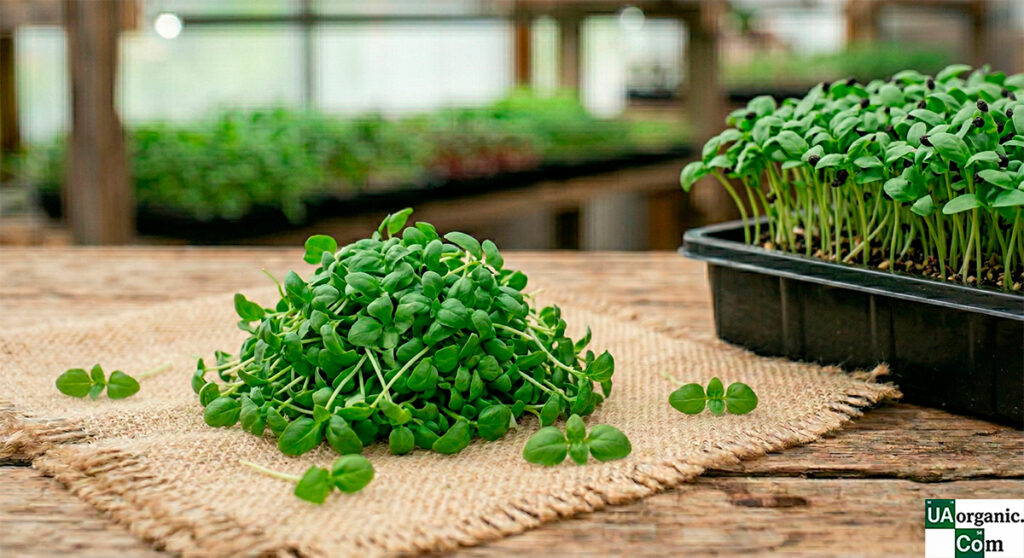
Gentle, velvety leaves on a thin stem. Much softer than adult basil leaves - without hardness and wax coating
Ripening and optimal harvest time
Cotyledons still predominate, the taste is clean and sweet.
The first real leaves appear, the taste becomes fuller and more "basilic" with a clove note.
The taste can become sharper and bitter when exposed to light.
Why flavor may vary batch to batch
The intensity of the aroma of basil depends on the growing temperature. At +24...+26°C, essential oils accumulate more actively — the aroma is rich and bright. At +18...+20°C, the culture grows, but the aroma is noticeably weaker. This is one of the reasons why basil is grown only in warm conditions.
Culinary use
How to use
Basil (Green) is a great culinary accent. Add fresh at the end of cooking or directly on the plate.
Caprese
instead of torn leaves - a handful of microgreen basil between slices of mozzarella and tomato. It looks more modern, the taste is not inferior
Pizza and pasta
add only after serving, already on the plate - the aroma flares up from the heat, but disappears with prolonged heating
Strawberry with basil
classic dessert. A few stalks of microgreens on fresh strawberries with balsamic is simple and effective
Lemonade and cold drinks
basil with lemon, cucumber or watermelon - adds depth to the drink without bitterness
Eggs
scramble or poached eggs with basil microgreens and a drop of olive oil - a Mediterranean breakfast in 5 minutes
Carpaccio
a few stalks on thinly sliced beef with parmesan - basil here is not a decoration, but a full-fledged ingredient
Perfect pairings
Basil and fresh cheese are one of the most famous gastronomic combinations
Basil is revealed next to sweet and sour foods
Olive oil and basil are a classic Mediterranean pairing
- Do not add to a hot dish during cooking - at a temperature above +60°C, essential oils evaporate in a matter of minutes, leaving only a faded taste
- Do not season the basil with acid in advance - the leaves turn black from contact with the acid and lose their appearance
- Do not store cut for a long time - basil turns black faster than any other microgreen
Home storage
How to store
Basil (Green) keeps longer than most microgreens. Follow simple rules to keep it fresh for 5–7 days.
Never put in an ordinary refrigerator - the leaves turn black from cold burns already at +4°C. Keep the tray at room temperature or in the warmest part of the refrigerator (+10...+12°C). The term is 5–7 days at the right temperature.
Store in an open container at +10...+12°C (wine refrigerator or the top shelf of the refrigerator away from the freezer). At room temperature - no more than 1 day. The term under the right conditions is 3–4 days.
Don't wash until ready to eat. Wet greens spoil much faster. Rinse just before serving.
Pro tip: If there is no refrigerator with a temperature of +10...+12°C, sell basil exclusively alive in a tray. Buyer cuts at home before serving. This is the only reliable way to preserve the product appearance.
Nutrients & health
Benefits & composition
Basil (Green) is valued for its rich vitamin-mineral composition and bioactive compounds typical of microgreens.
Like most microgreens, basil (green) contains a concentrated amount of nutrients relative to its weight — many times more than the mature plant.
| Protein | 3.2 g — building material for cells |
|---|---|
| Calories | ~23 kcal |
| Vitamins | K, A |
| Minerals | Potassium, Magnesium, Iron |
- People with individual sensitivity to essential oils — the intense aroma of basil may be excessive; start with a small amount
- Children up to 3 years old - pronounced spicy taste may not be suitable; it is better to start with calmer cultures
- People taking blood thinners — due to the vitamin K content in leafy greens, should stick to a moderate amount and consult a doctor
This information is general in nature and is not medical advice. Composition data: USDA FoodData Central.
Worth knowing
Essential oils
the main value of basil. Eugenol and linalool, which form the characteristic aroma, are traditionally considered compounds with antibacterial properties. It is the high concentration of essential oils in young greens that explains why microgreens are more fragrant than mature leaves.
Vitamin K
is found in basil leafy greens in significant amounts — it is traditionally associated with vascular support.
Vitamin A (beta-carotene)
basil is a plant source of this vitamin, which is traditionally associated with healthy skin and vision.
Antioxidants
Basil contains flavonoids and polyphenols — compounds that are traditionally considered antioxidants. Microgreens accumulate them in a higher concentration than adult leaves.
Similar crops
Similar by taste microgreens
If you are looking to complement or replace Basil (Green):
Basil (Green): how to grow — step-by-step guide
Growing parameters, agronomy, common mistakesGrowing parameters
Small, mucilaginous
Step-by-step guide
Seed preparation
Basil seeds - mucus-forming. When in contact with water, it is covered with a gel shell that sticks to any surface and retains moisture. This is both an advantage (good contact with the substrate) and a trap for beginners.
Soaking is strictly prohibited. Soaked seeds stick together in a lump, which cannot be evenly distributed. Sow only dry.
Sowing
- Moisten the substrate - it should be moist, but without standing water on the surface
- Sprinkle evenly dry seeds in a thin layer
- Spray liberally from the atomizer on top - a gel coat will form around each seed
- Do not move the seeds after moistening — mucus sticks to the substrate and fixes the seed. Any movement shifts the position and destroys contact with the mat
To control the uniformity of sowing dry seed, mix it with a small amount of dry vermiculite before sowing. Light vermiculite is clearly visible on a dark substrate - it is immediately noticeable where it is thick and where it is sparse. After spraying, vermiculite also holds moisture near the seed.
The greenhouse effect is instead of pressure
Weight press strictly prohibited — the seeds with mucus will stick to the lid, when removed, it will pull out the entire seed together with the mat.
Instead of pressure, there is a greenhouse effect:
- Cover the tray with transparent film or a dome (transparent lid)
- The film should not touch the seeds - leave a small gap
- Purpose: to maintain 100% humidity until complete germination and rooting
When to remove the film: when the sprout takes root in the mat and sheds the seed coat on its own - about the 4th-5th day. Not earlier: if the slime dries up before rooting, the sprout will die.
Darkness (Blackout) — 4–5 days
Temperature during darkness — +23...+26°C. This is critical. At a temperature below +20°C, even with proper watering, "black leg" and rotting begin.
What is normal:
- Uneven growth - basil sprouts more slowly and unevenly than radish or peas
- Remnants of the mucous membrane on the seeds are normal
What is NOT normal:
- Dark spots or the smell of rot → waterlogging or cold. Improve ventilation, raise the temperature
- The seeds are dry and do not germinate → the film was removed prematurely or insufficiently moistened when sowing
Watering in the dark: usually not needed - the mucous membrane retains moisture. If the edges of the substrate dry out, spray only the edges, not the center.
Vegetation in the light — 12–16 days
Basil grows slowly. This is the longest cycle among popular microcultures - be patient.
Lighting:
- LED phytolamps - mandatory: 16–18 hours a day, distance 20–25 cm
- Natural light: not enough - basil stretches and falls
- With a lack of light, the stems are thin, the leaves are small, the plant "lies down"
Temperature is the second critical parameter:
- Optimum: +23...+26°C
- At +18...+20°C: growth slows down, the aroma is weaker, the risk of diseases increases
- Below +18°C: growth stops, decay begins
Watering — only the bottom:
- Through the pallet, never from above
- The root system of basil is delicate and sensitive to waterlogging
- The substrate should be moist, but not wet - basil does not tolerate standing water
Ventilation: moderate, without drafts. Basil does not like sudden air movement - the leaves wither.
If it is not possible to keep the entire farm at +24°C, place the basil closest to a heat source (lamp, heating device). Even +2–3°C differences between the trays significantly affect the result.
Watering
- Water it 1-2 times a day ONLY by bottom watering (through a tray)
- Basil categorically does not tolerate water on the leaves - mold develops in a few hours
- Even moderate humidity is the key to success
- A sign of lack: tender leaves become matte and curl slightly → pour through a pan
Storage
| Uncut in tray | Fridge +4...+6°C | up to 3 weeks |
|---|---|---|
| Cut in container | Refrigerator | up to 7 days |
| Room temperature | 1–2 days |
Harvest
- The first real leaves have appeared - they are larger than the cotyledons and have a characteristic basil shape
- The aroma is bright and recognizable when touched lightly
- The stem is elastic, not watery
With a sharp knife or scissors above the level of the substrate. Important: do not water 12 hours before cutting - wet greens are better preserved and blacken faster.
Just before serving. Wet basil turns black in a matter of hours.
Seasonal adjustments
- Slime: at +28°C and above, the mucous membrane ferments faster — the time from sowing to rooting is shortened
- Watering: the substrate dries out faster - monitor the humidity twice a day
- Cut: cut a day or two earlier - in the heat the aroma is very intense
- Expect: shortening the cycle by 1-2 days, extremely rich aroma
- Temperature: below +20°C, basil should not be grown without additional heating — the result is unsatisfactory
- Solution: heating mat for trays (heat mat) is the most effective way to ensure +24°C
- Place: near a battery or other heat source, but not close
- Expect: prolongation of the cycle by 3–5 days, weaker aroma with insufficient heat
Water pH and EC
The optimal range for basil: 6.5–7.0. Basil is sensitive to an acidic environment — at a pH below 6.0, growth slows down and the aroma weakens. Hard tap water (pH 7.0–7.5) is fine, so basil is considered undemanding in this regard.
Optimal range: 1.5–2.0 mS/cm. Basil needs moderate nutrition. When growing on a substrate without additives (normal watering), EC is not critical. In hydroponics, it is important not to exceed 2.5 - an excess of nitrogen gives too juicy, but less aromatic sprouts.
Experienced grower tips
The heat mat is a game changer for basil
The heating mat under the trays (heat mat, +5°C to the temperature of the substrate) completely solves the problem of the temperature minimum. Indispensable in the cold season.
Do not water before cutting
Stop watering 12 hours before harvesting - the greens will be drier, last longer after cutting and have less chance of blackening.
A live tray is the only reliable sales format
Cut basil under standard refrigerator conditions is a reputational risk. The live tray at the buyer's place is at room temperature, it is stored much better.
Mix with neutral greens
Basil in its pure form is an expensive and complex product. In a mix with peas or sunflower (20% basil) you get a spectacular aromatic product at a lower cost and less risk.
The mucous membrane is not a bug, but a feature
Beginners are often afraid of "slime" and try to wash it off. It's not worth it: it keeps moisture near the root at the start and is a natural protection of the seed.
Agronomy notes and common mistakes
- Sowing: No soaking. Very high density - small seeds evenly spread over the entire surface.
- Clamp: Without clamping. Small basil seeds do not need and do not tolerate pressure.
- Temperature: +22...+28°C. CRITICAL: below +18°C, basil stops developing and turns black.
- Watering: ONLY lower, 1-2 times a day. Basil and overhead watering are incompatible.
- Ventilation: Mandatory and active. A dense canopy of basil in heat and humidity without ventilation is an ideal environment for mold.
- Soaking seeds → Seeds stick together in a lump, uneven sowing → Sow only dry - without exception
- Weight press → All the seed sticks to the lid, the mat breaks out → Only the film or dome, without any weight
- The temperature is below +20°C → Mildew, black leg, growth stop → Provide +23...+26°C — this is the minimum for basil
- Top watering on stems → Stains, rotting, blackening → Only bottom watering through a pallet
- Premature film removal → The mucus dries up, the sprout dies, does not take root → Remove the film only after rooting (4–5 days)
- Storage at +4°C → Leaves turn black in a few hours → Store at +10...+12°C or sell alive
- Weak lighting → Pulling, lying down, small leaves → Phytolamps are a must, natural light is not enough
Variety selection
Classic green varieties
Genoese, Bigleaf, Marquis
The optimal choice for microgreens. They germinate stably, give a good yield of mass, a classic basil aroma. Recommended for beginners and commercial cultivation.
Small-leaved and Greek varieties
Greek basil, Tom Taus
More compact plants, less yield, but more concentrated aroma. Suitable for premium serving. Need more careful control of humidity and temperature.
Що далі?
More crops in the catalog
Explore similar and contrasting flavors — from basil to amaranth