
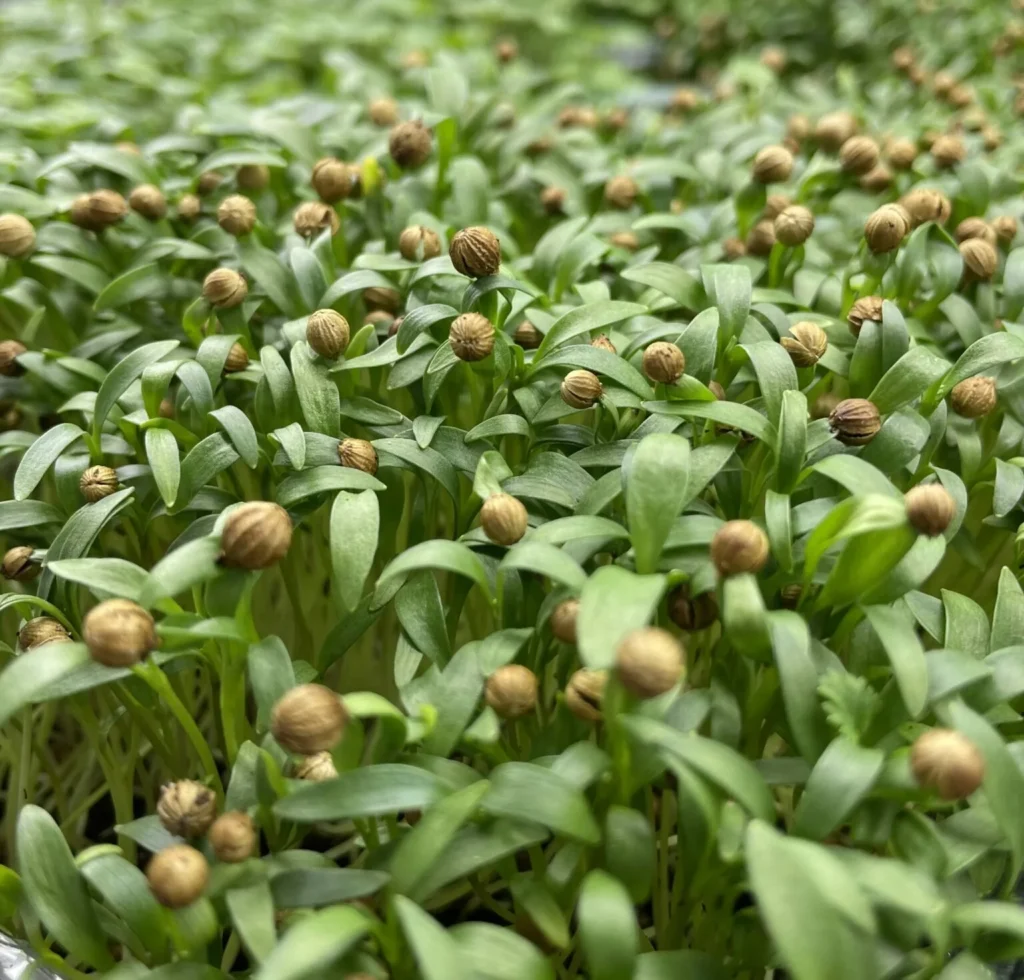
Flavor profile
Taste & aroma
Spicy, citrus, sweet - lime, lemon zest, a little green pepper. Sharp, spicy aroma.
lime, lemon zest, some green pepper. Microgreens have a "cleaner" and more citrusy taste than adult cilantro, which sometimes has an earthy note
Pungent, spicy, citrus-soapy - essential oils open instantly when cut, stay on hands and indoors longer than any other microgreen.
Gentle, Thin, Soft - does not tolerate pressure during packaging. The stem is soft, edible in its entirety
Why flavor may vary batch to batch
The temperature during the growing season significantly affects the intensity of essential oils: when grown cooler (+18°C), the aroma is more delicate and citrusy, when it is warmer (+24°C and above) it is sharper and "bug-like". The type of seed also plays a role: split seeds and whole seeds can produce a slightly different flavor profile.
Culinary use
How to use
Coriander is a great culinary accent. Add fresh at the end of cooking or directly on the plate.
Asian soups (Tom Yum, Pho Bo, ramen)
added to the plate at the last moment, do not cook. The aroma remains fresh, not "cooked"
Tacos and Mexican dishes
a classic combination with salsa, guacamole and roast beef. Cilantro is not an accent here, but a mandatory component
Toast with avocado and salmon
a handful of micro cilantro on top gives a citrusy freshness that cannot be replaced with lemon juice
Curries and dishes with coconut milk
Coriander emphasizes the spiciness of the pasta and refreshes the rich sauce
Marinades for meat
chopped micro cilantro in a marinade with oil and lime gives a bright aroma in just 30 minutes
Cold rice bowls
together with edamame, carrots, sesame and miso cilantro dressing turns a simple bowl into an Asian dish
Perfect pairings
The classic is cilantro with tomatoes and onions: they enhance the citrus note and soften the sharpness
Coriander "cuts" fat and refreshes heavy meat dishes
In combination with spicy sauce or curry paste, cilantro opens up completely
- Do not boil or stew: the heat quickly evaporates the essential oils, and all that remains is a grassy, odorless bitterness.
- Do not add to milk sauces: cilantro's citric acid clashes with creamy flavors, the result is unpredictable.
- Do not mix with dill: two very strong flavors fight with each other, and the dish gets a chaotic spicy background instead of an accent.
- Do not dose "just in case" in small quantities: with or without cilantro as a full accent. Too little gives only a slight "bug-like" smell with no taste.
Home storage
How to store
Coriander keeps longer than most microgreens. Follow simple rules to keep it fresh for up to 3 weeks.
Don't cut more than you plan to eat right away. Store in refrigerator at +4...+6°C. No watering needed — natural moisture is enough.
Place in an open container or plate, cover with a damp paper towel. Don't seal — without air, greens yellow faster.
Don't wash until ready to eat. Wet greens spoil much faster. Rinse just before serving.
Nutrients & health
Benefits & composition
Coriander is valued for its rich vitamin-mineral composition and bioactive compounds typical of microgreens.
Like most microgreens, coriander contains a concentrated amount of nutrients relative to its weight — many times more than the mature plant.
| Protein | 2.1 g — building material for cells |
|---|---|
| Calories | ~23 kcal |
| Vitamins | K |
| Minerals | Potassium |
- About 4-14% of people have it genetic feature of taste receptors, because of which coriander is perceived as "soap" or "bugs". This is not an allergy or a habit - just a feature that cannot be overcome. If cilantro has always seemed unpleasant, it probably is.
- To people who accept blood thinners, it is worth maintaining a uniform intake of vitamin K without sudden changes in the amount — it is better to check with a doctor.
- At sensitive stomach with increased acidity it is worth starting with small quantities - essential oils of coriander stimulate the production of gastric juice.
This information is general in nature and is not medical advice. Composition data: USDA FoodData Central.
Worth knowing
vitamin K
Coriander is one of the richest sources of vitamin K among herbs — it is traditionally included in the diet as part of a variety of green nutrition.
linalool
Coriander essential oils—particularly linalool—are traditionally associated with a calming effect and digestive support. Coriander is often eaten after fatty or heavy meals: it is part of the culinary traditions of many cultures in this context.
antioxidants
It is a source of antioxidants — compounds that are a common part of a diverse plant diet and are being studied in the context of combating oxidative stress.
Antioxidants and biologically active substances
Microgreens are a concentrated source of antioxidants — compounds that are being studied in the context of protecting cells from oxidative stress. Regular consumption of a variety of microgreens is part of a balanced plant-based diet.
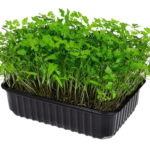
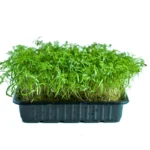
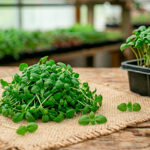
Coriander: how to grow — step-by-step guide
Growing parameters, agronomy, common mistakesGrowing parameters
Large, round (two-seeded fruit), brown
Watering
- Water it 1-2 times a day carefully (in the morning - necessarily)
- Lower watering is better - coriander is prone to slime formation with upper watering
- Moderate humidity: do not overmoisten - mucous substrate = diseases
- A sign of lack: sprouts stop growing, leaves fade → water through the tray
Storage
| Uncut in tray | Fridge +4...+6°C | up to 3 weeks |
|---|---|---|
| Cut in container | Refrigerator | up to 7 days |
| Room temperature | 1–2 days |
Harvest
The first real carved leaf has completely unfolded. The height of the stem is 6-10 cm. Take your time: the difference between "there are cotyledons" and "there is a first leaf" is the difference between a bush that no one needs and a real microcilantro.
With a sharp knife or scissors, cut 1–1.5 cm above the substrate. A tender leaf does not tolerate a dull blade — it cuts the stem and leaves a crushed cut that quickly darkens.
Wash gently in cold water, gently shaking - do not rub. Dry naturally or on a towel. Do not spin - the delicate lace leaf will be remembered. Pack only completely dry.
Seasonal adjustments
- Aroma: in heat it becomes sharper and less citrusy — essential oils are more aggressive at higher temperatures
- Blackout phase: increase to 6–7 days — when warm, seeds emit heat more slowly and need more time
- Watering: reduce doses, but more often - the substrate dries out imperceptibly under the lid
- Collection: cut a little earlier - at the first signs of the first leaf, without waiting for full disclosure, to avoid coarsening
- Ventilation: open the tray 1-2 times a day during a blackout — excess heat and moisture gives cilantro a musty smell
- Thermostat: heat the substrate from below - cold temperature strongly inhibits the germination of coriander, without heating the seedlings are uneven
- Cycle: extends to 23–25 days; in winter, the aroma is more delicate and citrusy - winter cilantro is often better in quality
- Watering: reduce the frequency - when it is cool, the substrate dries slowly, overwetting is more dangerous than drying out
Water pH and EC
Optimum range for Coriander / Cilantro: 6.0–7.0. Coriander grows optimally in a neutral environment. Undemanding to pH in a short cycle.
Optimal range: 1.0–1.8 mS/cm. Moderate mineralization is ideal. Coriander seed coat can react to very hard water - EC above 2.0 is best avoided.
Experienced grower tips
Split instead of a whole seed — always
The difference in the start time is 2–3 days and there are significantly fewer problems with "helmets". If the supplier sells only the whole, split it yourself with a rolling pin before soaking.
Do not judge the tray by the smell in the first days
An aldehydic smell during germination is the norm for coriander. Smell again on the 5th day of vegetation in the light: if a citrus aroma appears, everything is going well.
Steam before the light is a must
Moisturize from a spray bottle and leave under the lid for 2-3 hours before going out into the light. Save time on manual removal of "helmets" from each sprout.
A carved leaf is a single product form
Do not sell coriander at the cotyledon stage. A customer who knows cilantro will not recognize it and will be dissatisfied. Wait another 3-4 days - the product will be radically different.
Keep separate from other crops during storage
Coriander essential oils are very volatile and can "flavor" neighboring trays with neutral greens. Store in a closed container in the refrigerator.
Agronomy notes and common mistakes
- Sowing: Split or untwisted seeds - high density. No soaking. Even sowing.
- Clamp: Light pressure (1 kg), 1–2 days.
- Temperature: +18...+24°C. Coriander is a moderate thermophile.
- Watering: 1–2 times a day, lower. Coriander slime is susceptible to bacterial damage when watered from above.
- Ventilation: Very important. Coriander without ventilation gives a mucous coating when warm.
- No soaking → Liquid, uneven germination, half of the seeds did not germinate → Always soak for 8–12 h, it is preferable to use split seeds
- Panic because of the smell at the start → The tray is thrown away as "rotten" → The smell of aldehydes during germination is the norm. Disappears in the light. Focus on the look, not the smell
- Section at the cotyledon stage → Greens "do not look like cilantro", there is no demand → Waiting for the first carved leaf is micro cilantro
- Weak grip → "Helmets" for 70%+ sprouts, have to be removed manually → 2 kg clamp is mandatory, keep the entire blackout
- Excess moisture in the package → The leaf dries up, mucus appears on the 3rd-4th day → Dry paper towel at the bottom, do not hermetically close
- Too high a temperature (>24°C) → Sharp "bug" smell instead of citrus → Keep at +18...+22°C, especially during the growing season
Variety selection
Whole seed (dicot)
Standard version. It descends more slowly and unevenly. Before soaking, it is advisable to slightly split with a rolling pin.
Standard cilantro (Dicot)
Caribe, Cordoba, Strimko
Standard selection. Seeds in the form of dicotyledons - slightly split before sowing. Even germination.
Split-seed (split)
Slow Bolt, Santo
Ready split seeds - gives more even seedlings without additional preparation.
Що далі?
More crops in the catalog
Explore similar and contrasting flavors — from basil to amaranth