Flavor profile
Taste & aroma
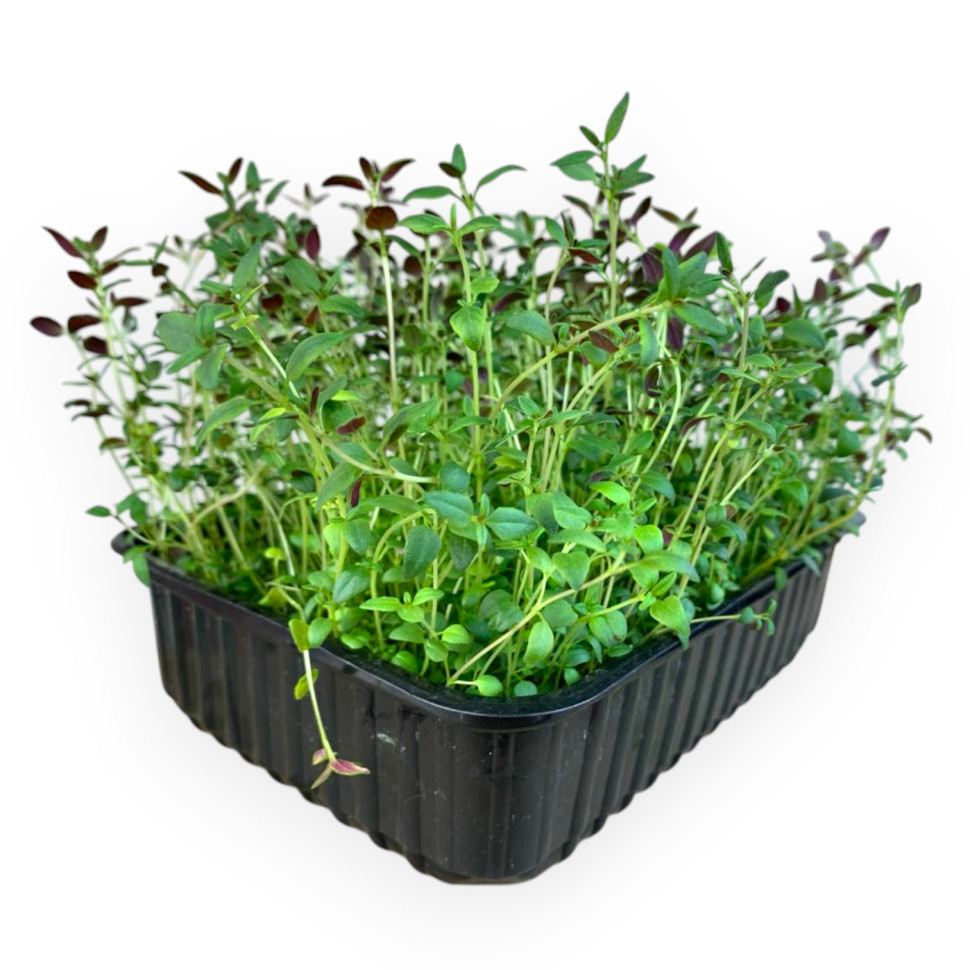
Spicy, spicy, grassy - young sprouts concentrate essential oils in a higher proportion to the mass. Very strong, forest aroma.
young sprouts concentrate essential oils in a higher proportion to the mass. They are used in microdoses, not in handfuls
Very strong, "forest", opens instantly at the slightest touch. Thymol and carvacrol - the main essential oils - give the same recognizable smell associated with Provençal cuisine and drugstore cough drops. When grown indoors, the aroma can be felt from a distance.
Thin, Gentle, Soft - the leaves are miniature, the stems are thin, but not watery. It is not felt on the teeth as a separate element - thyme completely dissolves in the dish, leaving only the taste and aroma
Ripening and optimal harvest time
The first couple of real leaves, the aroma is clean and fresh, the most tender moment.
A few pairs of leaves, aroma at its peak, optimal collection.
The aroma becomes sharper and "medicinal", the stems begin to grow woody.
Why flavor may vary batch to batch
Thymol and carvacrol are synthesized more actively in bright light and at a temperature of +22...+25°C. In low light or in a cold room, sprouts grow without a characteristic aroma - they smell just like neutral grass. This is the most important quality factor for thyme: without sufficient lighting, the product has no meaning.
Culinary use
How to use
Thyme is a great culinary accent. Add fresh at the end of cooking or directly on the plate.
Steak or chop
put a pinch on the meat immediately after removing it from the heat - the residual heat will open the essential oils, the aroma will permeate the dish
Cream of mushroom soup or risotto
sprinkle just before serving - thyme on a hot surface gives an instant aromatic effect
Goat cheese on toast
ricotta or soft goat cheese + honey + thyme microgreens — a simple and elegant snack option
Baked potatoes
cut hot potatoes, put butter and a pinch of thyme - three ingredients, restaurant result
Aromatic tea
a few stalks in a teapot with green or white tea - live thyme gives a fresh floral-spicy aroma
Desserts with a contrast
pear, honey, caramel or dark chocolate + thyme is an unexpected combination that works well in modern cuisine
Perfect pairings
Put on a hot steak or baked meat at the very end - the heat opens the essential oils without their evaporation
Mushroom risotto and baked potatoes are classic combinations
Better than the dried analogue: fresh aroma, without "pharmacy" sharpness
- Do not add to dishes during long cooking - thyme in the microgreen is more tender than dried, essential oils evaporate quickly when heated above 80°C
- Do not use in large quantities as salad greens - too intense taste in large quantities overloads perception
- Do not combine with very sharp flavors (horseradish, wasabi, hot chili) - two aggressive accents drown each other out
- Do not store in an open form - essential oils are volatile, the aroma disappears in a few hours
Home storage
How to store
Thyme retains its aroma much longer than most microgreens thanks to its stable essential oils — but only under the right conditions.
Keep at room temperature or at +10...+15°C - not in a regular refrigerator. Cut immediately before use. In a tray at a moderate temperature, greens remain fragrant for up to 14 days.
Place in a tightly closed container and store in the refrigerator at +4...+6°C. Sealing is a key condition: essential oils are very volatile, the aroma disappears in 4-6 hours when open. The term is up to 12–14 days.
Don't wash until ready to eat. Wet greens spoil much faster. Rinse just before serving.
Pro tip: Thanks to the essential oils, cut thyme will last longer than most tender crops — but only in an airtight container. Sell alive in a tray: the buyer cuts before consumption, the aroma is maximum.
Nutrients & health
Benefits & composition
Thyme is valued for its rich vitamin-mineral composition and bioactive compounds typical of microgreens.
Like most microgreens, thyme contains a concentrated amount of nutrients relative to its weight — many times more than the mature plant.
| Protein | 5.5 g — building material for cells |
|---|---|
| Calories | ~34 kcal |
| Vitamins | C, A |
| Minerals | Iron, Calcium, Magnesium |
- Pregnant women: thyme essential oils in high concentrations are traditionally not recommended - in culinary quantities it is not critical, but in large portions or in the form of a concentrated infusion it is worth refraining
- People with acute kidney diseases: due to active essential oils, it is better to consult a doctor during exacerbations
- For people allergic to licorice (mint, basil, sage): thyme belongs to the same family - if sensitive, start with minimal amounts
This information is general in nature and is not medical advice. Composition data: USDA FoodData Central.
Worth knowing
Thymol
the main active ingredient of thyme. It is a natural antiseptic that is traditionally used in traditional medicine for colds and coughs, which is why thyme tea is a classic home remedy. Microgreens contain thymol in the most active, living form, before any heat treatment.
Vitamin C
present in significant quantities in fresh greens. It is best preserved when eating raw greens - heat treatment destroys vitamin C.
iron
is contained in thyme in a noticeable amount for herbal culture. When used in microdoses, the absolute contribution to the daily norm is small, but in combination with vitamin C, digestibility improves.
Flavonoids luteolin and apigenin
are of scientific interest as antioxidant compounds. Present in concentrated form in young shoots.
Similar crops
Similar by taste microgreens
If you are looking to complement or replace Thyme:
Thyme: how to grow — step-by-step guide
Growing parameters, agronomy, common mistakesGrowing parameters
Dusty, ethereal, very fine
Step-by-step guide
Seed preparation
Thyme seeds are dust-like, one of the smallest in the standard assortment of microgreens. One mistake in sowing - and the batch is ruined beyond repair.
Soaking is strictly prohibited. The seeds are so small that after soaking, they stick together in an indistributable mass. Sow exclusively dry.
Check before sowing:
- The seeds are dry and loose - even a slight stickiness means high humidity of the batch
- The substrate is prepared, level, evenly moistened
- The atomizer is set for the finest mist — any coarse jet will dislodge the seeds
- Indoor temperature +22...+25°C — below this threshold, thyme will either not sprout at all, or will sprout after 2–3 weeks
Mix 0.5 g of seeds with 2–3 g of dry fine sand or vermiculite. It is much easier to distribute the mixture evenly over the surface of the tray. This is the only practical way to sow dusty seeds without clumps and empty areas.
Sowing
- Moisten the substrate in advance - evenly wet, without puddles and dry spots
- Spread the mixture of seeds and sand in slow movements from the center to the edges
- The seeds should lie on the surface — do not deepen, do not sprinkle on top
- Spray with a fine mist from the atomizer - the seeds will press against the substrate
Why the norm is critical: 0.5 g is really very little. If it is exceeded (more than 0.8 g without sand), the seeds lie in heaps, the lower layer suffocates. If there is a shortage, there is a thin, uneven carpet. Weigh on accurate scales or measure with a measuring cup.
Use a dark substrate (coconut or peat) - the distribution of small seeds is clearly visible on a dark background. On white agrocotta, the unevenness is almost imperceptible until the emergence of seedlings, when it is already too late to correct.
The greenhouse effect is instead of pressure
Weight pressure is not used for thyme — tender sprouts will suffocate under any load.
- Cover the tray with a transparent film with several small holes or a transparent lid with a slot
- Goal: Maintain 95-100% humidity until confident seedlings appear
- Minimum ventilation is mandatory - complete tightness leads to the appearance of algae and mold on the surface of the substrate
When to shoot: only when a uniform green carpet of sprouts is visible — 5–7 days. It is dangerous to remove it earlier: the microscopic roots of thyme die from drying out in a matter of minutes.
Darkness (Blackout) — 5–7 days
The tray stands under the dome in the dark +22...+25°C is a minimum requirement, not a recommendation. Thyme is a heat-loving plant: at +18°C, seeds can lie "dead weight" for weeks, and at +15°C, they will not germinate at all.
What is normal:
- On the 3rd-4th day - barely noticeable white or yellowish dots (this is a root hair and the beginning of germination)
- On the 5th-7th day - tiny sprouts 2-5 mm high unevenly on the surface
- A slow and uneven start is the norm for thyme
What is not normal:
- Green or black spots on the substrate → algae or mold from insufficient ventilation under the dome. Ventilate, check for holes in the film
- On the 7th day, most of the seeds have not germinated → either the temperature is lower than +20°C, or the seeds are old. Check the temperature and, if necessary, move to a warmer place
Watering during a blackout: the most dangerous moment is drying out. Thyme sawdust dies from lack of moisture within hours at the root hair stage. Check the condition of the substrate every 1-2 days, moisten only from the atomizer with a fine mist around the perimeter.
Vegetation in the light — 14–20 days
Remove the dome gradually: first open it for a few hours, the next day - remove it completely. A sudden change in humidity from 100% to room temperature kills young thyme sprouts instantly.
Lighting is a key factor in fragrance:
- Phytolamps LED: 16-18 hours per day, distance 15-20 cm (closer than for most crops)
- Natural window sill: not enough for the synthesis of thymol - the aroma will be weak or absent
- A minimum of 4000-5000 lux directly above the tray
- Without sufficient lighting, thyme grows as a neutral herb without taste and demand
Temperature: +22...+25°C during the entire cycle. This is the most important parameter after lighting.
Watering:
- Only from a sprayer (mist) the first 5–7 days after removing the dome — while the roots are still superficial
- Then — bottom watering through a pallet, very moderate
- Thyme is prone to leaching: the substrate should be moist, but not wet. The top layer should dry out slightly between waterings
- Never water from above the leaves - drops of water on the delicate leaves leave stains
Ventilation: moderate, without drafts. With a long cycle (up to 27 days) without air circulation, mold develops on the surface of the substrate. But the sudden movement of air dries the microscopic leaves - find a balance.
Check for doneness by smell, not by the calendar. Touch the leaf and bring your finger to your nose. If a clear thymol aroma is felt, the greens are ready. If it smells just like grass - another 2-3 days under the lamp closer to the light source.
Watering
- Water it 1 time a day (in the morning) or every other day with small watering
- Bottom watering or fog - thyme is drought-resistant
- Excess moisture is more dangerous than drying out for thyme
- A sign of lack: tiny leaves fade, plants stop → water gently
Storage
| Uncut in tray | Fridge +4...+6°C | up to 3 weeks |
|---|---|---|
| Cut in container | Refrigerator | up to 7 days |
| Room temperature | 1–2 days |
Harvest
- Height 3–5 cm
- Several pairs of real small leaves are formed
- When lightly touched, there is a strong smell of thyme
- The stem is elastic, does not lie down
With manicure scissors or small sharp scissors, this is painstaking work. Greens are very small and light, cut slowly. Cut above the substrate level without grabbing the roots.
Very carefully, in a bowl of cold water with light movements. Tender leaves stick together from a strong jet. After washing, let it drain on a paper towel.
Seasonal adjustments
- Heat is a natural environment thyme: at +24...+26°C growth is the most even and the aroma is the most balanced
- At +28°C and above the aroma becomes sharper and more "pharmacy" - avoid direct sunlight and overheating of the room
- Dome: reduce to 4-5 days, when the roots are warm, they go into the substrate faster - the delay of the dome increases the risk of mold
- Ventilation mandatory: long cycle + heat + humidity without air movement = mold
- Expect: shorter cycle and more powerful aroma compared to cool season
- Heat mat is mandatory: at +20°C and below, thyme does not germinate or gives single shoots after 3+ weeks — the heat of the substrate is critical
- The substrate temperature is more important than the air temperature — the heat mat under the tray solves exactly this problem even in a cold room
- Expect: with proper heating (+22°C substrate), growth is normal, but the cycle can be extended by 2–4 days
Water pH and EC
Optimal range for thyme: 6.0–7.0. Thyme is a typical representative of the Mediterranean flora, accustomed to neutral and slightly alkaline soils. At a pH above 7.5, chlorosis is possible in the later stages. At a pH below 5.5, growth is inhibited and mold increases.
Optimal range: 0.5–1.0 mS/cm. Thyme is sensitive to mineralization during a long cycle. Excessively mineralized water (EC above 1.5) with frequent watering leads to the accumulation of salts and a bitter chemical aftertaste - especially noticeable with such a concentration of essential oils. With hard water in the region, dilute it with filtered water.
Experienced grower tips
Sand during sowing is not an option, but a necessity
It is practically impossible to evenly sow 0.5 g of dusty seeds without diluting them with sand. A ratio of 1:5 (seed:sand) is the minimum. Some use 1:10 for maximum uniformity.
Aroma is the only reliable indicator of readiness
Don't count the days - touch a leaf and smell your finger. Clear thymol = done. Neutral grass = still under the lamp and closer to the light.
Heat mat is a must-have tool for thyme
Among all cultures, thyme is the most sensitive to substrate temperature. Even in summer with warm air, the cold surface of the rack can keep the substrate at +18°C — and the sowing will not come off. Heat mat under the tray solves this problem completely.
Dark substrate = better control
Coconut mat or peat allows you to see the distribution of seeds and the uniformity of watering much better than white agrocotton. For such a capricious culture, control at every stage is the key to success.
Do not oversow
Thyme takes place on the shelf for almost a month and gives 12–15 g of yield. This is justified only with a price of 3-5 USD per tray and a confirmed buyer. Plan sowing for a specific request.
Agronomy notes and common mistakes
- Sowing: No soaking. The seeds are dusty - mix 1:5 with dry sand or vermiculite for even distribution. Without sand - piles and uneven stairs.
- Clamp: Not needed. A dome is required for 6–10 days — without it, the seeds dry out and die in the first days.
- Temperature: +22...+26°C minimum. Heat mat is mandatory in winter - thyme does not germinate at +20°C and below.
- Watering: 1 time a day or every other day - the culture is drought-resistant. Only a sprayer or lower watering through a tray, never with an upper jet - the leaves rot.
- Ventilation: critically important during a long cycle — a warm and humid microclimate without air movement inevitably gives mold.
- The temperature is below +20°C → Seeds do not germinate for weeks → Minimum +22°C is mandatory, use a heat mat
- Sowing without sand → Seeds fall in clumps, uneven seedlings → Mix 1:5 with dry sand or vermiculite
- Rough substrate → Seeds fall into cracks and do not germinate → Only a small fraction — small coconut, peat, agrocotton
- It is too early to remove the dome → Sprouts die from drying out within hours → Remove only when there is a uniform green carpet, gradually
- Weak lighting → Greens grow, but without aroma → Phytolamps are closer, 4000–5000 lux minimum
- Overflow ("swamp") → Thyme turns black from the root, washing → The substrate is moist, but not wet; dries up slightly between waterings
- Watering from above on the leaves → Spots, clumping, leaf rot → Sprayer or bottom watering only
- Growing without an order → Spend a month, 12 g yield, no buyer → Sow only under confirmed demand
Variety selection
Common thyme (Thymus vulgaris)
Standard selection. Classic thymol aroma, the highest concentration of essential oils. The most common seed on the market.
Lemon thyme (Thymus × citriodorus)
If you manage to find the seeds, it gives an interesting citrus-thymol profile. The aroma is softer and more "gastronomic". Suitable for desserts and drinks better than regular.
Що далі?
More crops in the catalog
Explore similar and contrasting flavors — from basil to amaranth