
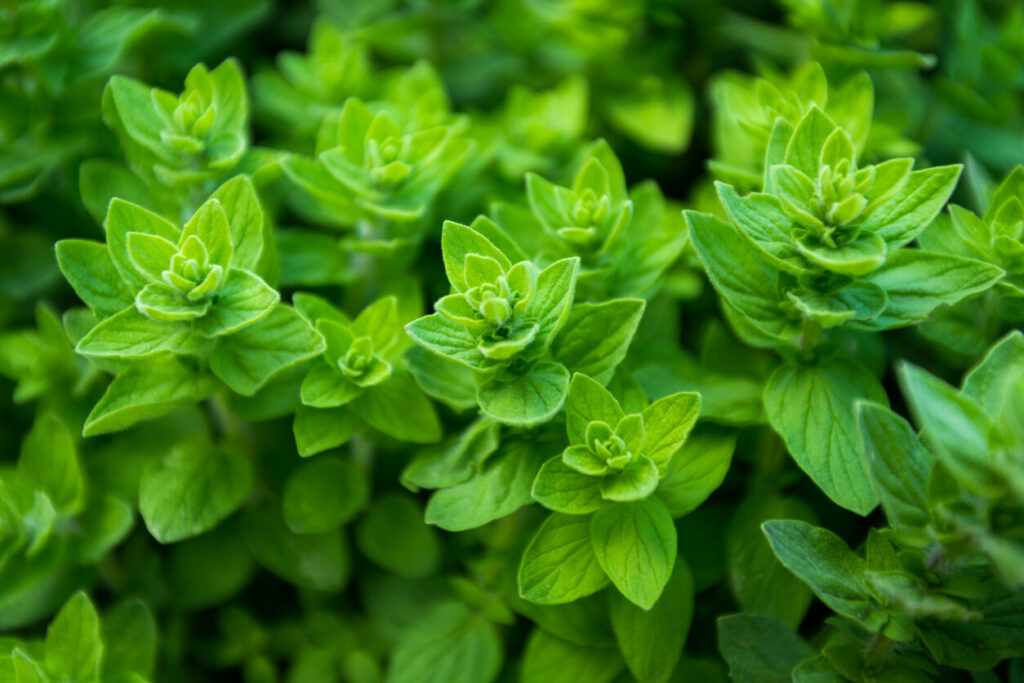
Flavor profile
Taste & aroma
Spicy, sharp, grassy — Spicy, tart, with a pleasant peppery bitterness. A warm, woody scent.
Spicy, tart, with a pleasant peppery bitterness. Much brighter and more concentrated than an adult plant - even a fresh one
Warm, woody, spicy - Mediterranean in its pure form, opens from heat and when touching the leaf, it feels more restrained on a cold dish.
Gentle, thin, velvety — the classic texture of labial flowers. The leaves are small, they are not cut - they are put whole
Why flavor may vary batch to batch
Thymol and carvacrol — the main essential oils of oregano — are synthesized more actively when bright light and a temperature of +20...+24°C. At in low light or in a cold room sprouts grow without a characteristic aroma - they smell just like neutral grass. Oregano is one of the most demanding microgreens for lighting. Without high-quality phytolamps, it is very difficult to get a fragrant product.
Culinary use
How to use
Oregano is a great culinary accent. Add fresh at the end of cooking or directly on the plate.
pizza
put on top after removing from the oven, do not bake. From the heat, the aroma is revealed in seconds, essential oils do not burn out
Pasta with tomato sauce
a few stalks instead of dry oregano. The taste is brighter, the appearance is neater
Caprese
mozzarella, tomato, basil and oregano together. Two spicy accents on one plate, but each with its own character
Baked feta
softened cheese with a few stalks of oregano and olive oil - a minimalist Mediterranean snack
Steak or burger
a few stems on top after cooking. It looks sophisticated and tastes like a restaurant
Greek salad
instead of dry oregano. The textural difference and fresh aroma are noticeable immediately
Perfect pairings
The heat of the dough instantly reveals essential oils — the effect is many times stronger than that of dry seasoning
Oregano and tomato are a classic Mediterranean pairing that needs no justification
A few stalks on top of hot meat is a minimalist restaurant presentation
- Do not bake inside the dish: with prolonged heating, essential oils burn out, only bitterness remains. Oregano is added after, not during, cooking.
- Do not use as a base for salad: it is impossible to eat a whole plate of micro-oregano with a fork: it is a spice, an excessive amount will give an aggressive bitterness.
- Do not combine with other very intense spicy greens: oregano and dill, or oregano and coriander in one dish — a conflict of flavors without a winner.
- Do not cut: when cutting, the knife squeezes out essential oils, the leaf darkens and loses its marketable appearance in a few minutes. Place whole stalks.
Home storage
How to store
Oregano keeps longer than most microgreens. Follow simple rules to keep it fresh for up to 3 weeks.
Don't cut more than you plan to eat right away. Store in refrigerator at +4...+6°C. No watering needed — natural moisture is enough.
Place in an open container or plate, cover with a damp paper towel. Don't seal — without air, greens yellow faster.
Don't wash until ready to eat. Wet greens spoil much faster. Rinse just before serving.
Nutrients & health
Benefits & composition
Oregano is valued for its rich vitamin-mineral composition and bioactive compounds typical of microgreens.
Like most microgreens, oregano contains a concentrated amount of nutrients relative to its weight — many times more than the mature plant.
| Protein | 4.0 g — building material for cells |
|---|---|
| Calories | ~30 kcal |
| Vitamins | K |
| Minerals | Calcium |
- Through high concentration of essential oils in microgreens, pregnant women are recommended to use oregano in cooking quantities (several stalks) — without excess. Large doses of Lilium essential oils are traditionally considered undesirable during pregnancy.
- To people from individual sensitivity to bitterness or a specific aversion to tart flavors — oregano can be too intense even in small amounts.
This information is general in nature and is not medical advice. Composition data: USDA FoodData Central.
Worth knowing
antioxidant potential (ORAC)
Oregano is one of the leaders in antioxidant potential (ORAC) among all known herbs and spices — ahead of most berries and fruits on a per gram basis. This is due to the extremely high concentration of flavonoids and phenolic compounds.
Carvacrol and thymol
Carvacrol and thymol—the main essential oils of oregano—are being actively researched as natural antimicrobial agents. That is why oregano is traditionally present in Mediterranean cuisine, where a hot environment could accelerate the spoilage of products.
a concentrated source of calcium and iron
Oregano is an extremely concentrated source of calcium and iron - although due to microdosing, these indicators do not significantly affect the daily intake of minerals.
Antioxidants and biologically active substances
Microgreens are a concentrated source of antioxidants — compounds that are being studied in the context of protecting cells from oxidative stress. Regular consumption of a variety of microgreens is part of a balanced plant-based diet.
Similar crops
Similar by taste microgreens
If you are looking to complement or replace Oregano:
Oregano: how to grow — step-by-step guide
Growing parameters, agronomy, common mistakesGrowing parameters
Sawdust, ethereal culture
Watering
- Water it 1 time a day (in the morning) with small watering
- Bottom watering or fine mist - avoid excess moisture
- Oregano is a drought-resistant plant that tolerates slight drying
- A sign of lack: tiny leaves fade → moisten gently
Storage
| Uncut in tray | Fridge +4...+6°C | up to 3 weeks |
|---|---|---|
| Cut in container | Refrigerator | up to 7 days |
| Room temperature | 1–2 days |
Harvest
2–3 pairs of real leaves, the plant smells when touched, height 4–6 cm. If there is no aroma, it is early, give another 3–5 days. Aroma is the main criterion, not appearance or height.
Manicure scissors — the plants are delicate. Cut whole stems, do not cut leaves separately. Avoid excessive touches to the leaves: the velvety surface is damaged and darkens.
Carefully submerge in cold water for a second, shake slightly. Dry naturally. Pack immediately—cut oregano darkens within a few hours.
Seasonal adjustments
- Soaking: reduce by 2–3 hours from the standard - the seeds are active in the heat
- Ventilation: open more often in the blackout phase to avoid excess moisture
- Watering: increase the frequency - the substrate dries faster at a higher temperature
- Expect: shortening of the cycle by 2–3 days, a more tender stem
- Soaking: increase by 2-3 hours from the standard - cold water is absorbed more slowly
- Placement: keep the trays in a warmer place (next to the battery, but not close to it)
- Watering: use water at room temperature—cold slows growth
- Expect: lengthening the cycle by 2-4 days, denser and more fragrant result
Water pH and EC
Optimal range for Oregano: 6.0–8.0. Oregano is one of the most alkali-tolerant microgreens. Even at pH 8.0 (very hard water) oregano shows no problems.
Optimal range: 1.0–2.0 mS/cm. Modest consumer. The natural drought resistance of oregano gives tolerance to increased EC.
Experienced grower tips
Aroma is the only criterion for readiness
Do not look at the height and do not count the leaves. Rub a leaf - if the smell of oregano is clear, you can cut it. There is no smell - it's early. This principle does not fail.
Oregano is exclusively made to order
Cycle 20-28 days, low yield, poor storage after cutting. Growing "for storage" is a loss. If you have an order from a restaurant, it's done. No - do not sow.
Position as a premium micro-spice
"Live oregano instead of dry" is a clear message for the chef. The aroma is 5-7 times brighter than that of dry seasoning - this difference is noticeable and sells itself.
A fog generator is mandatory equipment
As for mint and thyme - without it, it is impossible to water the first two weeks without destroying the crops. Ultrasonic humidifier or garden fogger.
Three dust-like crops — one technological process
Oregano, thyme and mint have almost identical agricultural techniques. If you have mastered one, the rest follow the same pattern. Grow them in parallel for more efficient use of equipment and time.
Agronomy notes and common mistakes
- Sowing: No soaking. Extremely high density - tiny seeds in a thin layer.
- Clamp: Without clamping.
- Temperature: +20...+26°C. Oregano is very heat-loving - it almost does not grow below +18°C.
- Watering: 1 time a day or every other day. Oregano is drought-resistant - less moisture than for others.
- Ventilation: It is important. A warm microclimate without ventilation is a risk of mold on slow sprouts.
- Sprinkle seeds with substrate → Zero or minimal germination → Sow only superficially - seeds need light
- Watering with a sprayer → Seeds washed into piles, uneven islands → Only fogger for first 2 weeks
- Using a clamp → The seeds stick to the cover and die → Only the greenhouse film — no weight
- Sharp removal of the film → Sprouts dry in a few hours → Gradual hardening 3–4 days
- Cut without aroma (too early) → Greens without character, the restaurant is disappointed → Waiting for the aroma when touched is the only accurate criterion
- Selling cut → Green darkens before delivery → Sell only live tray
Variety selection
Greek oregano
Origanum vulgare subsp. hirtum
The most intense aroma. A classic of Mediterranean cuisine — a distinct spicy profile.
Oregano is common
O. vulgare, Marjorana
A slightly softer aroma. Suitable for dishes that require a delicate spicy note without harshness.
Що далі?
More crops in the catalog
Explore similar and contrasting flavors — from basil to amaranth