Flavor profile
Taste & aroma
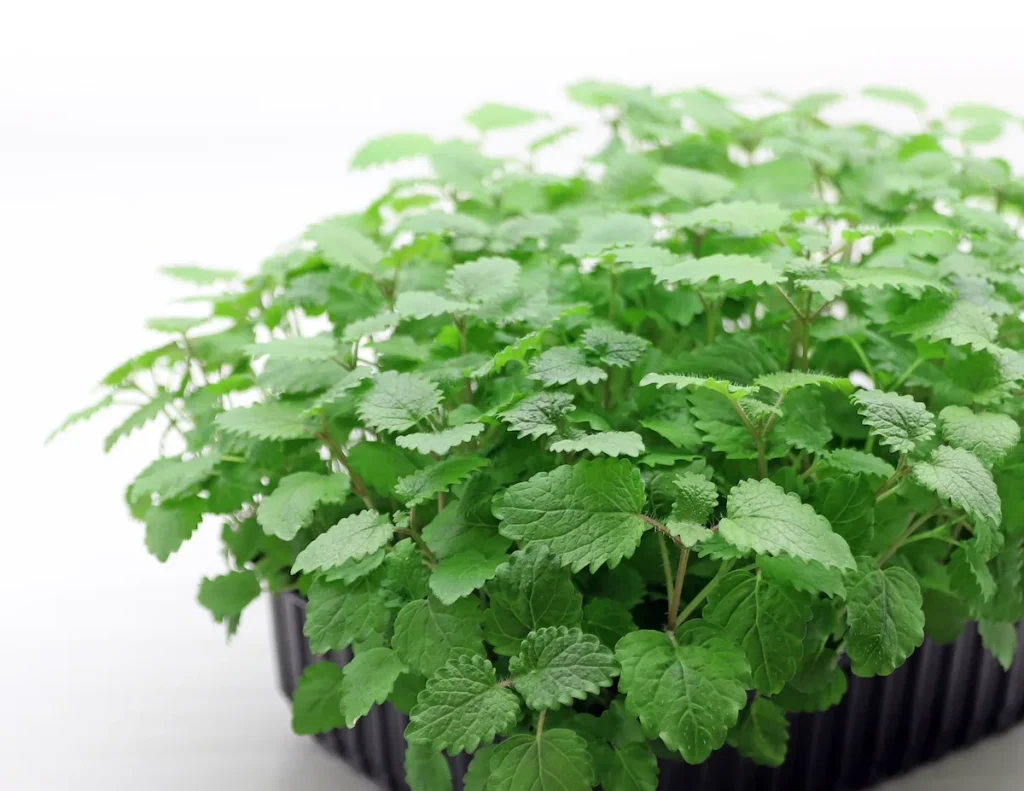
Refreshing, spicy, citrus - just a mild citrus sweetness. Strong, lemony aroma.
just a mild citrusy sweetness. The taste is much milder than the aroma: if the aroma "screams lemon", then the taste is only hinted at
Powerful, lemony, honey-floral - citral opens instantly upon touching a leaf and aromatizes even a glass of water.
Gentle, velvety - the leaves are slightly hairy to the touch. Thin stems
Why flavor may vary batch to batch
The lemon aroma of lemon balm is formed thanks to citral and citronellal. The intensity depends on the lighting: at bright light (+18...+22°C) more essential oils - the aroma is rich and lemony. At weak light or heat above +26°C the aroma weakens and becomes more grassy. Melissa is a slow culture (14-18 days), patience is the key condition for a quality result.
Culinary use
How to use
Lemon Balm is a great culinary accent. Add fresh at the end of cooking or directly on the plate.
Lemonade with lemon balm
water + lemon + honey + a few stalks of lemon balm, leave for 15 minutes - the easiest and most effective way to use
Mojito without mint
lemon balm instead of mint - a softer and sweeter version with a lemon accent
Panna cotta or cheesecake
2-3 leaves on top when serving — and the dessert smells like a summer garden
Baked salmon
put a sprig of lemon balm on top for 2 minutes before the end of baking - the aroma will enter the fish without bitterness
Fruit salad
strawberry + mango + lemon balm + a drop of honey — minimal and aromatic
Homemade tea
boiling water + a handful of lemon balm + honey. Do not boil - just pour boiling water and cover for 5 minutes
Perfect pairings
Lemonade, panna cotta, salmon are the best combinations
Melissa is a classic ingredient in lemonades, iced teas and cocktails with a lemon-mint profile
Chocolate and lemon balm is a classic combination
- Do not subject to long-term heat treatment - essential oils evaporate when heated above +60°C, lemon balm turns black and loses all its aroma
- Do not combine with very sharp flavors (garlic, hot pepper) - the delicate aroma of lemon balm is completely lost
- Do not keep it cut for a long time - the aroma disappears much faster than withered leaves; it is better to sell and buy live in a tray
Home storage
How to store
Lemon Balm keeps longer than most microgreens. Follow simple rules to keep it fresh for up to 7–10 days.
Room temperature or a cool place out of direct sunlight. Cut immediately before use - freshly cut lemon balm smells the brightest. The term in the tray is up to 7–10 days.
Place in an open container or plate, cover with a damp paper towel. Don't seal — without air, greens yellow faster.
Don't wash until ready to eat. Wet greens spoil much faster. Rinse just before serving.
Pro tip: Lemon balm is the only crop in the catalog that is better stored and sold **alive in a tray**, rather than cut. The aroma of cut lemon balm diminishes day by day, while a living plant retains it and grows back after cutting.
Nutrients & health
Benefits & composition
Lemon Balm is valued for its rich vitamin-mineral composition and bioactive compounds typical of microgreens.
Like most microgreens, lemon balm contains a concentrated amount of nutrients relative to its weight — many times more than the mature plant.
| Protein | 3.0 g — building material for cells |
|---|---|
| Calories | ~29 kcal |
| Vitamins | C, A |
| Minerals | Magnesium, Potassium, Iron |
- For people with low blood pressure - lemon balm is traditionally considered to be able to lower blood pressure; if prone to hypotension, use sparingly
- Pregnant and lactating women should consult a doctor before regular use in large quantities
- Melissa in culinary quantities (a few leaves as a seasoning or decoration) is safe for the vast majority of people
This information is general in nature and is not medical advice. Composition data: USDA FoodData Central.
Worth knowing
Citral and citronellal
essential oils that give lemon balm a characteristic lemon aroma. These same compounds have traditionally been studied in the context of a calming effect on the nervous system — lemon balm has long been used in herbal medicine as a means to support sleep and reduce anxiety.
Magnesium
is contained in lemon balm and is traditionally associated with the support of the nervous system and muscle relaxation.
Vitamin C
present in fresh green lemon balm in noticeable quantities.
Antioxidants and biologically active substances
Microgreens are a concentrated source of antioxidants — compounds that are being studied in the context of protecting cells from oxidative stress. Regular consumption of a variety of microgreens is part of a balanced plant-based diet.
Similar crops
Similar by taste microgreens
If you are looking to complement or replace Lemon Balm:
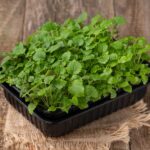
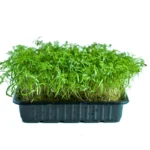
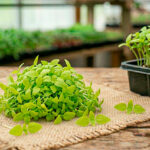
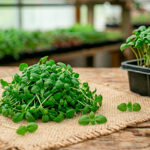
Lemon Balm: how to grow — step-by-step guide
Growing parameters, agronomy, common mistakesGrowing parameters
Dusty, ethereal - one of the smallest among microcultures
Step-by-step guide
Seed preparation
Lemon balm seeds are dust-like - smaller than most essential oil crops. When soaked, it sticks together into an inseparable mass and dies. Soaking is strictly prohibited.
Sow only dry.
Sowing is a piece of jewelry
Sowing lemon balm differs from all other crops in two basic rules:
Rule 1: Seeds are not sprinkled with substrate. Melissa does not have the strength to break through even a thin layer of soil. The seeds remain on the surface.
Rule 2: Water only with mist. The coarse jet of the atomizer will wash away the seeds - you need a finely dispersed "mist", not a drop.
Sowing order:
- Prepare the substrate: a flat, compacted, well-moistened surface
- Spread the seeds evenly on the surface — 0.6–0.7 g per tray
- Moisten carefully with a "mist" from a fine atomizer
- Cover with a film or dome
Due to the dust-like size of lemon balm seeds, it is convenient to sow through a sheet of paper folded several times - pour the seeds on the paper and gently tap the edge above the tray. This gives better control of uniformity than sowing by hand.
Greenhouse effect — instead of darkness and pressure
Melissa is an exception to the general rule: her complete darkness is not required at the start Diffused light under the film accelerates germination.
- Cover the tray with transparent film or a dome with a small gap
- Goal: 100% humidity and diffused light at the same time
- Do not remove until the appearance of confident green shoots (5–7 days)
Do not remove the film abruptly. The delicate microscopic sprouts are used to 100% humidity. An abrupt removal of the dome—a sudden drop in humidity—kills them in a few hours. Remove gradually: first a few hours during the day, then more. Adaptation takes 2-3 days.
Vegetation in the light — 14–20 days
Watering is a key parameter for lemon balm:
- The first 10–14 days: only "mist" spraying from above. The roots are too short for bottom watering - the water from the tray simply will not reach
- Z on the 14th day: you can carefully switch to lower watering through a pallet - the roots have already developed sufficiently
- A rough jet at any time is prohibited
Nutrition from the 14th day: melissa - a long cycle, seed reserves are exhausted. A weak solution of complex fertilizer (nutritional profile, EC not higher than 0.8) from the 14th day improves growth and aroma saturation.
Lighting:
- LED phytolamps: 16–18 hours a day
- Moderate intensity - with too strong light, the leaves may dry out at the edges
- The aroma (citral) is synthesized when there is enough light — in low light, lemon balm grows, but the aroma is weak
Temperature: +18...+22°C. In case of overheating (+26°C and above), essential oils partially evaporate directly during growth - the aroma weakens.
Ventilation: moderate Without drafts - delicate stems break from a sharp blow.
Watering
- Water it 1 time a day (in the morning) with light watering or misting
- Bottom watering or shallow top watering - be careful
- Melissa is very slow and delicate: do not overmoisturize
- A sign of lack: tiny leaves become dull → moisturize very carefully
Storage
| Uncut in tray | Fridge +4...+6°C | up to 3 weeks |
|---|---|---|
| Cut in container | Refrigerator | up to 7 days |
| Room temperature | 1–2 days |
Harvest
- 2–3 pairs of true carved leaves (resembling nettle leaves) are formed
- A distinctive lemon aroma appeared when touching the leaf - this is the main indicator of readiness
- Height 5–8 cm
Manicure scissors or a very sharp knife - the stems are thin and tender, a blunt tool cuts, not cuts.
— the optimal format for lemon balm. Cut greens quickly lose their aroma, and a live tray on the windowsill preserves them for weeks.
Seasonal adjustments
- The aroma weakens: at +26°C and above, essential oils (citral) partially evaporate directly during growth - place the trays in the coolest part of the room
- Cycle and humidity: the long cycle of lemon balm (20–27 days) in the heat requires daily control of substrate humidity — drying is critical
- Lighting: limit the intensity - with a powerful summer sun, the edges of the leaves dry up
- Dome: keep sealed in heat to retain moisture and slow evaporation of essential oils
- Expect: weaker aroma and thinner leaves compared to the winter harvest
- Ideal season: coolness slows down the evaporation of citral - the aroma is the most powerful and persistent
- Cycle: is extended by 3–5 days, but the quality of the leaves and the richness of the aroma are at their peak
- Dry air: humidity drops due to heating - increase the frequency of finely dispersed humidification under the dome
Water pH and EC
The optimal range for lemon balm: 6.0–7.5. Lemon balm is unpretentious to pH - in nature it grows on various types of soil. Ordinary tap water is suitable without adjustment.
Optimal range: 1.0–1.5 mS/cm. Melissa is unpretentious to nutrition. An excess of nitrogen gives lush greenery, but with a lower content of essential oils, the main quality indicator for this crop.
Experienced grower tips
A live tray is the only correct sales format
Cut lemon balm loses half of its aroma in 3 days. A living tray gives the buyer the opportunity to cut fresh greens every day - this is the main value. Market as a "living fragrant garden in a pot".
Readiness test - touch and smell
The aroma when touching a leaf is the only reliable indicator of readiness. If it smells strongly of lemon when touched, it's ready. If it is grassy and neutral - a few more days.
Pair seeding for a continuous supply
Due to the long cycle (up to 27 days), lemon balm requires a well-thought-out sowing schedule. Two trays with an interval of 10-14 days — and you always have a ready-made culture.
Melissa + lemon basil on sale
Both cultures have a lemony aroma, but a different profile. Basil is faster and easier to grow, lemon balm is more difficult and expensive. Offer both - the client will choose or take both for comparison.
Agronomy notes and common mistakes
- Sowing: No soaking. Very high density - tiny seeds in a thin, even layer.
- Clamp: Without clamping.
- Temperature: +18...+22°C. A moderate temperature is ideal.
- Watering: 1 time a day, carefully. Melissa is one of the slowest and most delicate.
- Ventilation: moderate Tender seeds and sprouts need protection from drafts.
- Soaking seeds → Sticky mass, zero steps → Only dry sowing
- Weight press → Sprouts break, seeds stick → Only film or dome
- Sprinkle seeds with substrate → Seeds do not germinate - there is no strength to break through → Leave on the surface
- Sharp removal of the film → Sprouts die in a few hours → Gradual adaptation 2–3 days
- Rough watering with a jet → The seeds are washed away, the crop is destroyed → Only finely dispersed "fog" for the first 14 days
- Weak lighting → Weak or absent lemon aroma → Phytolamps, sufficient intensity
- Overheating (+26°C and above) → The aroma is weak, the leaves dry up → Keep at +18...+22°C
Variety selection
Medicinal Melissa
Lika, Bayaliyska, Citrina
Standard selection. Lemon-mint aroma, even germination, unpretentiousness.
Melissa garden
Lemon, Honey
A slightly more intense aroma. The taste is similar - the same citrus-mint profile.
Що далі?
More crops in the catalog
Explore similar and contrasting flavors — from basil to amaranth