
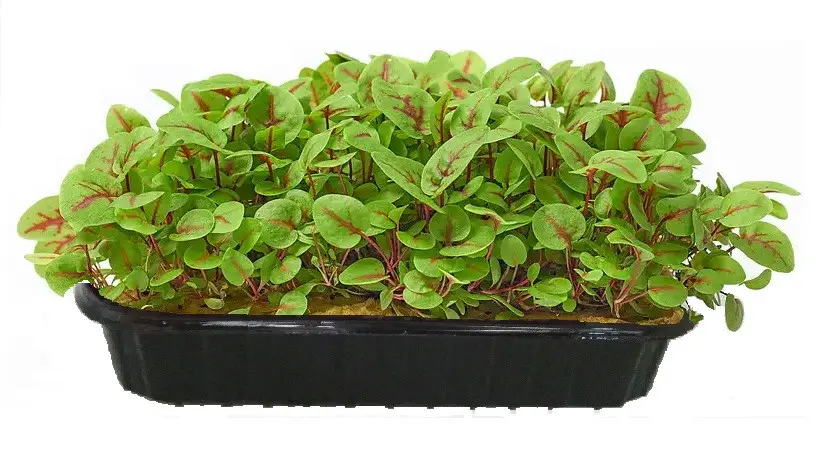
Flavor profile
Taste & aroma
Sour, refreshing, grassy - like lime or green apple, but with a nice grassy freshness. Light citrus aroma.
like lime or green apple, but with a nice grassy freshness. No bitterness, no spiciness — pure refreshing acid
Light, citrus, spring. Unobtrusive - the aroma enhances the impression of taste, but does not dominate by itself.
Gentle, but elastic. The leaf pleasantly "flakes" on the teeth
Why flavor may vary batch to batch
The sour-lemon taste of sorrel depends on the content of oxalic and malic acids. At warm cultivation (+22°C and above) acidity is higher. At cool (+14...+18°C) — the taste is more balanced, with a gentler acidity. The saturation of red veins depends on the lighting: in bright light, anthocyanins are synthesized more actively and the leaf pattern is brighter.
Culinary use
How to use
Sorrel 'Bloody Mary' is a great culinary accent. Add fresh at the end of cooking or directly on the plate.
Oyster or scallop
one leaf on top instead of a drop of lemon — Michelin aesthetics
Salmon carpaccio
3–5 leaves are laid out on a fish — a red pattern on a pink background
Panna cotta or meringue
sorrel leaves + berries — acid and color as a final touch
Sauer or Aperol
a leaf on the tap of the glass or on the surface of the drink - an instant upgrade of the service
Tuna tartare
sorrel in the filling and on top - acid instead of lemon inside the dish
Creamy pea or asparagus soup
2–3 leaves from above when serving — green-red contrast
Perfect pairings
Salmon, scallop, oyster - oxalic acid replaces lemon and looks hundreds of times more impressive
The contrast of color and taste — bright red veins on a white or cream background — looks flawless
A leaf in a glass — and an ordinary cocktail takes on the level of an author's drink
- Do not cut at the cotyledon stage - without red veins, it is just sour green microgreens without decorative value
- Do not use in large quantities as the basis of a dish - the intense acid will dominate
- Do not subject to heat treatment - heat destroys the color and texture instantly
Home storage
How to store
Sorrel 'Bloody Mary' keeps longer than most microgreens. Follow simple rules to keep it fresh for up to 14 days (продовжує рости).
Refrigerator +2...+5°C. Cut the leaves one at a time just before serving - the "baby leaf" method. The tray continues to grow after the cut.
Hermetic container, refrigerator +2...+5°C. The term is 5–7 days. Sorrel is tender - the leaves darken from pressure and moisture. Keep in one layer.
Don't wash until ready to eat. Wet greens spoil much faster. Rinse just before serving.
Nutrients & health
Benefits & composition
Sorrel 'Bloody Mary' is valued for its rich vitamin-mineral composition and bioactive compounds typical of microgreens.
Like most microgreens, sorrel 'bloody mary' contains a concentrated amount of nutrients relative to its weight — many times more than the mature plant.
| Protein | 2.0 g — building material for cells |
|---|---|
| Calories | ~22 kcal |
| Vitamins | C, A |
| Minerals | Iron, Magnesium, Potassium |
- For people with high acidity of the stomach, gastritis or ulcers - sorrel can increase discomfort; use with caution or avoid
- With a tendency to the formation of kidney stones (oxalate) - oxalates in sorrel can be relevant; for specific appointments, you should consult a doctor
- In cooking amounts (decor, a few leaves) is safe for most people
This information is general in nature and is not medical advice. Composition data: USDA FoodData Central.
Worth knowing
Vitamin C
in sorrel is contained in a significant concentration - the sour taste is due to organic acids in combination with vitamin C.
Anthocyanins
in red veins are pigments with antioxidant properties characteristic of red-pigmented plants.
Oxalic acid (oxalates)
natural organic acid that gives sorrel its characteristic sour taste. When used in culinary quantities (a few leaves as a decoration or accent) is safe for most people.
Antioxidants and biologically active substances
Microgreens are a concentrated source of antioxidants — compounds that are being studied in the context of protecting cells from oxidative stress. Regular consumption of a variety of microgreens is part of a balanced plant-based diet.
Similar crops
Similar by taste microgreens
If you are looking to complement or replace Sorrel 'Bloody Mary':
Sorrel 'Bloody Mary': how to grow — step-by-step guide
Growing parameters, agronomy, common mistakesGrowing parameters
Very small
Step-by-step guide
Seed preparation
The seeds are very small. Without soaking - sow dry. Do not sprinkle the seeds with substrate - sorrel, like lemon balm, does not have enough strength to break through the soil layer.
Sowing
- Prepare the substrate: a flat, compacted, well-moistened surface
- Sprinkle evenly 0.2 g seeds on the surface — the seeds remain on the surface without being sprinkled
- Moisten carefully with a "mist" from a fine atomizer
- Cover with film or dome immediately
0.2 g is literally the minimum amount. Sow through a folded sheet of paper or a micro spatula for even distribution. Every seed counts.
Greenhouse effect — 6–8 days
Weight press forbidden — tender sprouts die from mechanical pressure.
- Transparent film or dome with a small gap
- Goal: 100% humidity at all times under the dome
- The smallest loss of moisture at the start is the death of seeds. Check daily
Drying out under the film is the main risk of sorrel at the start. The substrate must remain consistently moist all the time under the dome. Even a few hours without moisture can destroy the entire crop at the stage of hatching.
Vegetation in the light — 20–30 days
Stages of development and what to expect:
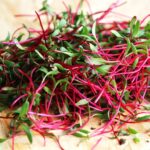
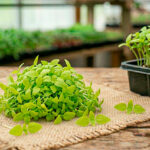
Week 1–2 in the light (cotyledons): Small green cotyledons appear without any red pattern. It is normal - do not cut, do not be disappointed. Red veins will appear only on real leaves.
Week 3-4 in the light (true leaves): The first real leaves are formed - larger, with a characteristic sorrel shape. The red streak pattern is starting to show. This is the moment of waiting.
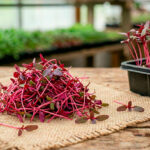
Week 4–5 (full decorativeness): 2–3 pairs of leaves with a pronounced red pattern — the product is ready.
Lighting:
- LED phytolamps: 16–18 hours a day
- Moderate intensity - with too strong light, the leaves may dry out at the edges
- High-quality lighting enhances the saturation of the red pattern
Temperature: +20...+23°C is optimal. At higher temperatures, growth is somewhat accelerated, but there is a risk of drying out.
Watering: very careful bottom through pallet. Sorrel grows slowly, the roots develop weakly - the substrate easily "sours" with excess moisture. Check the moisture before watering, rather than watering on a schedule.
Watering
- Water it 1-2 times a day (in the morning - necessarily, in the evening - if necessary)
- Bottom watering through a pallet - preserves the rich red color of the stems
- Sorrel is cool - at +16°C it needs less watering
- A sign of lack: bright red stems fade and curl slightly → pour through pan
Storage
| Uncut in tray | Fridge +4...+6°C | up to 3 weeks |
|---|---|---|
| Cut in container | Refrigerator | up to 7 days |
| Room temperature | 1–2 days |
Harvest
- 2–3 real leaves with a clear red pattern of veins are formed
- When touched, the leaf is elastic and fragrant
Manicure scissors, selectively — the "baby leaf" method. Cut off the largest ready leaves, leaving the smaller ones to grow. The tray continues to produce new leaves after partial harvesting.
In a single layer in a sealed container - the leaves darken from the pressure.
Seasonal adjustments
- Drying: the risk of losing the crop under the film increases dramatically - check the moisture daily, maybe twice a day
- Lighting: in the heat, reduce the intensity or move the lamp away - with too strong light, the edges of the leaves dry out
- Cycle can be reduced to 25-30 days - watch for the appearance of real leaves and do not focus on the standard 35-40 days
- Substrate humidity: water more carefully, but more often - in the heat, the substrate dries out, and excess moisture acidifies the roots
- Expect: weaker saturation of the red pattern — heat reduces the intensity of the anthocyanin pigment
- Perfect season for sorrel: coolness reduces the risk of drying and acidification of the substrate, increases the saturation of the red pattern
- Cycle extends to 40–45 days — do not rush to cut, wait for the maximum development of the drawing
- Lighting: with a short winter day, the saturation of the red pattern weakens - illumination of 16–18 h is critically important for decorativeness
Water pH and EC
The optimal range for sorrel: 6.0–7.0. Sorrel is unpretentious to pH - in nature it grows on various types of soil. Normal tap water is fine.
Optimal range: 1.0–1.5 mS/cm. Sorrel is undemanding to nutrition. Excess nitrogen can increase acidity - take this into account when growing hydroponically.
Experienced grower tips
Selling individually or in small bundles is the only correct model
With an output of 10–12 g from the tray and a cycle of 30–40 days, mass sales by weight do not pay off. The target audience is chefs of haute cuisine restaurants, for whom 5-10 leaves per dish is enough and they are ready to pay the appropriate price.
The "baby leaf" method extends the life of the tray
Cut off the largest finished leaves, leaving the smaller ones. The tray continues to produce new leaves for another 2-3 weeks after the first harvest — making better use of your 40-day investment.
Photo is half of the sale
A bright green leaf with a red network of veins looks incredible in the photo. A well-lit photo of a single leaf on a white plate is the best marketing tool for this crop.
Double sowing every 2 weeks
With a cycle of 30–40 days, in order to have a finished product every week, you need to keep 4–5 trays in circulation at different stages. Crop planning is critical for continuous supply.
Agronomy notes and common mistakes
- Sowing: No soaking. Medium-high density.
- Clamp: Light or no pressure.
- Temperature: +16...+22°C. Cool culture with beautiful red stems.
- Watering: 1-2 times a day. When it's cool (+16°C) — once a day.
- Ventilation: moderate
- Section at the cotyledon stage → Green leaves without red veins — no decorative value → Wait for real leaves — 30–40 days
- Drying under the film → Seeds die, zero germination → Check humidity daily, maintain 100%
- Sprinkle seeds with substrate → Seeds do not penetrate → Leave on the surface
- Weight press → Tender sprouts are damaged → Only dome or film
- Expecting a quick result → Week 2 disappointment → 30-40 days is a normal cycle, the longest in the catalog
- Excess moisture → The substrate sours, the roots rot → Water as needed, not according to the schedule
Variety selection
Sorrel Bloody Mary
Rumex acetosa Bloody Mary
Profile variety with bright red veins. Sour taste and spectacular appearance at the same time.
Common sorrel
Rumex acetosa is green
Less decorative, but somewhat more stable in cultivation. The taste is more sour and pronounced.
What's next?
More crops in the catalog
Explore similar and contrasting flavors — from basil to amaranth