
Flavor profile
Taste & aroma
Fresh, mustardy, spicy - reminiscent of a mixture of arugula and young cabbage. Subtle, spicy aroma.
resembles a mixture of arugula and young cabbage. The sharpness is delicate: it "tickles" the receptors, but does not burn
Thin, spicy, grassy. No sharpness. The aroma is revealed when the leaf is lightly kneaded.
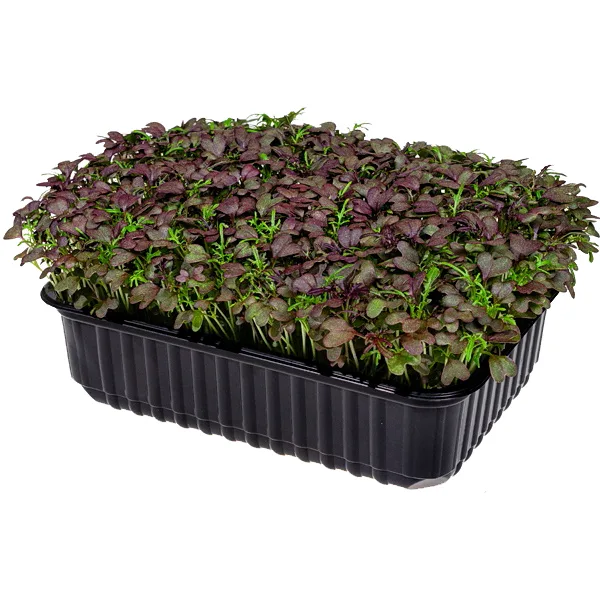
Gentle, Thin, Elastic - the main decorative value: dark maroon "corals" add volume and sophistication to the dish, unattainable by any other culture. The main difference from green mizuna is the color: dark purple or burgundy instead of bright green
Ripening and optimal harvest time
The cotyledons are opened, the color is still uneven, the taste is clean and mild.
The first carved leaf, the color is as saturated as possible, the sharpness at its peak is the optimal moment.
The leaf grows, the sharpness intensifies, the stem hardens.
Why flavor may vary batch to batch
The purple-burgundy color of red mizuna is anthocyanins, which are synthesized only under the influence of intense lighting. In the first days of the growing season, mizuna may look green or dirty brown - this is normal and not a sign of a problem. A rich dark color appears on the 5th-6th day of vegetation with sufficient lighting. In low light, it remains pale green with a faint blush.
Culinary use
How to use
Mizuna (Red) is a great culinary accent. Add fresh at the end of cooking or directly on the plate.
Beef or salmon carpaccio
dark burgundy "coral" mizuna on pink carpaccio is one of the most spectacular serving options in modern cuisine
Beef or tuna tartare
mizuna as a decoration and taste accent — the spiciness emphasizes the raw taste of the meat
Meat salad with bacon
mustard spiciness of mizuna + fattiness of bacon = classic contrast
Brie or Camembert cheese
a handful of mizuna next to or on top — and the cheese plate takes on the appearance of a restaurant serving
Sandwich with turkey or chicken
instead of ordinary mustard or sauce, mizuna gives the same sharpness and crunch
Pumpkin or tomato cream soup
a few twigs above — a dark carved leaf on a cream surface
Perfect pairings
A few sprigs of red mizuna on a plate — and the serving immediately acquires a restaurant level
The mustard spiciness of the mizuna balances the fattiness of the fried meat and gives a bright color contrast
The dark color of the leaf looks impressive on the white surface of the cheese
- Do not add to hot dishes - the tender leaf instantly withers and darkens from the heat, the decorative effect disappears
- Don't expect "fiery" spiciness — it's not mustard or wasabi; mizuna is delicate
- Do not add to children without warning - they usually do not like the taste of mustard
Home storage
How to store
Mizuna (Red) keeps longer than most microgreens. Follow simple rules to keep it fresh for up to 10–12 days.
Keep at +4...+6°C in the refrigerator. The term is up to 10–12 days.
Place in an open container or plate, cover with a damp paper towel. Don't seal — without air, greens yellow faster.
Don't wash until ready to eat. Wet greens spoil much faster. Rinse just before serving.
Pro tip: **Practical hint for the grower:** Mizuna red is a culture with the highest decorative value with simple agricultural techniques. The cycle is 1-2 days longer than green, but the result is worth the wait. Position as "mizuna premium" - for restaurants where presentation is important.
Nutrients & health
Benefits & composition
Mizuna (Red) is valued for its rich vitamin-mineral composition and bioactive compounds typical of microgreens.
Like most microgreens, mizuna (red) contains a concentrated amount of nutrients relative to its weight — many times more than the mature plant.
| Protein | 2.0 g — building material for cells |
|---|---|
| Calories | ~22 kcal |
| Vitamins | C |
| Minerals | Iron, Calcium, Phosphorus |
- People with increased acidity of the stomach should consume moderately in large quantities - mustard oils can increase irritation.
- With individual intolerance to cruciferous vegetables (cabbage, broccoli, radish) - mizuna belongs to the same family.
This information is general in nature and is not medical advice. Composition data: USDA FoodData Central.
Worth knowing
Mizuna red combines
Red mizuna combines two types of active compounds: anthocyanins (for color) and isothiocyanates (for pungency). Both types are of scientific interest in the context of antioxidant and anti-inflammatory nutrition. The culture is very low-calorie (~25 kcal) - it can be added to dishes without restrictions.
Antioxidants and biologically active substances
Microgreens are a concentrated source of antioxidants — compounds that are being studied in the context of protecting cells from oxidative stress. Regular consumption of a variety of microgreens is part of a balanced plant-based diet.
Antioxidants and biologically active substances
Microgreens are a concentrated source of antioxidants — compounds that are being studied in the context of protecting cells from oxidative stress. Regular consumption of a variety of microgreens is part of a balanced plant-based diet.
Antioxidants and biologically active substances
Microgreens are a concentrated source of antioxidants — compounds that are being studied in the context of protecting cells from oxidative stress. Regular consumption of a variety of microgreens is part of a balanced plant-based diet.
Similar crops
Similar by taste microgreens
If you are looking to complement or replace Mizuna (Red):
Mizuna (Red): how to grow — step-by-step guide
Growing parameters, agronomy, common mistakesGrowing parameters
Small, round, cabbage
Step-by-step guide
Seed preparation
Red mizuna is not soaked. Small cabbage seeds germinate without preliminary treatment.
Sowing
- Moisten the substrate evenly.
- Spread the seeds evenly. The norm of 3 g is less than that of most cabbages, because mizuna grows and needs space to form a carved leaf. With thickened sowing (more than 3 g), the stems become too thin and tend to lie down.
- Spray the surface liberally with water from a spray bottle - a "mist", not a stream.
Clamp - 0.5 kg (light)
The mizuna needs only a light pressure to fix the small seeds. Heavy pressing can damage tender sprouts. It is enough to put the trays in a stack or put an empty box on top.
Darkness (Blackout) — 3–4 days
Conditions:
- Complete darkness
- Temperature: +18...+22°C
- Watering is moderate, lower
On the 2nd or 3rd day, white fluff will appear on the roots - root hairs, not mold. The test is standard: spray it with water and it will disappear.
A sign of readiness: the sprouts have raised the clamp, the height is 3–4 cm.
Vegetation in the light — 6–9 days
This is where the main thing happens for red mizuna — the formation of the color and the carved leaf.
First days: don't panic if the mizuna looks green or dirty brown. Anthocyanins begin to be actively synthesized only on the 3rd–4th day of vegetation. A rich dark color appears gradually.
Lighting is a key factor: intensive, 16 hours a day. The closer the boxes are to the lamp, the darker and more uniform the color. In low light, the mizuna remains pale green with a faint blush — this is considered a defect.
Take your time with the cut: at the red mizuna cotyledon stage, it looks like an ordinary unremarkable green. The main value is the first carved leaf with a dark color, which appears on the 8-10th day. Cutting before it appears means getting an uninteresting product at the price of restaurant decor.
Watering: moderate, lower. Water on leaves under lamps can leave "burns" - small light spots on dark leaves that are noticeable and spoil the appearance. Only through the pallet.
Mizuna red and green are a perfect pair. The same agricultural technology, the same cycle (with a difference of 1-2 days), opposite colors. Together in the mix, they mutually emphasize each other. Selling as "mizuna mix" or "lace mix" is convenient and profitable.
Watering
- Water it 1-2 times a day (in the morning - necessarily, in the evening - if necessary)
- Lower watering is better — preserves the anthocyanin color
- Similar to the green mizuna in needs
- A sign of lack: the red shade fades, the leaves curl slightly → water
Storage
| Uncut in tray | Fridge +4...+6°C | up to 3 weeks |
|---|---|---|
| Cut in container | Refrigerator | up to 7 days |
| Room temperature | 1–2 days |
Harvest
- The first real carved leaf with sharp edges and a dark color appeared
- The color is uniform dark maroon or purple throughout the box
- The stem is still tender and has not begun to coarsen
- Height 8–12 cm
Sharp knife under the root. The tender leaf is easily crushed with a blunt instrument.
Rinse very carefully in cold water before serving. Do not rub or squeeze - the carved leaf is easily deformed. Shake off the water or dry very lightly with a paper towel.
Seasonal adjustments
- Soaking: reduce by 2–3 hours from the standard - the seeds are active in the heat
- Ventilation: open more often in the blackout phase to avoid excess moisture
- Watering: increase the frequency - the substrate dries faster at a higher temperature
- Expect: shortening of the cycle by 2–3 days, a more tender stem
- Soaking: increase by 2-3 hours from the standard - cold water is absorbed more slowly
- Placement: keep the trays in a warmer place (next to the battery, but not close to it)
- Watering: use water at room temperature—cold slows growth
- Expect: lengthening the cycle by 2-4 days, denser and more fragrant result
Water pH and EC
The optimal range for Mizuna red: 6.0–7.0. Similar to the green mizuna. Anthocyanin pigments (red color) are more stable in a slightly acidic environment (pH 5.5–6.5).
Optimal range: 1.0–1.8 mS/cm. The parameters are identical to the green mizuna. Color is determined by genetics and temperature, not mineralization.
Experienced grower tips
The color comes gradually - take your time
If the mizuna is still green on the 4th day of vegetation, this is normal and not a problem. The dark color is formed between the 5th and 8th day with sufficient lighting. Patience is part of agricultural technology here.
Mizuna red + green = the simplest and most effective mix
One agricultural technique, minimal difference in the cycle, maximum color contrast. The best start for those who want to start making mix trays.
Bottom irrigation is no exception
On a dark carved leaf, any drop leaves a visible mark. One careless splash under the lamp — and the entire box looks "defective". Set the rule: pallet only.
A carved leaf is the main selling point
Photograph the mizuna at the moment when the first leaf has just opened - it is at this moment that it looks most impressive. Such photos sell themselves to restaurant customers.
Winter shelving enhances the color
At cool temperatures (+16...+18°C), anthocyanins are synthesized more actively and the color becomes darker and more stable. Plan your red mizuna production for the fall/winter season for best results.
Agronomy notes and common mistakes
- Sowing: No soaking. Medium-high density. Similar to the green mizuna.
- Clamp: Light or no pressure.
- Temperature: +15...+20°C. Coolness enhances anthocyanin color.
- Watering: 1-2 times a day.
- Ventilation: It is important. Similar to the green mizuna.
- Panic because of the color green → Grover believes that he sowed "the wrong variety" → Anthocyanins appear only on the 5th-6th day of vegetation under intense light - wait and illuminate
- Weak lighting → The plant remains pale green with a barely noticeable blush → Increase the intensity, bring the boxes closer to the lamp, 16 h/day
- Early cut (at the cotyledon stage) → An inconspicuous green mass without a carved leaf → Waiting for the appearance of the first carved leaf is the main commodity product
- Thickened sowing (more than 3 g) → Thin stems tend to lie down, uneven color → Observe the norm of 3 g
- Top watering under the lamp → Light "burnt" spots on dark leaves → Only lower watering through a tray
- Fluff/mold confusion → Grover discards healthy tray → Spray with water: root hairs will disappear
Variety selection
The mizuna is red
Red Mizuna, Red Genius
Bright burgundy or purple color of the leaves, spicy mustard taste.
Mizuna is pink
Pink Mizuna, Ruby Streaks
A gentler pink-red shade. The taste is a little softer than dark red, the decorative effect is preserved.
Що далі?
More crops in the catalog
Explore similar and contrasting flavors — from basil to amaranth