
Flavor profile
Taste & aroma
Fresh, sweet, tender - without the bitterness and sharpness of an adult plant. Light herbal aroma.
without the bitterness and sharpness of an adult plant. The taste is neutral in the best sense: it does not compete with the rest of the ingredients, but fits into any environment
Light herbal, almost imperceptible. Without the characteristic smell of boiled cabbage, the aroma of microgreens is fundamentally different.
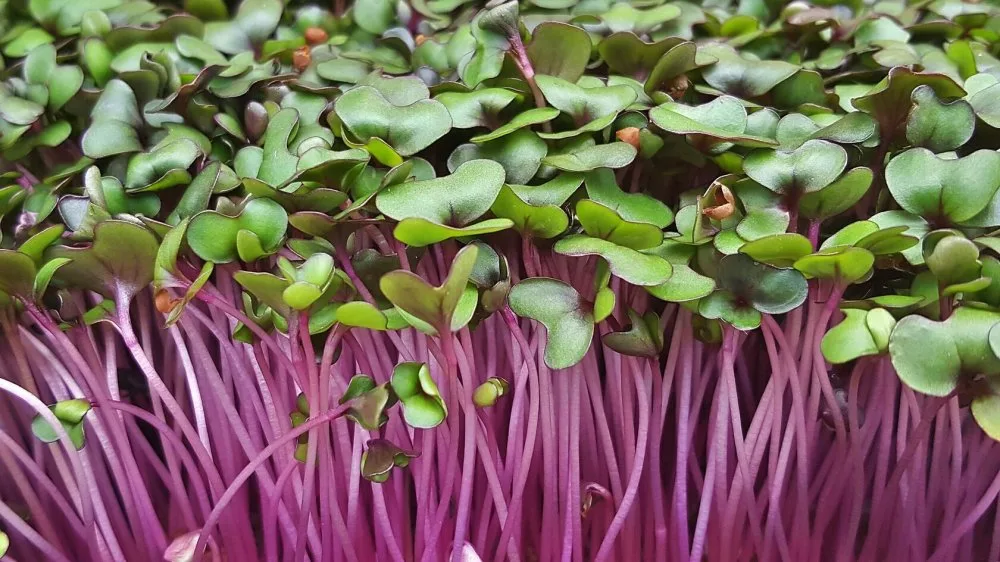
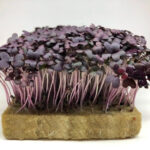
Crispy, elastic, keeps volume even in dressed salads. The stem is bright purple, dense
Ripening and optimal harvest time
The cotyledons are opened, the color is still uneven, the taste is clean and fresh.
Full pigmentation, uniform purple color, optimal moment of collection.
The first real leaf appears, the taste acquires a more pronounced cabbage character, the stem hardens.
Why flavor may vary batch to batch
The purple color of cabbage is the result of the synthesis of anthocyanins in response to intense light. In low light, microgreens grow pale green with a barely noticeable purple tint - the decorative value is significantly reduced. The brighter the lighting and the cooler the temperature (+18...+22°C), the richer and more stable the color. The refrigerator after collection even increases the saturation — the color becomes darker in the cold.
Culinary use
How to use
Purple Cabbage is a great culinary accent. Add fresh at the end of cooking or directly on the plate.
Poke Bowl
sprinkle the finished bowl on top - a uniform purple carpet on multi-colored components looks confident and stylish
Tacos or burritos
inside together with the filling instead of chopped cabbage - crunch, freshness and color without preparation
Toast with avocado and poached egg
a handful of purple cabbage between an avocado and an egg — three colors, three textures in one toast
Green or mixed salad
cabbage as the main green component or as a color accent among arugula, spinach, watercress
Hamburger or sandwich
between a cutlet and a bun as a substitute for regular cabbage — juicier and more decorative
Hummus or dip
sprinkle on top instead of paprika - the purple color on the beige background immediately makes the dish stand out
Perfect pairings
Avocado, taco, bowl - the best combinations
Purple next to avocado, rice and salmon gives maximum color contrast with minimal effort
Purple cabbage adds juiciness, color and fresh crunch — replaces chopped cabbage
- Do not pour hot sauce or boiling water on top - heat turns the color dirty blue, anthocyanins change color in alkaline and acidic environments
- Do not mix with lemon juice directly and for a long time - the acid changes the color of anthocyanins to bright pink (although sometimes this can be an interesting effect)
- Do not use where you need neutral greens without their taste - there is a cabbage note, and in some dishes it is superfluous
Home storage
How to store
Purple Cabbage keeps longer than most microgreens. Follow simple rules to keep it fresh for up to 12–14 days.
Keep at +4...+6°C in the refrigerator. The term is up to 12–14 days. The cold not only preserves, but also intensifies the saturation of the purple color - a batch that has been in the refrigerator for two days looks brighter than a freshly cut one.
Place in an open container or plate, cover with a damp paper towel. Don't seal — without air, greens yellow faster.
Don't wash until ready to eat. Wet greens spoil much faster. Rinse just before serving.
Pro tip: **Practical hint for the grower:** Purple cabbage is one of the best crops to sell both in a tray and cut. Excellent ease of use reduces risks when selling. Fun fact for marketing: the color becomes more intense after a few days in the fridge - customers who keep the tray in the fridge get a "better than yesterday" product.
Nutrients & health
Benefits & composition
Purple Cabbage is valued for its rich vitamin-mineral composition and bioactive compounds typical of microgreens.
Like most microgreens, purple cabbage contains a concentrated amount of nutrients relative to its weight — many times more than the mature plant.
| Protein | 2.5 g — building material for cells |
|---|---|
| Calories | ~32 kcal |
| Vitamins | K, E |
| Minerals | Calcium, Magnesium, Iron |
- With individual intolerance to cruciferous vegetables (cabbage, broccoli, radish), purple cabbage belongs to the same family.
- People taking blood thinners should consider their overall intake of vitamin K-rich greens.
This information is general in nature and is not medical advice. Composition data: USDA FoodData Central.
Worth knowing
Purple cabbage microgreens
Microgreens of purple cabbage contain a much higher concentration of vitamin C compared to adult cabbage — this is a characteristic feature of microgreens in the germination phase, when the plant accumulates the maximum resources for growth.
Anthocyanins are pigments
Anthocyanins — pigments from the group of polyphenols — are traditionally included in the diet as part of antioxidant nutrition. An important detail about anthocyanins: they change color depending on the pH of the environment. In acidic (lemon juice, vinegar) the color shifts to pink, in alkaline - to blue-green. This is not product spoilage, but a chemical property of the pigment.
Antioxidants and biologically active substances
Microgreens are a concentrated source of antioxidants — compounds that are being studied in the context of protecting cells from oxidative stress. Regular consumption of a variety of microgreens is part of a balanced plant-based diet.
Antioxidants and biologically active substances
Microgreens are a concentrated source of antioxidants — compounds that are being studied in the context of protecting cells from oxidative stress. Regular consumption of a variety of microgreens is part of a balanced plant-based diet.
Similar crops
Similar by taste microgreens
If you are looking to complement or replace Purple Cabbage:
Purple Cabbage: how to grow — step-by-step guide
Growing parameters, agronomy, common mistakesGrowing parameters
Small, round, dark brown
Step-by-step guide
Seed preparation
Purple cabbage is not soaked. The seeds are small and germinate quickly without pretreatment.
Sowing
- Moisten the substrate evenly.
- Spread the seeds evenly. The norm of 5 g gives a dense, but not thickened carpet. Important: with thickened sowing (more than 5 g), the plants shade each other, and the lower tier remains green instead of purple. It is uniform seeding with compliance with the norm that is a condition for obtaining an even color throughout the box.
- Spray the surface with water from a sprayer after sowing.
Clamp — 0.5–1 kg
A clamp is needed to fix the root in the substrate. Without clamping, small seeds "hang" above the surface and give uneven sprouts prone to lying down.
Rate: 0.5–1 kg — standard for small cabbage seeds.
Darkness (Blackout) — 3–4 days
Conditions:
- Complete darkness: cover with a second box or move to a dark place
- Temperature: +18...+22°C — purple cabbage likes coolness; in the heat above +24°C, the color will be duller
- Watering is moderate, lower
On the 2nd or 3rd day, white fluff will appear on the roots - root hairs, not mold. The test is standard: spray it with water and it will disappear.
A sign of readiness: the sprouts have raised the clamp, the height is 3–4 cm.
Vegetation in the light — 5–7 days
The entire decorative effect of culture is formed here.
Lighting is a key factor: anthocyanins are synthesized only with sufficient light intensity. Cabbage grows pale green in low light. Pigmentation begins to appear from the first day of vegetation and grows gradually - by 4-5 days there should be a saturated and uniform purple color throughout the box. LED lamps with an emphasis on the blue spectrum enhance the synthesis of anthocyanins. Lighting duration: 16 hours per day.
Temperature: +18...+22°C — coolness stabilizes anthocyanins and gives a richer color. At a temperature above +24°C, the color becomes duller, the leaves may dry out at the edges.
Watering: lower. Water that falls on dark leaves leaves salt stains - they are clearly visible on a purple background and spoil the marketability. Only through the pallet.
If after 4 days of vegetation the color is uneven - one half of the box is purple, the other is greener - check the uniformity of the lighting. The easiest solution: turn the box 180° and leave it for another 1-2 days.
Watering
- Water it 1-2 times a day (in the morning - necessarily, in the evening - if necessary)
- Lower watering is better — it preserves the delicate anthocyanin color
- Purple cabbage develops more slowly than usual - take your time with watering
- A sign of lack: the purple color fades, the leaves wilt slightly → pour through the tray
Storage
| Uncut in tray | Fridge +4...+6°C | up to 3 weeks |
|---|---|---|
| Cut in container | Refrigerator | up to 7 days |
| Room temperature | 1–2 days |
Harvest
- Cotyledons are fully opened, saturated uniform purple color
- Sometimes there is a light green rim around the edges - this is normal for some varieties
- The stem is strong, bright purple
- The first true leaf has not yet appeared or is just emerging
Sharp knife under the root. A clean cut is a condition for good storage.
Rinse in cold water before serving. The water after washing may be slightly colored - these are anthocyanins washed from the surface of the cut. Normally. Dry with a paper towel.
Seasonal adjustments
- Color: at a constant temperature above +24°C, anthocyanins are synthesized more weakly — purple becomes noticeably paler
- Placement: grow in the coolest part of the room, away from direct sun
- Collection: shorten the cycle by 1 day - harvest earlier before the heat has had time to affect the color
- Ventilation: mandatory - when it is warm, a thick carpet gets moldy faster
- Watering: moderate; overheated substrate + excess moisture = risk of souring
- Color: the best season for purple cabbage — anthocyanins are maximally saturated and stable when cool
- Cycle: can be extended up to 12 days - do not rush to cut, the quality of the product is higher
- Heating: if the temperature is below +14°C, heating the substrate accelerates germination
Water pH and EC
The optimal range for purple cabbage: 6.0–7.0. Similarly to ordinary cabbage, a weakly acidic-neutral environment is optimal. Anthocyanins (pigments) in purple cabbage are more stable at lower pH.
Optimal range: 1.0–2.0 mS/cm. The parameters are identical to white cabbage. Pure water with moderate mineralization gives the best rich color of the leaves.
Experienced grower tips
The refrigerator intensifies the color
This is real chemistry, not marketing. Anthocyanins stabilize at low temperatures and the color becomes darker. If the batch turned out a little paler than desired, give it a day in the refrigerator before selling.
Purple cabbage + broccoli = basic mix
The same agricultural equipment, the same cycle, one neutral and one colored — a classic combination for the basic assortment. Together they look more complete than separately.
Color control is quality control
Even saturated purple on the 5th-6th day of vegetation is a sign that the lighting and temperature are normal. An uneven or greenish color is a signal to change something right now, while there are a few days to harvest.
Bottom watering is mandatory, not "preferable"
The salt spots on the purple leaf are very visible and even a little top sprinkling gives a visible result. If watering from above happened by accident - just give the box another 1-2 days: new leaves grow without spots.
Positioning "the most beautiful microgreens for bowls and tacos" is working
The concrete context of the dish sells better than the abstract "benefit". Poke bowls and tacos are popular right now - purple cabbage looks just right in this format.
Agronomy notes and common mistakes
- Sowing: No soaking. High density. Purple cabbage grows a little slower than usual - allow +1-2 days.
- Clamp: Light pressing (0.5 kg), 1 day.
- Temperature: +16...+20°C. Coolness enhances anthocyanin color — at +22°C and above, the color is less saturated.
- Watering: 1-2 times a day. Similar to ordinary cabbage.
- Ventilation: It is important. A dense carpet of crucifers needs air movement.
- Weak lighting → Green or pale purple microgreens instead of saturated color → Increase the intensity, bring the boxes closer to the lamp, check the duration (16 h/day)
- Thickened sowing (more than 5 g) → The lower tier is green, the color is uneven → Observe the norm of 5 g; uniform distribution is more important than density
- Top watering → Salt spots on dark leaves → Only bottom watering through a tray
- High temperature (above +24°C) → Dull pale color, drying of leaf edges → Maintain +18...+22°C; in the heat - air conditioning or ventilation
- Panic over white fluff → Grover throws out a healthy batch → Spray with water: root hairs will disappear, mold will not
- Exposure to light → The appearance of the first true leaf, hardening of the stem → Cut when the cotyledons are fully opened, do not delay
Variety selection
Purple cabbage (early varieties)
Autoro, Rainbow, Redball
Bright purple-burgundy stem color. A rich anthocyanin pigment — the more intense the color, the more antioxidants.
Purple cabbage (medium varieties)
Kalibros, Giko, Maander
Stable germination and more uniform color. The taste is identical to the early varieties.
Що далі?
More crops in the catalog
Explore similar and contrasting flavors — from basil to amaranth