
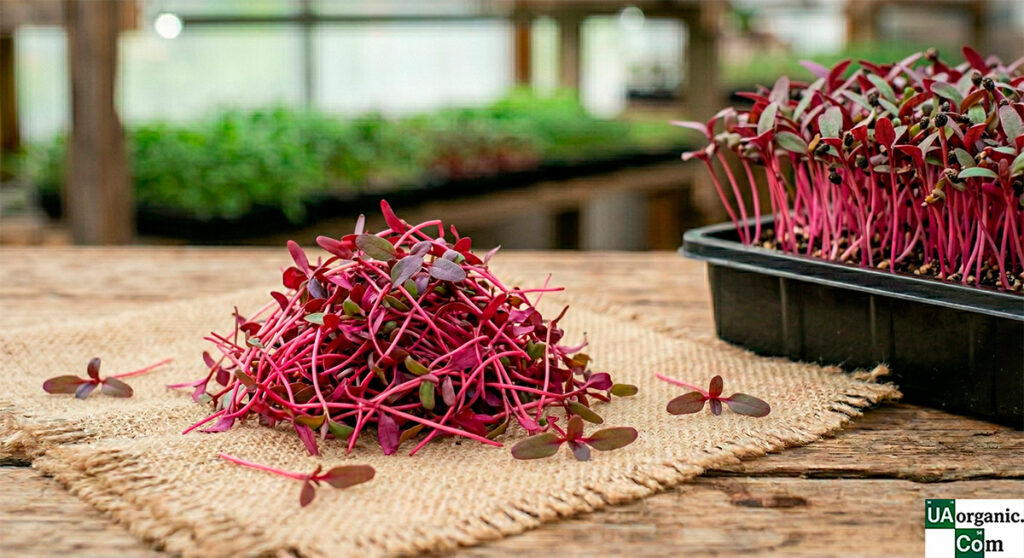
Flavor profile
Taste & aroma
Soft, grassy, sweet - this is a green companion that does not interrupt the main dish. Unobtrusive, fresh aroma.
it is a companion green that does not interrupt the main dish
Unobtrusive, fresh, almost vegetal. Practically neutral - that's why amaranth is so easily combined with any flavors.
Very gentle and soft. The stems are thin, the leaves melt in your mouth
Ripening and optimal harvest time
Optimal moment: bright color, mild taste, elastic stem.
The leaves open more, the taste is slightly stronger, but the texture remains delicate.
The stem begins to lose its elasticity, the color may fade without strong lighting.
Why flavor may vary batch to batch
The intensity of the crimson color of amaranth directly depends on the lighting during cultivation. Under strong light, the stem and leaves are bright red. With weak or natural lighting - pale, pinkish-greenish. This is not a defect, but a feature of the culture: the color is an indicator of growing conditions.
Culinary use
How to use
Amaranth is a great culinary accent. Add fresh at the end of cooking or directly on the plate.
Bruschetta and canapes
put a handful of amaranth on top of cream cheese and sun-dried tomato - the look immediately becomes restaurant-like
Bowl
use as a finishing touch on top—a few stems change the look of the entire dish
Carpaccio or tartare
amaranth as a decoration instead of microgreens with a pronounced taste - does not distract from fish or meat
Salad mix
add 20-30% amaranth to a neutral base (peas, sunflower) - it will give color and variety without changing the taste
Eggs and breakfast
a few stalks of amaranth on top of poached eggs or avocado toast - turn an ordinary breakfast into a restaurant serving
Desserts
unusual, but interesting - a few stems on a panna cotta or tart look like art
Perfect pairings
Red stem on white ricotta - looks like on a restaurant plate
Amaranth adds color and freshness without competing with the taste of fish
Bright red amaranth looks impressive against a green background in bowls or salads
- Do not add to hot dishes and sauces - it instantly loses color from heat and turns into a gray-green mass
- Do not season in advance - the tender stems will turn sour from the acid and oil in just 10-15 minutes
- Do not wash in advance - amaranth withers from water very quickly, wash only immediately before serving
Home storage
How to store
Amaranth keeps longer than most microgreens. Follow simple rules to keep it fresh for up to 7–10 days.
Keep in the refrigerator at +4...+6°C. Do not water or cover with film. The term is up to 7–10 days in a tray. Cut just before serving.
Place in an open container, do not seal - amaranth needs air. Shelf life in the refrigerator is 3–5 days. This is one of the most tender microgreens in terms of ease of cutting.
Don't wash until ready to eat. Wet greens spoil much faster. Rinse just before serving.
Pro tip: ⚠️ Amaranth is one of the most tender microgreens after cutting. It is better to sell in a tray, cut - only with clear instructions for the buyer on storage and washing.
Nutrients & health
Benefits & composition
Amaranth is valued for its rich vitamin-mineral composition and bioactive compounds typical of microgreens.
Like most microgreens, amaranth contains a concentrated amount of nutrients relative to its weight — many times more than the mature plant.
| Protein | 3 g — building material for cells |
|---|---|
| Calories | ~38 kcal |
| Vitamins | K, C, A |
| Minerals | Potassium, Calcium, Magnesium, Iron |
- People who take blood thinners — because of the vitamin K content; it is worth consulting with a doctor about the amount of leafy cultures in the diet
- For those who are prone to the formation of kidney stones, amaranth, like spinach, contains a certain amount of compounds that can be relevant when used regularly in large portions; moderate use is not a problem for most people
This information is general in nature and is not medical advice. Composition data: USDA FoodData Central.
Worth knowing
Vitamin K
is contained in a noticeable amount - it is traditionally associated with the support of blood vessels and blood coagulation processes. Leafy greens are a natural source of this vitamin.
Betacyanin
a natural pigment that colors the stem and leaves in red. This is the same class of compounds found in beets, which are traditionally considered rich in antioxidants.
Vegetable protein
in combination with minerals, amaranth makes an interesting addition to a diverse diet, in particular, in a vegetarian diet.
Iron and minerals
Amaranth contains potassium, calcium, magnesium and iron — minerals important for the normal functioning of the heart and muscles. A useful addition to a varied diet.
Similar crops
Similar by taste microgreens
If you are looking to complement or replace Amaranth:
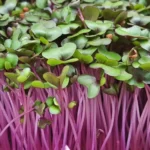
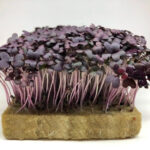
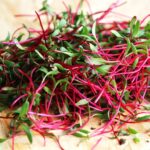
Amaranth: how to grow — step-by-step guide
Growing parameters, agronomy, common mistakesGrowing parameters
Very fine, dusty, non-mucous-forming
Step-by-step guide
Seed preparation
Amaranth seeds are very small - like dust. Soaking is absolutely not necessary: the seeds will swell from the moisture of the substrate. When in contact with water before sowing, it sticks together in a lump and it becomes impossible to distribute it evenly.
Sow only dry seeds.
After sowing, sprinkle the surface with a thin layer of fine vermiculite. It keeps moisture near the seeds and at the same time prevents the substrate from "greening" — suppresses the growth of algae, which often appear when the open surface is wet for a long time.
Sowing
- Moisten the substrate - it should be moist, but without standing water
- Make sure that the surface of the substrate is even and without pits - unevenness will cause the stairs to be uneven
- Spread the seeds evenly over the surface in a thin layer
- Do not sprinkle the seeds with a substrate - amaranth germinates in the light, it needs contact with the surface, not immersion
- Lightly press the seeds with your fingers or a flat object for tight contact with the substrate
The norm is 0.5–1 g - this is very little. Start with 0.5 g and adjust according to the result. Overcrowding → thickening → black leg.
The greenhouse effect is instead of pressure
Clamping is contraindicated - any weight will kill small seeds.
Instead, immediately after sowing, cover the tray with transparent film or a lid. This creates a humidity of 90–100% and prevents the seeds from drying out before germination.
Importantly: remove the film immediately upon the appearance of the first shoots ("brushes") - usually for 1-2 days. Film delay after germination → mold.
Darkness (Blackout) — 3–5 days
After removing the film, the tray is moved into the dark to extract the stem.
What is normal:
- Uneven height of sprouts — amaranth descends in waves
- A light pink shade of the stems - the color has not yet revealed, it will appear in the light
What is NOT normal:
- Black leg (darkening at the base of the stem) → overmoistened substrate or too dense sowing. Solution: improve ventilation, reduce the seeding rate next time
- Mold → the film was removed too late or there is no ventilation → ventilate, reduce humidity
Watering in the dark: usually not needed. If the substrate dries out, only the lower watering through the tray, not the upper watering at all.
Vegetation in the light — 6–9 days
This is a key stage for amaranth - this is where the color is formed.
Lighting is critically important:
- Natural light (windowsill): the color will be pale or uneven
- LED phytolamps: optimal, 16–18 hours a day, distance 15–20 cm
- Intensity: Amaranth needs a strong light - 4000-5000 lux for bright color. This is more than most microgreens
Watering — only the bottom:
- Always through the pallet, never on top of the stems
- Drops of water on the stems of adult amaranth → spots, rotting, loss of marketability
- Top watering from a fine atomizer is permissible only in the first 1-2 days if the top of the substrate dries out
Ventilation is critical:
- Stagnation of air → foci of mold
- Ventilate the room daily, but without cold drafts directly on the tray
Temperature: +18...+24°C. Amaranth is heat-loving — at temperatures below +16°C, growth slows down sharply.
If the color remains pale for 4-5 days after exposure to light, move the tray closer to the lamp or increase the lighting time to 18-20 hours. The color appears gradually and "picks up" in the last 2-3 days.
Watering
- Water it 1-2 times a day fine spraying or bottom irrigation
- Lower watering is better — amaranth leaves with upper watering are prone to mold
- Amaranth is heat-loving and active - at +26°C, control the humidity twice
- A sign of lack: tender leaves curl slightly and fade → moisten through a tray
Storage
| Uncut in tray | Fridge +4...+6°C | up to 3 weeks |
|---|---|---|
| Cut in container | Refrigerator | up to 7 days |
| Room temperature | 1–2 days |
Harvest
- Cotyledons are fully opened and have a pronounced color
- The stem is elastic, holds its shape, not watery
- Height 5–8 cm
Scissors above the substrate level. Amaranth does not give a large yield (~10 g from a box) - it is a decorative, not a mass culture.
Just before serving. Wet amaranth will turn sour in a matter of hours. If you sell, do not wash at all, pass this recommendation on to the buyer.
Seasonal adjustments
- Ventilation: especially important — the risk of mold increases with heat and humidity
- Watering: reduce the frequency, the substrate should not be constantly wet
- Film: remove even faster - in warm weather, the seeds germinate in 1 day
- Temperature: amaranth is heat-loving, at +16°C and below, growth slows down sharply and the color does not reveal
- Solution: keep the tray in a warm place, add substrate heating if possible
- Lighting: in winter, natural light is not enough even near the window - phytolamps are a must
Water pH and EC
The optimal range for amaranth: 6.0–6.5. Amaranth tolerates a slightly alkaline environment well, but at a pH above 7.0, the intensity of the red pigment (betacyanin) may decrease — the leaves become less saturated in color. It is best to use filtered or settled water.
Optimal range: 1.2–2.0 mS/cm. Amaranth absorbs nutrients well at an average concentration. When grown on soil without additives, EC is not critical. But with hydroponics, you should not exceed 2.0 - an excess of salts can inhibit seed germination.
Experienced grower tips
Color is an indicator of lighting quality
If the customer's amaranth turns pale at home after purchase, it is not a spoiled product, but a matter of lighting. It is useful to explain to buyers when selling.
Mix with peas or sunflower
Amaranth itself gives a small yield and is more expensive to produce. In a mix of 20–30% amaranth + 70–80% neutral greens, a spectacular product with an optimal cost price is obtained.
A smooth substrate surface is half the battle
Before sowing, smooth the substrate with a flat object. Irregularities give uneven stairs, and moisture accumulates in the pits and a black leg develops.
Not to be confused with white amaranth
Sometimes beginner growers sow too rarely and get sparse green seedlings - this is not sick amaranth, just the wrong variety or not enough light. For a bright color, you need a variety marked "tricolor" or "red".
Agronomy notes and common mistakes
- Sowing: No soaking. Extremely high density - tiny seeds in a thin, even layer.
- Clamp: Without clamping. Small seeds do not tolerate pressure.
- Temperature: +22...+28°C. Critical: amaranth almost does not grow below +18°C.
- Watering: 1–2 times a day, lower. Excess moisture + heat + poor ventilation = mold guaranteed.
- Ventilation: Mandatory and active. Without air movement, amaranth at +26°C gives mold very quickly.
- Soaking seeds → Seeds stick together, uneven sowing → Sow only dry
- Dense sowing → Black leg, rotting in the center → The norm of 0.5 g per box is very little, do not exceed
- Late film removal → Mold immediately after germination → Remove the film when the first sprouts appear (1–2 days)
- Top watering on stems → Spots, stem rot → Only bottom watering through a pallet
- Weak lighting → Pale pink-green color instead of bright red → Phytolamps, minimum 4000–5000 lux, distance 15–20 cm
- Poor ventilation → Mold cells → Daily airing of the room
- A slice of overripe amaranth → Flabby stem, pale color → Cut no later than the 14th day, reference point — stem elasticity
Variety selection
Red Garnet
Red amaranth
The most popular variety for microgreens. Gives a rich ruby-red color of the stem and leaves, which persists after cutting. The taste is soft, slightly earthy, with a hint of beetroot.
Green Tails
Green amaranth
Green leaves with a more delicate taste - without a beetroot note. It is suitable when color is not a priority, but a soft neutral microgreen is needed.
What's next?
More crops in the catalog
Explore similar and contrasting flavors — from basil to amaranth