Radish Sango Microgreen Salad
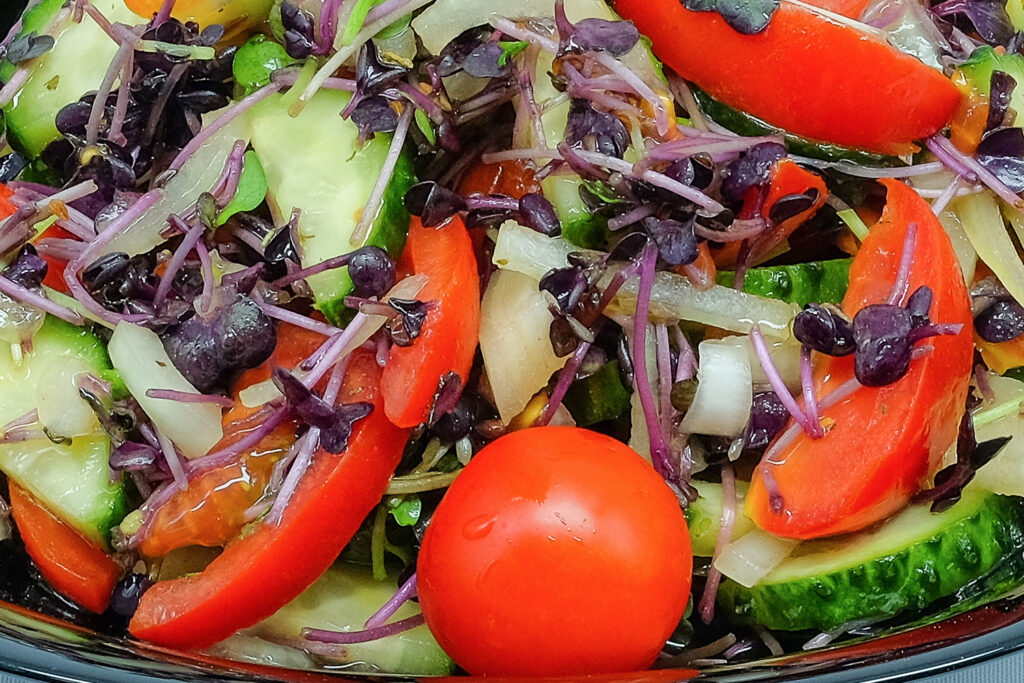
A bright, fresh salad with purple Radish Sango microgreens, cherry tomatoes and cucumber. Ready in 10 minutes, no…

Raphanus sativus var. Sango
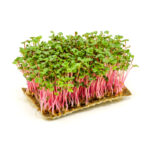
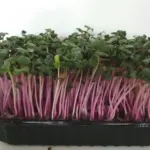
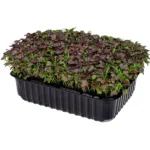
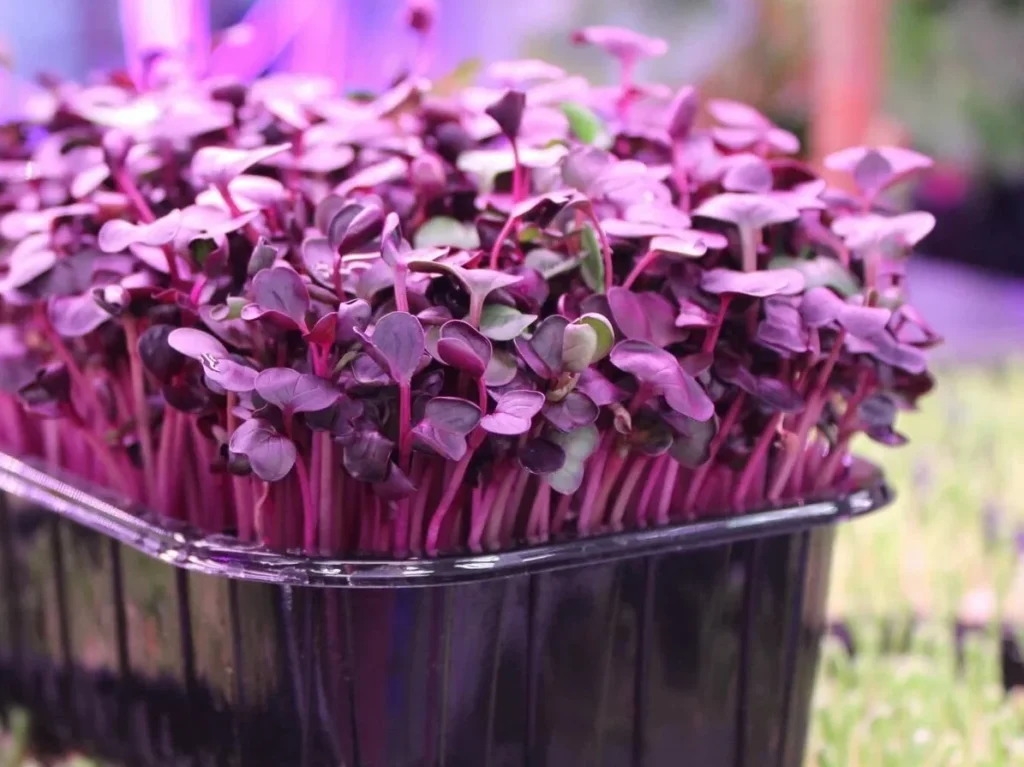
Sango radish microgreens are the "black pearl" among microgreens. The darkest variety of radish: the leaves and stem have a deep purple, almost inky shade that no other radish gives. Sango is chosen when you want to impress: on the plate it looks like a work of art - an incredible contrast with green avocado, white cheese or red fish. But it's not just the color: the classic radish piquancy, juicy and crunchy, is hidden under the spectacular appearance.
Flavor profile
Spicy, Spicy, Refreshing — A pronounced spiciness, identical to a ripe radish, but fresher and cleaner — without the earthy aftertaste of the root. Light, spicy aroma.
A pronounced spiciness, identical to a ripe radish, but fresher and cleaner — without the earthy aftertaste of the root. Sharpness appears immediately and lasts for several seconds, then recedes
Light, spicy, radish - characteristic of cruciferous, felt when opening the package and intensifies when chewing.
Crispy, Juicy, Dense is one of the crispiest microgreens. The stem keeps its shape even in a dressed salad, does not "lie down" from moisture
Why flavor may vary batch to batch
The intensity of the peppery taste of radish depends on the temperature and lighting. At cool cultivation (+14...+18°C) glucosinolates are concentrated higher — the taste is sharper and more pronounced. At warm (+22°C and above) - more tender and less spicy. The stage of the cut is also important: an early cut (5–6 days) is more tender, a late one (8–9 days) is sharper.
Culinary use
Radish Sango is a great culinary accent. Add fresh at the end of cooking or directly on the plate.
a handful of Sango on top: purple on green is an Instagram classic, and it's delicious
a few sprigs instead of arugula: more piquant, more impressive, more unusual
spread out next to each other. Minimalist restaurant serving without sauces
from above and along the edge. Dark on dark gives depth, spiciness accentuates the raw taste of meat
a small sprig adds character and style to any cracker
Sango as a color accent among neutral ingredients
Perfect pairings
Purple on bright green is a classic of food photography and restaurant serving
The spiciness of the radish emphasizes the taste of raw or lightly salted fish, and the contrast of colors looks impressive
Dark purple on dark red meat — restaurant aesthetics without complex manipulations
Home storage
Radish Sango keeps longer than most microgreens. Follow simple rules to keep it fresh for up to 3 weeks.
Don't cut more than you plan to eat right away. Store in refrigerator at +4...+6°C. No watering needed — natural moisture is enough.
Place in an open container or plate, cover with a damp paper towel. Don't seal — without air, greens yellow faster.
Don't wash until ready to eat. Wet greens spoil much faster. Rinse just before serving.
Nutrients & health
Radish Sango is valued for its rich vitamin-mineral composition and bioactive compounds typical of microgreens.
Like most microgreens, radish sango contains a concentrated amount of nutrients relative to its weight — many times more than the mature plant.
| Protein | 2.5 g — building material for cells |
|---|---|
| Calories | ~32 kcal |
| Vitamins | C |
| Minerals | Potassium |
This information is general in nature and is not medical advice. Composition data: USDA FoodData Central.
Worth knowing
Sango anthocyanins —
Sango anthocyanins are the same group of compounds responsible for the color of blueberries, red cabbage, and elderberries. These pigments are the subject of active research on their protective effect for the cardiovascular system and vision. Eating Sango is one of the ways to get anthocyanins in a live and easily accessible form for the body.
glucosinolates
Sango contains glucosinolates — compounds characteristic of cruciferous plants, which, when chewed, turn into active substances with antibacterial properties. It is they who give radish its characteristic sharpness.
vitamin C
It is a source of vitamin C in a significant concentration — 50–60 mg per 100 g cover half of the daily norm. Suitable as part of a varied diet for those looking for natural sources of antioxidants.
Antioxidants and biologically active substances
Microgreens are a concentrated source of antioxidants — compounds that are being studied in the context of protecting cells from oxidative stress. Regular consumption of a variety of microgreens is part of a balanced plant-based diet.
Similar crops
If you are looking to complement or replace Radish Sango:
Large, round (standard radish)
Watering
Storage
| Uncut in tray | Fridge +4...+6°C | up to 3 weeks |
|---|---|---|
| Cut in container | Refrigerator | up to 7 days |
| Room temperature | 1–2 days |
Harvest
The leaves are completely colored in a rich purple-ink color, the height is 6–9 cm, the cotyledons are open and elastic. If the color is still "not perfect" - give another 1-2 days under the lamp. To cut a pale Sango means to sell a low-quality product.
Knife or scissors above the substrate. The stem is dense and juicy, it is easy to cut. Cut evenly - an uneven cut spoils the appearance of the cut bundle.
Rinse in cold water, stirring slightly. Dry naturally - do not spin, so as not to break the juicy leaves. Pack immediately.
Seasonal adjustments
Optimum range for Radish Sango: 5.8–7.0. Radish Sango grows optimally in a slightly acidic environment. Anthocyanins (the purple color) are more stable at pH below 7.0 - this is the natural chemistry of pigments.
Optimal range: 1.0–2.0 mS/cm. The parameters are identical to other varieties of radish. Sango's purple color is determined by genetics and pH, not mineralization.
Experienced grower tips
Sango is a test for your lighting
If Sango comes out deep purple, your lighting system is fine. If it is pale or green, there is a problem with the lamp or the location. Use Sango as a "litmus test" for the quality of lighting on your farm.
Do not wet the leaves under the lamps — a rule without exceptions
Drops on a purple leaf under intense light give characteristic light circles - "burns". They are not fatal for the plant, but they destroy the marketable appearance. Bottom watering - always.
A pair of Sango + avocado in promotional materials
A photo of purple on bright green is the most persuasive marketing tool for this crop. If there is an opportunity to take one good photo, this is it.
Control temperature, not just lighting
Two causes of pale Sango are low light and high temperature. One lamp without temperature control can give an unstable result. A thermometer in the area of the trays is a must.
Mix Sango with neutral cultures
Sango as 20–30% in a color mix (+ arugula + spinach) is a ready-made restaurant mix, where the purple accent is read on a green background. The price of the mix is higher than for each culture separately.
Variety selection
Radish Sango
Raphanus sativus Sango
Profile variety — purple-burgundy stem. One of the most spectacular radishes for microgreens.
Radish purple
Daikon Purple, Violet King
Similar color, but sometimes a little less intensity. Suitable when Sango is not available.
Що далі?
More crops in the catalog
Explore similar and contrasting flavors — from basil to amaranth
A bright, fresh salad with purple Radish Sango microgreens, cherry tomatoes and cucumber. Ready in 10 minutes, no…