
Flavor profile
Taste & aroma
Burning, fresh, sharp - Spicy, spicy, mustard-horseradish - but without the bitterness that occurs in an adult watercress. Fresh, burning aroma.
Spicy, spicy, mustard-horseradish - but without the bitterness of an adult watercress. In the microgreen phase, the sting is clean and fresh, it appears immediately and quickly disappears without leaving an unpleasant plume
Fresh, burning, grassy - reminiscent of horseradish, but without harshness, well felt when cutting and practically does not spread indoors.
Crispy, Juicy, Tender - you need to pack it right away
Why flavor may vary batch to batch
Watercress is one of the spiciest microgreens. The intensity of the mustard-pepper flavor depends on the temperature: at cool cultivation (+14...+18°C) sharpness is more pronounced and persistent. At warm (+22°C and above) - softer, tender sprouts. The stage of cutting is also important: the younger sprout (5–6 days) is more tender, the older one (8–9 days) is sharper.
Culinary use
How to use
Garden Cress is a great culinary accent. Add fresh at the end of cooking or directly on the plate.
Eggs in any form
English classics: watercress and poached, scrambled or boiled eggs. The spiciness of the greens and the fatness of the yolk complement each other. This is probably the best gastronomic combination for watercress
A sandwich with salmon or tuna
instead of mustard or horseradish. A handful of watercress gives the same spiciness, but with a freshness that no seasoning from a jar can give
Okroshka and cold soups
thrown into a plate immediately before serving. Watercress opens up especially well in cold soup: the sting becomes softer, and the freshness becomes more pronounced
Avocado toast
a layer of avocado, salt, lemon and a handful of watercress on top. Avocado fat "extinguishes" the burning sensation to a comfortable level
Burger
instead of lettuce or next to it. Watercress does not crumple under the patty as quickly as tender greens, and adds gastronomic spiciness without additional sauces
Potatoes and sausages
for fatty, heavy dishes, watercress is suitable as a fresh counterpoint: the burning "cuts" the fat and relieves the feeling after eating
Perfect pairings
Watercress works as an accent on a neutral background - it should not be mixed with other sharp greens, because the flavors merge into one sharp background
Fatty and salty foods soften the spiciness of watercress and bring out its fresh grassy note
Milk fat soothes the burning sensation and allows you to experience the full taste
- Do not add to hot dishes: from the heat, the sharpness disappears, only bitterness and a flabby appearance remain. Watercress is exclusively raw.
- Do not mix with other spicy herbs: arugula plus watercress plus mustard in one salad will give an aggressive monotonous heat without nuances.
- Do not refuel in advance: after 5 minutes in the dressing, the delicate leaf will settle and become unattractive. Season only before serving.
- Do not add to the children's menu without warning: the spiciness of watercress for children is often unexpected and excessive.
Home storage
How to store
Garden Cress keeps longer than most microgreens. Follow simple rules to keep it fresh for up to 3 weeks.
Don't cut more than you plan to eat right away. Store in refrigerator at +4...+6°C. No watering needed — natural moisture is enough.
Place in an open container or plate, cover with a damp paper towel. Don't seal — without air, greens yellow faster.
Don't wash until ready to eat. Wet greens spoil much faster. Rinse just before serving.
Nutrients & health
Benefits & composition
Garden Cress is valued for its rich vitamin-mineral composition and bioactive compounds typical of microgreens.
Like most microgreens, garden cress contains a concentrated amount of nutrients relative to its weight — many times more than the mature plant.
| Protein | 2.6 g — building material for cells |
|---|---|
| Calories | ~32 kcal |
| Vitamins | C |
| Minerals | Iron, Calcium, Iodine |
- At sensitive stomach with increased acidity watercress may increase discomfort due to the burning effect of glucosinolates on the mucosa. It is worth starting with small amounts or avoiding.
- To people who accept blood thinners, it is worth maintaining a uniform intake of vitamin K without sudden changes — it is better to check with a doctor.
- To children watercress is better to offer in small quantities and in combination with fatty or dairy products that soften the burning sensation.
This information is general in nature and is not medical advice. Composition data: USDA FoodData Central.
Worth knowing
vitamin K
Watercress is one of the richest sources of vitamin K among microgreens and is traditionally included in the diet as part of a variety of green diets, especially in British and Central European culinary traditions.
vitamin C
It contains vitamin C in a significant concentration - more than most leaf crops. It is suitable as part of a varied diet in the season when there are fewer fresh fruits and vegetables.
Glucosinolates
the compounds that give watercress its characteristic pungency are being actively studied in the context of their properties. In the traditional medicine of various cultures, cruciferous flowers with this profile were used to stimulate appetite and digestion.
Antioxidants and biologically active substances
Microgreens are a concentrated source of antioxidants — compounds that are being studied in the context of protecting cells from oxidative stress. Regular consumption of a variety of microgreens is part of a balanced plant-based diet.
Similar crops
Similar by taste microgreens
If you are looking to complement or replace Garden Cress:
Garden Cress: how to grow — step-by-step guide
Growing parameters, agronomy, common mistakesGrowing parameters
Small, mucilaginous
Watering
- Moisturize 1-2 times a day fine spray - ONLY fog
- NEVER water with a strong stream: tiny watercress seeds are washed away and stick together
- The substrate should be slightly moist - watercress dries out very quickly due to its small size
- A sign of lack: microscopic sprouts nest horizontally → mist immediately
Storage
| Uncut in tray | Fridge +4...+6°C | up to 3 weeks |
|---|---|---|
| Cut in container | Refrigerator | up to 7 days |
| Room temperature | 1–2 days |
Harvest
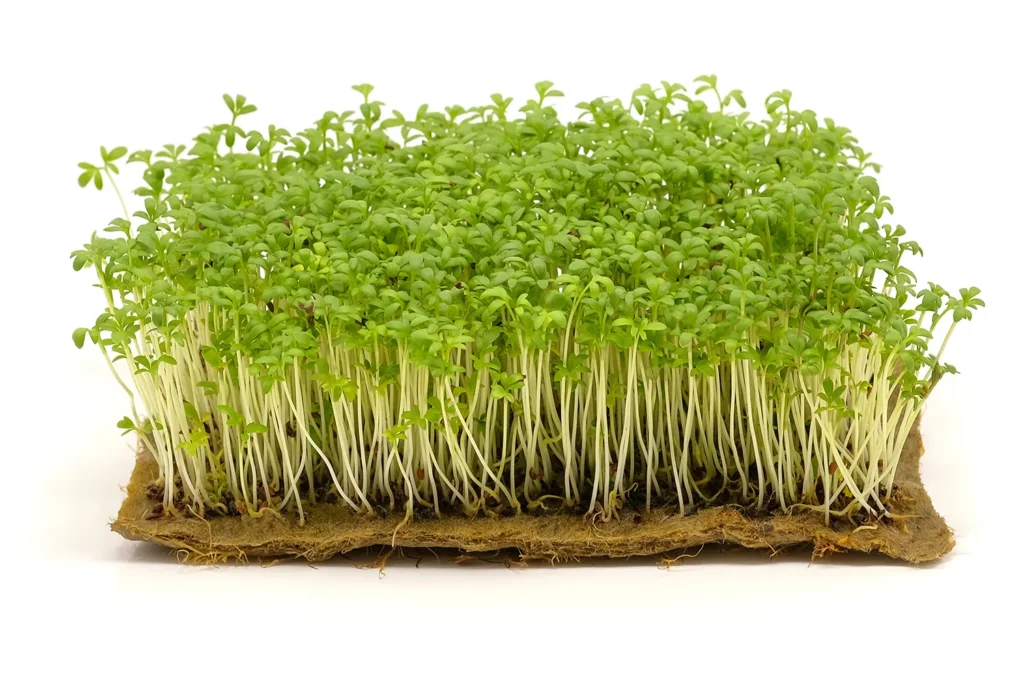
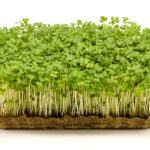
The cotyledons are completely opened, the seed coat is shed, the stem is still juicy. Usually this is the 5-7th day in the light. Do not wait for the appearance of a real leaf - this is already a delay. Landmark: if you lift the tray and look from below, you can see a dense white root system that is held in the mat.
With a sharp knife or scissors, bundles — as low as possible to the substrate. The stem is thin and easy to cut. A blunt blade crushes the stem and produces a slippery cut that dramatically reduces shelf life.
Rinse in cold water gently, gently shaking - do not rub. Dry on a towel or in a salad bowl. Pack right away - watercress wilts faster than most crops, and you shouldn't delay after cutting.
Seasonal adjustments
- Blackout phase: reduce to 2-3 days - warm seeds germinate very quickly, excessive darkening gives an elongated stem
- Ventilation: open the tray 1-2 times a day during a blackout — hot air and moisture = mold
- Watering: water more often, in small doses - the substrate under the lid dries out imperceptibly
- Collection: harvest 1-2 days earlier than the standard - in the heat, the stem quickly thickens
- Storage: after collection - immediately in the refrigerator, the leaves wither for several hours
- Germination: keep the trays in a warmer place (next to the battery, but not close to it) - the cold significantly slows down the start
- Watering: use water at room temperature — cold water inhibits the growth of small seeds
- Expect: prolongation of the cycle by 2–4 days; in winter, watercress turns out denser and with a more pronounced burning taste
Water pH and EC
The optimal range for watercress: 5.5–6.5. Watercress prefers a slightly acidic environment. At a pH above 7.0, the germination of tiny seeds may be slightly slowed down.
Optimal range: 0.8–1.5 mS/cm. Low mineralization is ideal for tender watercress. High EC (>2.0) may inhibit germination due to osmotic stress.
Experienced grower tips
Watercress is a culture for a "fast" row in the assortment
An 8-10 day cycle allows you to close urgent orders or fill gaps between slower crops. Keep it in constant rotation.
Dry seed is the only condition for sowing
Store the seed bag away from moisture, even condensation in the refrigerator. Slightly damp seeds stick together even before sowing and give an uneven gel.
Cut in bunches, not all over the tray
It is convenient to collect watercress in bunches-"strands" from the edge to the center - this way it is easier to control the evenness of the cut and not to crush the neighboring stems.
Sell cut, not live
Unlike komatsuna or corn salad, watercress in a live tray is a bad idea: it overgrows in 1-2 days and the stem becomes coarse. It is better to cut, pack and sell ready.
Ventilation is a priority
If you grow several trays of watercress next to each other, the smell in the room becomes noticeable. This is not a quality issue, but it can be uncomfortable. Ventilation or a fan solves the problem.
Agronomy notes and common mistakes
- Sowing: No soaking. Extremely high density - a thin, even layer of tiny seeds.
- Clamp: WITHOUT pressure - the tiny seeds do not tolerate any pressure.
- Temperature: +18...+22°C. At a higher temperature, it grows even faster.
- Watering: ONLY fine mist. Watercress is minimally watered - it is already very fast.
- Ventilation: moderate Too much ventilation dries out the tender seeds.
- Soaking seeds → Seeds stuck together in a lump, sowing is impossible → Throw away soaked seeds, take new ones - only dry ones
- Seed movement after wetting → Uneven seeding, “islands” of density → Do not touch the tray after the atomizer — the gel sets in minutes
- Exposure to light → The stem is hard, the taste is bitter-burning, the appearance is unattractive → Cut on the 5th–7th day, do not wait for a real leaf
- Top watering during the growing season → "Black leg" — rot at the base of the stems → Only lower watering in the tray, monitor ventilation
- Poor ventilation → Musty smell, laying of crops → Increase the distance between the trays, ventilate the room
- Late packing after cutting → Greens wither before sale → Pack immediately after washing and drying, without delay
Variety selection
Watercress is ordinary
Watercress, Broadleaf, Cranberry
Standard selection. Pronounced burning and horseradish taste, rapid germination.
Curly watercress
Curly Cress, Afro
More decorative leaves with a similar taste. It looks more spectacular in presentation, but the taste is the same.
What's next?
More crops in the catalog
Explore similar and contrasting flavors — from basil to amaranth