
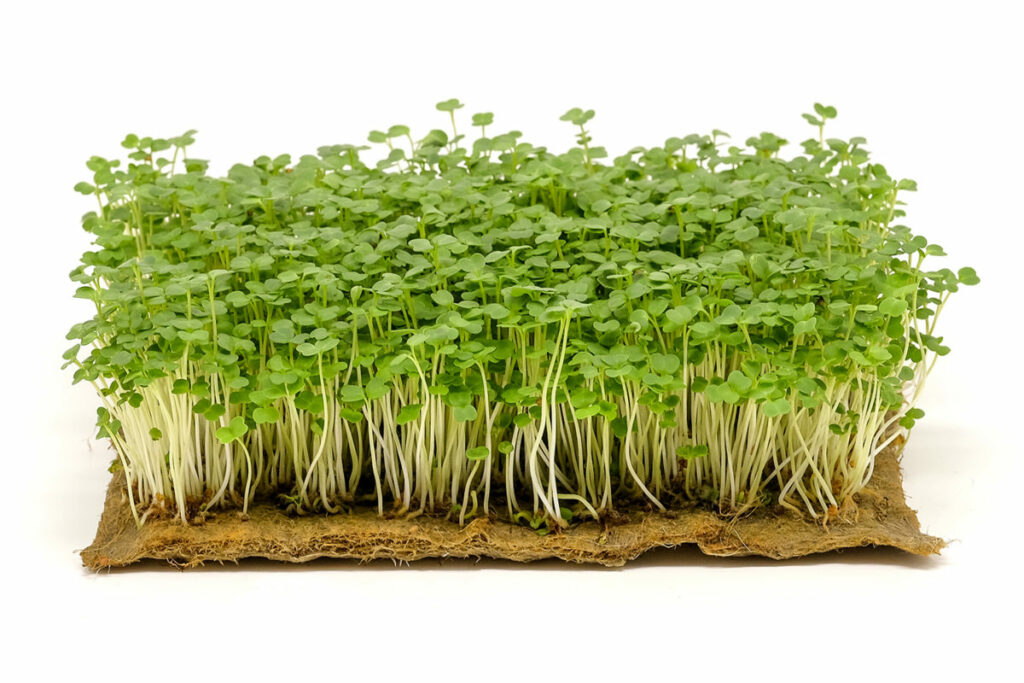
Flavor profile
Taste & aroma
Scorching, Nutty, Spicy — A recognizable spicy profile with hints of walnut and a light peppery spiciness on the finish. Strong, spicy aroma.
A recognizable spicy profile with hints of walnut and a light peppery spiciness on the finish. Softer and cleaner than an adult arugula: there is bitterness, but without sharpness and without an earthy aftertaste
Strong, spicy, nutty-peppery — noticeable immediately upon opening the package and remains on the palate after chewing.
Tender, Crisp, Juicy - arugula exclusively raw and in the finale
Why flavor may vary batch to batch
The sharpness of arugula depends on the content of isothiocyanates (glucoerucin), which are concentrated at cool cultivation (+14...+18°C) - the taste is sharp and spicy. At warm (+22°C and above) - softer and less pronounced. Cutting stage: early (5–6 days) — tender and less spicy, late (8 days) — maximally piquant. Arugula is one of the fastest growing and temperature sensitive microgreens.
Culinary use
How to use
Arugula is a great culinary accent. Add fresh at the end of cooking or directly on the plate.
pizza
a handful of arugula on top immediately after removing from the oven. From the residual heat, the leaf will become slightly sticky and wet from the oil - exactly the consistency that is served in Neapolitan pizzerias
Steak with balsamic
arugula + a few drops of balsamic cream + parmesan shavings. A trio that makes steak restaurant-style without any sauce
Bruschetta with prosciutto
arugula between bread and meat or on top. A spicy note instead of lettuce
Caprese
arugula instead of or next to basil. A sharper, more characteristic version of the classic
Toast with salmon and cream cheese
arugula between cheese and fish: a spicy accent that does not interrupt the fishy taste
Salad with pear and gorgonzola
arugula as a base. The nutty note of arugula and the sweetness of pear are an unexpectedly organic pair
Perfect pairings
Arugula on hot dough is a classic that needs no justification
Spicy and nutty spiciness of arugula interrupts the greasiness of meat and balances heavy dishes
A classic combination — arugula adds a spicy kick to tender tomatoes and mozzarella
- Do not add to hot dishes in advance: the leaf withers in seconds from the heat. Put it at the very end or already on the plate.
- Do not refuel in advance: arugula "sits down" in a dressed salad in 5–7 minutes. Season immediately before serving.
- Do not mix with other very spicy greens: arugula + watercress + mustard in one salad will give excessive aggressive sharpness. Arugula likes a neutral background.
- Do not use in large quantities for people with a sensitive stomach: glucosinolates can increase acidity.
Home storage
How to store
Arugula keeps longer than most microgreens. Follow simple rules to keep it fresh for up to 3 weeks.
Don't cut more than you plan to eat right away. Store in refrigerator at +4...+6°C. No watering needed — natural moisture is enough.
Place in an open container or plate, cover with a damp paper towel. Don't seal — without air, greens yellow faster.
Don't wash until ready to eat. Wet greens spoil much faster. Rinse just before serving.
Nutrients & health
Benefits & composition
Arugula is valued for its rich vitamin-mineral composition and bioactive compounds typical of microgreens.
Like most microgreens, arugula contains a concentrated amount of nutrients relative to its weight — many times more than the mature plant.
| Protein | 2.6 g — building material for cells |
|---|---|
| Calories | ~25 kcal |
| Vitamins | K |
| Minerals | Calcium |
- To people from increased acidity of the stomach or a tendency to heartburn arugula should be used sparingly: cruciferous essential oils can increase acidity.
- To people who accept drugs to support blood coagulation, it is worth maintaining a uniform intake of vitamin K — sharp fluctuations are undesirable.
- At Allergies to cruciferous flowers (cabbage, mustard, radish) arugula is contraindicated.
This information is general in nature and is not medical advice. Composition data: USDA FoodData Central.
Worth knowing
vitamin K
Arugula is one of the richest vegetable sources of vitamin K — it is involved in blood clotting and the assimilation of calcium by the bones. 100 g of micro arugula covers the daily norm of vitamin K in excess.
Glucosinolates
cruciferous plants are the subject of active research in oncological preventive medicine. Isothiocyanates, which are formed during their cleavage, are considered promising protective compounds. Arugula is one of the concentrated sources of these substances among leafy crops.
calcium
Arugula contains calcium in a noticeable concentration and is an interesting addition to the diet of those looking for plant sources of this mineral.
Antioxidants and biologically active substances
Microgreens are a concentrated source of antioxidants — compounds that are being studied in the context of protecting cells from oxidative stress. Regular consumption of a variety of microgreens is part of a balanced plant-based diet.
Similar crops
Similar by taste microgreens
If you are looking to complement or replace Arugula:

Arugula: how to grow — step-by-step guide
Growing parameters, agronomy, common mistakesGrowing parameters
Small, slime-forming (semi-slime when wet)
Watering
- EXCLUSIVELY lower watering (through a pallet) - small seeds stick together and rot during upper watering
- Moisturize 1-2 times a day be careful - the pallet should not be filled
- Arugula is tender and sensitive to moisture: a little less is better than overflowing
- A sign of lack: small leaves are slightly curled, stems are thin → moisten gently through the tray
Storage
| Uncut in tray | Fridge +4...+6°C | up to 3 weeks |
|---|---|---|
| Cut in container | Refrigerator | up to 7 days |
| Room temperature | 1–2 days |
Harvest
Cotyledons are fully opened, bright green, height 5–7 cm. The first true leaf has not yet appeared or is just beginning. Cut before the appearance of a real leaf - after it the bitterness increases sharply.
Knife or scissors above the substrate. The stem is thin - easy to cut. Cut in rows, not chaotically: an even cut gives a neat commercial appearance of the bundle.
Rinse gently in cold water, gently agitating. Dry on a towel - do not spin, the leaf is delicate and wrinkled. Pack immediately.
Seasonal adjustments
- Mold: the main threat in the summer — dense sowing without ventilation in the heat guarantees a moldy matrix on the 2nd-3rd day; ventilate the blackout daily
- Extraction: at +24°C and above, the stems are elongated, the mustard-nut aroma weakens - cut earlier, do not wait for the optimal height
- Cycle: is reduced by 1–2 days; watering is lower and more frequent - the substrate dries out faster
- Aroma: in summer it is weaker than in cool weather - arugula opens maximally at +16...+20°C
- Expect: thinner stem, less saturated taste compared to the winter harvest
- Ideal season: coolness (+14...+18°C) gives the maximum nutty-peppery aroma and intense spiciness - this is the peak quality of arugula
- Cycle: is extended by 1–2 days; watering with water at room temperature — cold slows down growth
- Expect: denser stem, pronounced spicy profile, longer shelf life after cutting
Water pH and EC
The optimal range for Arugula: 5.5–6.8. Arugula prefers a slightly acidic environment. At a pH higher than 7.0 (hard water), the germination of small seeds may be slightly slowed down.
Optimal range: 1.0–1.8 mS/cm. Moderate mineralization is ideal for tender arugula. High EC (>2.0) with bottom watering can accumulate and cause slight "burning" of leaf edges.
Experienced grower tips
A thermometer in the tray area is not an option
Arugula and temperature >24°C are incompatible. Especially in summer, when the lamps add warmth. Control the temperature exactly where the trays are, not in the room in general.
The film between the boxes is the standard, not the exception
If growing in stacks, a film between the seeds and the bottom of the upper box for arugula and basil is mandatory. Make it part of the standard process so you don't forget.
Arugula is a "marker" of the state of your farm
A black leg appears when the temperature is too high or there is too much moisture. If arugula is causing problems, check these two parameters across the farm: most likely they affect other crops, just less noticeably.
Combine with neutral cultures in the mix
Arugula as 20–30% in a salad mix — gives a "signature" taste without dominating. Standard restaurant mix: arugula + komatsuna + spinach. Arugula is the "star" here, the rest is the background.
A live tray is the best format for restaurants
The chef cuts it himself before serving: maximum aroma, no logistical loss of quality. Offer live trays to restaurants on a weekly basis - it's more convenient for them and more profitable for you.
Agronomy notes and common mistakes
- Sowing: No soaking. Very high density - small seeds evenly spread over the entire surface.
- Clamp: WITHOUT pressure - small seeds stick together under pressure and do not germinate.
- Temperature: +16...+22°C. At +24°C, arugula is extracted; at +14°C — softer and more aromatic.
- Watering: ONLY the lower one. Arugula is one of the most moisture-sensitive crops under overhead irrigation.
- Ventilation: Critical: dense seeds without ventilation and with excess moisture quickly give a moldy matrix.
- Soaking seeds → Gel mass, impossible to sow → Sow only dry, always
- Temperature > 24°C → Black leg, sprouts fall at the base → Reduce temperature, cool place for trays
- Overflow / waterlogged substrate → Black leg, rot → Lower watering, the substrate dries up slightly between waterings
- Without a film between the seed and the clamp → The seeds stick to the "ceiling" and come off when dissected → Film or parchment on top — always
- Cut after the appearance of a true leaf → Sharp bitterness, the customer is dissatisfied → Cut strictly at the cotyledon stage
- Top watering under lamps → Spots on the leaf, the appearance of the product deteriorates → Only lower watering on vegetation
Variety selection
Classic large-leaved varieties
Rocket, Salad, Eruko
The most common choice for microgreens. Even stairs, stable germination, classic nutty-mustard taste.
Wild arugula
Sylvetta, Selvatica, Delfino
Smaller leaf, more intense bitterness and aroma. For those who appreciate a distinct flavor profile.
Що далі?
More crops in the catalog
Explore similar and contrasting flavors — from basil to amaranth