
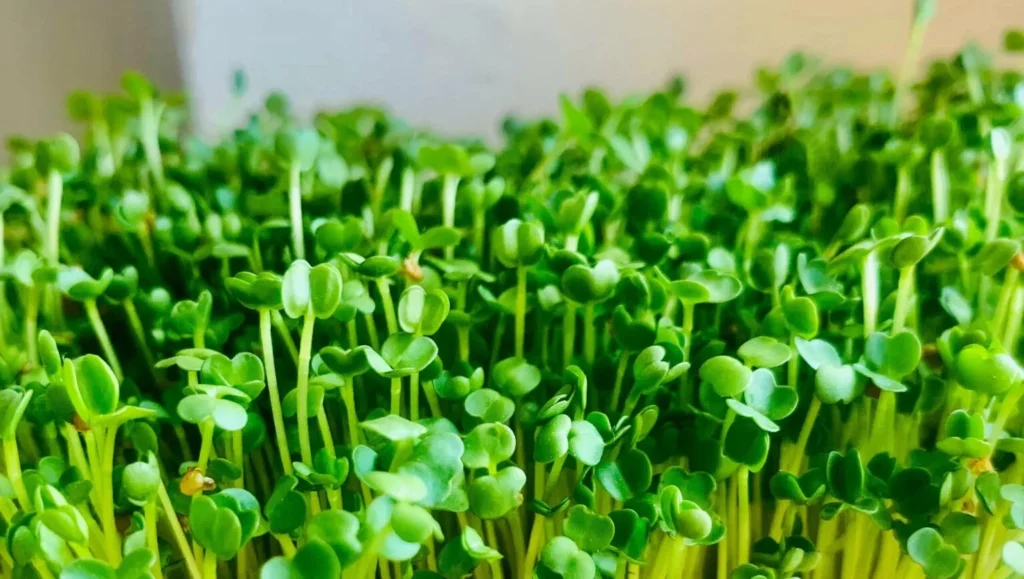
Flavor profile
Taste & aroma
Soft, fresh, cabbage - not burning, but barely noticeable. Fresh, neutral aroma.
not burning, but barely noticeable. It resembles a mixture of young spinach and Chinese cabbage, but softer than both
Fresh, neutral, herbal - a light "smell of green" without sharp accents, does not leave a smell on the hands when cutting.
Tender, Soft, Juicy — it's practically in the serving
Why flavor may vary batch to batch
Komatsuna is a quick culture with a mild taste. At warm cultivation (+22...+24°C) sprouts are tender, slightly sweet. At coolness (+16...+18°C) the taste is more pronounced, with a light cabbage bitterness. Illumination affects the color: in bright light, the leaves are rich green, in weak light - pale yellowish.
Culinary use
How to use
Komatsuna is a great culinary accent. Add fresh at the end of cooking or directly on the plate.
The basis for an Asian salad
instead of lettuce, put komatsuna, add edamame, carrot sticks, sesame seeds and miso dressing. Komatsuna keeps its shape even when tucked in
Sandwich with scramble
the layer of komatsuna under the hot egg slightly "gets tired" from the heat and becomes more tender, but does not turn into porridge
Green smoothie
gives the volume of greens and juice, practically without changing the taste of fruits. Good source of calcium without dairy products
Roll or poke
replaces nori or is added inside. A wide sheet is convenient to wrap
Hot noodles (ramen, udon)
thrown into the plate at the last moment: the leaf is slightly warmed up without being cooked
Eggs Benedict
komatsuna instead of spinach: less slippery after heating, retains its appearance
Perfect pairings
Goes well with arugula (it adds a spiciness that komatsuni lacks)
A large sheet is convenient to put under a piece of fish or between an egg and toast - it does not crumple and keeps its shape
Heavy cream sauces interrupt the taste - it is better to avoid
- Do not fry: the leaf instantly loses water and turns into a thin, bitter film.
- Do not refuel in advance: after 15–20 minutes in the sauce, the leaf will settle and lose its crunch.
- Do not mix with very sharp components: wasabi or fresh chili "clogs" the delicate taste of komatsuna, and you simply will not feel the difference between it and any other greens.
Home storage
How to store
Komatsuna keeps longer than most microgreens. Follow simple rules to keep it fresh for up to 3 weeks.
Don't cut more than you plan to eat right away. Store in refrigerator at +4...+6°C. No watering needed — natural moisture is enough.
Place in an open container or plate, cover with a damp paper towel. Don't seal — without air, greens yellow faster.
Don't wash until ready to eat. Wet greens spoil much faster. Rinse just before serving.
Nutrients & health
Benefits & composition
Komatsuna is valued for its rich vitamin-mineral composition and bioactive compounds typical of microgreens.
Like most microgreens, komatsuna contains a concentrated amount of nutrients relative to its weight — many times more than the mature plant.
| Protein | 2.2 g — building material for cells |
|---|---|
| Calories | ~22 kcal |
| Vitamins | K |
| Minerals | Calcium |
- To people who accept blood thinners, it is worth maintaining a constant level of consumption of products with vitamin K - without sudden changes in the amount. It is better to check with the doctor.
- At sensitive stomach komatsuna is much easier to tolerate than mustard or arugula - there is a minimum of mustard oils in it.
This information is general in nature and is not medical advice. Composition data: USDA FoodData Central.
Worth knowing
calcium
Komatsuna is a source of calcium in a highly absorbable form, making it an interesting addition to the diet for those avoiding dairy products or looking for plant-based sources of the mineral.
vitamin K
It is rich in vitamin K, which is traditionally associated with bone health and normal blood clotting.
chlorophyll and beta-carotene
The dark green color of the leaves indicates the presence of chlorophyll and beta-carotene, pigments that are a common part of a diverse plant diet.
Komatsuna fits the bill
Komatsuna is suitable as part of a varied diet for those interested in plant sources of calcium and iron: 100 g contains more calcium than a glass of cow's milk.
Similar crops
Similar by taste microgreens
If you are looking to complement or replace Komatsuna:
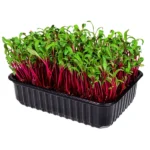
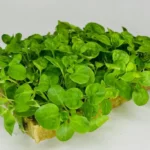
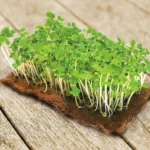
Komatsuna: how to grow — step-by-step guide
Growing parameters, agronomy, common mistakesGrowing parameters
Small, round, cabbage type
Watering
- Water it 1-2 times a day (in the morning - necessarily, in the evening - if necessary)
- Lower watering is better; the upper one is allowed carefully
- Komatsuna is similar to pak choi in needs - moderate humidity is ideal
- A sign of lack: the leaves curl slightly and acquire a matte shade → water
Storage
| Uncut in tray | Fridge +4...+6°C | up to 3 weeks |
|---|---|---|
| Cut in container | Refrigerator | up to 7 days |
| Room temperature | 1–2 days |
Harvest
A landmark is the opened large cotyledons or the very beginning of the appearance of the first true leaf. The height of the stem is 6–8 cm. Do not wait for the leaf to "open fully" - it will become coarse and too large for "micro".
With a knife or scissors above the level of the substrate by 1–1.5 cm. The stem is juicy and easily cut without effort. A sharp blade is a must - a dull one tears the fibers and leaves a slippery cut that shortens shelf life.
Rinse in cold water, gently agitating - do not rub. Center in a salad bowl or dry on a towel. Pack only completely dry.
Seasonal adjustments
- Height: komatsuna grows aggressively in the heat — the optimal collection phase can be completed in one day
- Blackouts: reduce to 3 days, check more often
- Collection: cut at a height of 5–6 cm, without waiting for 8 cm — the leaf quickly becomes rough
- Watering: water in the evening - there is less risk of moisture stagnation at night when the temperature is warm
- Ventilation: it is especially important in the heat — a dense carpet gets moldy faster
- Cycle: slows down to 13-14 days - do not rush to cut
- Watering: reduce - cold + excess moisture = mold in the root zone
- Heating: if there is a thermostat, use it; komatsuna responds well to the heat of the substrate
Water pH and EC
The optimal range for komatsuna: 6.0–6.8. A slightly acidic environment is optimal for cabbage plants. At a pH above 7.2, the assimilation of trace elements may decrease.
Optimal range: 1.0–1.5 mS/cm. Komatsuna is undemanding to nutrition. When growing in the substrate, water with clean water - this is enough for a high-quality sprout.
Experienced grower tips
The guideline of readiness is not days, but height
Komatsuna grows differently depending on the season and temperature. Instead of "counting the days", focus on the height of the stem (6-8 cm) and the condition of the leaf - this habit saves you from overeating at any time of the year.
The first day after leaving the blackout — without watering
Give bright light and do not water for 12-24 hours: the leaf will turn green quickly, and the dried basal zone will reduce the risk of mold in a dense carpet.
A live tray is a competitive advantage
Due to the long shelf life of komatsuna, it is convenient to sell it "alive". The buyer cuts himself at home, the perceived freshness is higher, there are fewer complaints.
Temperature regulation for batches to order
It is necessary to speed up - raise the temperature by 2-3 °C in the first 3 days. It is necessary to delay - after exposure to light, keep at +15°C: growth will slow down without compromising quality.
Combine with tat soi or pak choy in mix trays
These crops have a similar growth rate - komatsuna will not drown out the neighbors. Avoid mixing with slower crops (spinach, beets) - komatsuna will outgrow them and block the light.
Agronomy notes and common mistakes
- Sowing: No soaking. Medium-high density. Even distribution.
- Clamp: Without clamping or very light (0.5 kg), 1 day.
- Temperature: +16...+22°C. The coolness emphasizes the delicacy of the taste.
- Watering: 1-2 times a day. Similar to pak choy.
- Ventilation: It is important. Asian cabbages are prone to "black leg" when humid air stagnates.
- The sowing rate is higher than 3 g → Thin pale stems, prostrate, mold below → Stick to 2g - small seed produces more plants than you think
- Insufficient lighting → Stems are pulled out, pale "spaghetti" instead of a green carpet → Add a lamp or increase the lighting time to 16 h/day
- Exposure to light → The leaf becomes coarser, the first real leaf opens, the mustard note intensifies sharply → Cut according to the signs, not days — the reference height is 6–8 cm
- Watering from above with dense sowing → Dampness, clumping, mold spots in the center of the tray → Switch to watering from below in the tray, improve ventilation
- Too high a temperature (>26°C) → Accelerated growth, but the stem is thin and fragile → Move to a cooler place or ventilate the room
- Remove the clamp too soon → The seeds break out of the substrate together with the root, the shells do not fall off → Hold the clamp for up to 3 days even if the sprouts have already grown
Variety selection
Classic komatsuna
Japanese Mustard Spinach, Tendergreen
Standard selection. Cabbage-spinach taste, tender leaves, fast germination.
Red-leaved komatsuna
Red Giant, Kale-Spinach
A slightly more decorative look. The taste is identical, but sometimes the aroma is a little richer.
Що далі?
More crops in the catalog
Explore similar and contrasting flavors — from basil to amaranth