
Flavor profile
Taste & aroma
Soft, sweet, neutral - without bitterness and sharpness. Very light, barely perceptible aroma.
without bitterness and sharpness. Reminiscent of young Beijing cabbage or tender spinach - a neutral base that does not compete with other ingredients
Very light, barely perceptible, fresh. It does not give a cabbage smell - pak choi is more neutral than white cabbage in this sense.
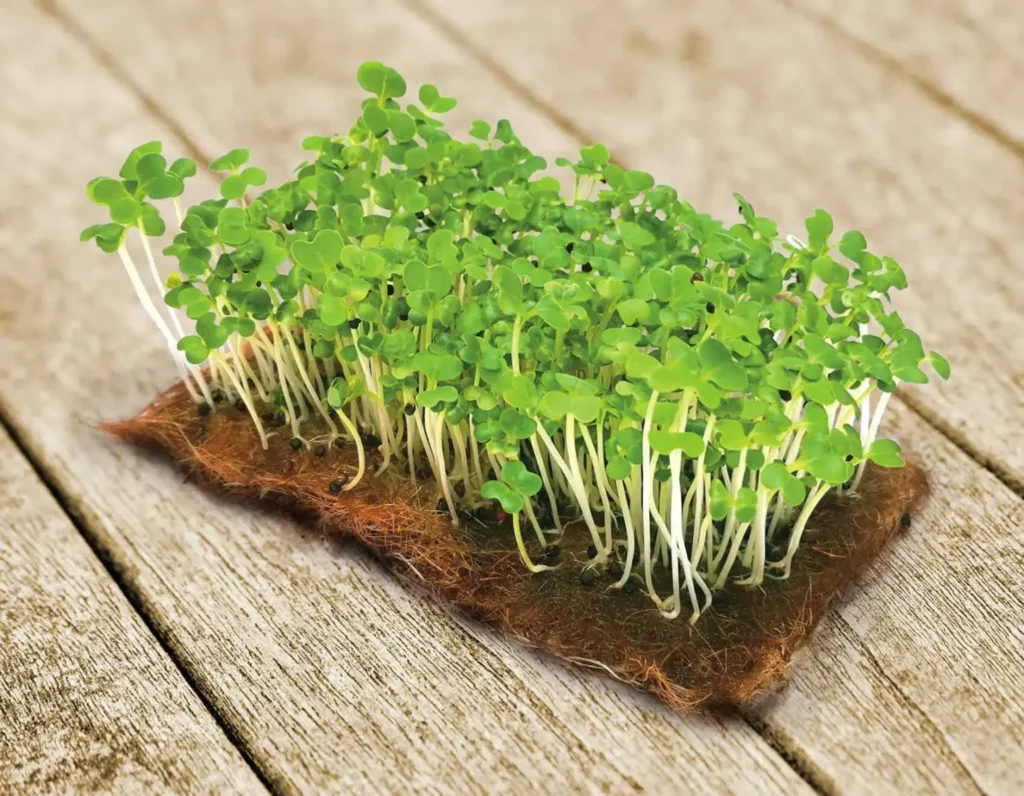
The main feature. The stem is thick, white, elastic - when bitten, it gives a distinct crunch and a burst of juice
Ripening and optimal harvest time
The stem is still thin, the cotyledons are just opening.
Optimal: the stem is thick and white, the cotyledons are large, the crunch is maximum.
The stem begins to become woody, the leaf turns yellow from below.
Why flavor may vary batch to batch
The thickness and color of the stem depend on the lighting. In strong light, the stem is snow-white, hard and juicy - this is the marketable appearance. In low light - pale green or yellowish, thin, less juicy. This is the most common cause of difference between parties.
Culinary use
How to use
Pak Choi is a great culinary accent. Add fresh at the end of cooking or directly on the plate.
Ramen and pho
a few stalks of pak choi in the finished plate before serving - the white stalks against the background of the dark broth look restaurant-like
Wok noodles
add to the already prepared dish on a plate - the stem will soften slightly from the heat, but will retain its juice and shape
Sashimi and rolls
pak choy as a base instead of shiso or lettuce - the white color emphasizes the fish
Salmon sandwich
between layers instead of a cucumber - does not release excess moisture and keeps its shape longer
Bowl in Asian style
rice or buckwheat noodles + pak choi + avocado + tamari sauce — minimalistic and delicious
Salad with miso dressing
pak choy + edamame + sesame + miso dressing is a classic of Japanese café
Perfect pairings
Microgreens are added to an already prepared dish, not during the cooking process
Fatty meat in sweet and sour or oyster sauce - pak choi gives freshness and crunch, balancing fat
The delicate taste of pak choy does not overpower the delicate taste of seafood - a good alternative to cucumber for textural contrast
- Do not add to the dish during cooking - from prolonged heating, the stalk will instantly wither and lose all its crunch
- Do not water immediately before cutting and selling - the stem accumulates water and will "flow" in the package
- Do not expect spiciness or piquancy - pak choi is very neutral, for spiciness it is better to add mustard or radish separately
Home storage
How to store
Pak Choi keeps longer than most microgreens. Follow simple rules to keep it fresh for up to 14 days.
Refrigerator +4...+6°C. The term is up to 14 days in the tray. Cut just before serving.
Place in an open container or plate, cover with a damp paper towel. Don't seal — without air, greens yellow faster.
Don't wash until ready to eat. Wet greens spoil much faster. Rinse just before serving.
Nutrients & health
Benefits & composition
Pak Choi is valued for its rich vitamin-mineral composition and bioactive compounds typical of microgreens.
Like most microgreens, pak choi contains a concentrated amount of nutrients relative to its weight — many times more than the mature plant.
| Protein | 2.0 g — building material for cells |
|---|---|
| Calories | ~13 kcal |
| Vitamins | A |
| Minerals | Calcium, Potassium, Magnesium |
- People taking blood thinners — because of the vitamin K content in leafy greens, should stick to a moderate amount and consult a doctor
- With diseases of the thyroid gland - cruciferous vegetables in large quantities in raw form can be relevant; moderate use is not a problem for most people, but for specific purposes, check with your doctor
This information is general in nature and is not medical advice. Composition data: USDA FoodData Central.
Worth knowing
Calcium
pak choi is traditionally considered highly digestible—unlike some other plant-based sources of calcium, bok choy contains relatively less oxalates, which interfere with absorption.
Vitamin C
is contained in a noticeable concentration - pak choi microgreens are a vegetable source of this vitamin.
Very low calorie
(~13 kcal per 100 g) combined with a juicy texture makes pak choi an interesting option for those who want to add volume and freshness to a dish without calories.
Glucosinolates
characteristic of all cruciferous plants, including pak choy. The body converts them into isothiocyanates — active compounds studied in the context of cellular protection and support of detoxification processes.
Similar crops
Similar by taste microgreens
If you are looking to complement or replace Pak Choi:
Pak Choi: how to grow — step-by-step guide
Growing parameters, agronomy, common mistakesGrowing parameters
Small, round, reddish-brown
Step-by-step guide
Seed preparation
The seeds are small, without soaking. Sow dry.
Sowing
- Moisten the substrate evenly
- Sprinkle 2 g seeds as evenly as possible - with a low rate, the unevenness is noticeable
- Spray liberally from a spray bottle
- Press lightly with the palm of your hand
To evenly distribute small seeds at a low rate, mix them with dry vermiculite before sowing. Vermiculite is clearly visible on the substrate - gaps are immediately visible. After sowing, it also keeps moisture near the seeds.
Clamp — 0.5–1 kg
Pak-choi forms powerful roots that go deep into the substrate - a clamp helps this process and ensures straight, vertical stems.
- Empty tray on top + 0.5–1 kg
- Evenly over the entire surface
Darkness (Blackout) — 3–4 days
What is normal:
- On the 2nd day, thick white fluff on the root — these are root hairs, not mold. In pak choi, they are especially abundant - a solid white "wool" at the base of the stem. They dry up in the light and disappear
- Friendly level stairs already for 2-3 days
What is NOT normal:
- Black or green mold with an unpleasant odor on stems and leaves
- Rotting of the base of the stem → waterlogging or poor air exchange
Watering: usually not needed. When drying - the lower one through the pallet.
Vegetation in the light — 5–7 days
Lighting is key to stem thickness:
- LED phytolamps: 16–18 hours a day, distance 20–25 cm
- Under strong lighting, the stem is snow-white, hard, juicy
- When weak - pale green or yellowish, thin, less juicy. This is the most frequent reason for an unsatisfactory result
Temperature: +18...+22°C. Pak-choi is cold-resistant, grows well in a wide range.
Watering: 1 time a day, lower through the pallet. Pak choi accumulates water in the stem - do not water, especially near the harvest.
Ventilation: critically important. A thick carpet of leaves retains moisture - daily ventilation is mandatory, otherwise there is a risk of mold near the root neck.
Watering
- Water it 1-2 times a day (in the morning - necessarily, in the evening - if necessary)
- Lower watering through a pallet is a priority; the upper one is allowed carefully
- Pak choi is tender - keep the substrate evenly moist, but without stagnation
- A sign of lack: the leaves become dull and slightly droop → water through the tray
Storage
| Uncut in tray | Fridge +4...+6°C | up to 3 weeks |
|---|---|---|
| Cut in container | Refrigerator | up to 7 days |
| Room temperature | 1–2 days |
Harvest
- Height 7–10 cm
- Stem white and poured - not greenish, not thin
- Cotyledons are large, fully opened
Scissors or a knife under the root, as close as possible to the substrate. Do not water for 8–12 hours before harvesting - pak choi accumulates water in the stem, wet products "flow" in the package.
Rinse in cold water immediately before use or sale.
Seasonal adjustments
- Soaking: reduce by 2–3 hours from the standard - the seeds are active in the heat
- Ventilation: open more often in the blackout phase to avoid excess moisture
- Watering: increase the frequency - the substrate dries faster at a higher temperature
- Expect: shortening of the cycle by 2–3 days, a more tender stem
- Soaking: increase by 2-3 hours from the standard - cold water is absorbed more slowly
- Placement: keep the trays in a warmer place (next to the battery, but not close to it)
- Watering: use water at room temperature—cold slows growth
- Expect: lengthening the cycle by 2-4 days, denser and more fragrant result
Water pH and EC
Optimum range for Pak Choi Cabbage: 6.0–7.0. Pak-choi grows optimally in a weakly acidic-neutral environment. Asian cabbages are generally less picky about pH than classic crucifers.
Optimal range: 1.0–1.8 mS/cm. Moderate mineralization is ideal. Pak-choi gives the most delicate taste when using filtered or slightly mineralized water.
Experienced grower tips
The stem is an indicator of quality
The snow-white, thick stem sells pak choi better than any description. If the stem is thin or greenish, the problem is in the lighting, not in the culture.
Pak choi + mizuna is an Asian mix
These two crops perfectly complement each other: the thick stem of pak choi and the lacy leaf of mizuna. Both have similar agricultural techniques and are prepared almost simultaneously.
Do not water before sale
The rule of "dry before cutting" is especially important for pak choi — the stem accumulates water and, when broken, gives condensate in the package, which spoils the product's appearance.
The living tray looks impressive
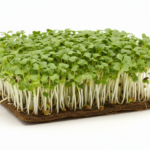
White stems on a green background in a tray are one of the most spectacular display options. Take pictures for social networks and menus.
Agronomy notes and common mistakes
- Sowing: No soaking. Medium-high density. Even distribution is the basis of a beautiful carpet.
- Clamp: Without clamping or light (0.5 kg), 1 day.
- Temperature: +16...+22°C. The optimum for Asian cabbage is coolness and moderate humidity.
- Watering: 1-2 times a day. When it is cool, a single watering in the morning is enough.
- Ventilation: It is important. Pak-choi is prone to "black leg" (stem rot) when moist air stagnates.
- The sowing rate is above 2 g → Stems interfere with each other, rotting → Strictly 2 g — a thick stem needs space
- Weak lighting → A thin pale green stem instead of a white juicy one → Phytolamps, powerful lighting is a must
- Watering before cutting → The product "flows" in the package → Do not water 8–12 hours before collection
- Panic due to root fluff → They throw away the tray, considering it to be mold → White fluff on the roots is the norm for cabbage plants
- Poor ventilation → Mildew with thick leaves → Daily airing, avoid air stagnation
- Delay → The stem becomes woody, the leaf turns yellow → Cut when the stem is white, no later than 11 days
Variety selection
Green pak choy
Shanghai, Joi Choi, Fortune
Standard selection. Classic green color, even germination, mild neutral taste.
Purple pak choi
Purple Lady, Red Choi
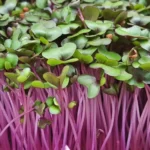
A distinct purple-green color with a similar taste. More decorative and spectacular in presentation.
Що далі?
More crops in the catalog
Explore similar and contrasting flavors — from basil to amaranth