Flavor profile
Taste & aroma
Gentle, nutty, fresh — Soft, sweet, with a distinct nutty shade on the finish. Almost absent, fresh aroma.
Soft, sweet, with a distinct nutty shade on the finish. There is no sharpness, no bitterness, no earthy notes
Almost absent, fresh, neutral - does not change the smell of the dish and does not compete with other ingredients, a rarity among greens.
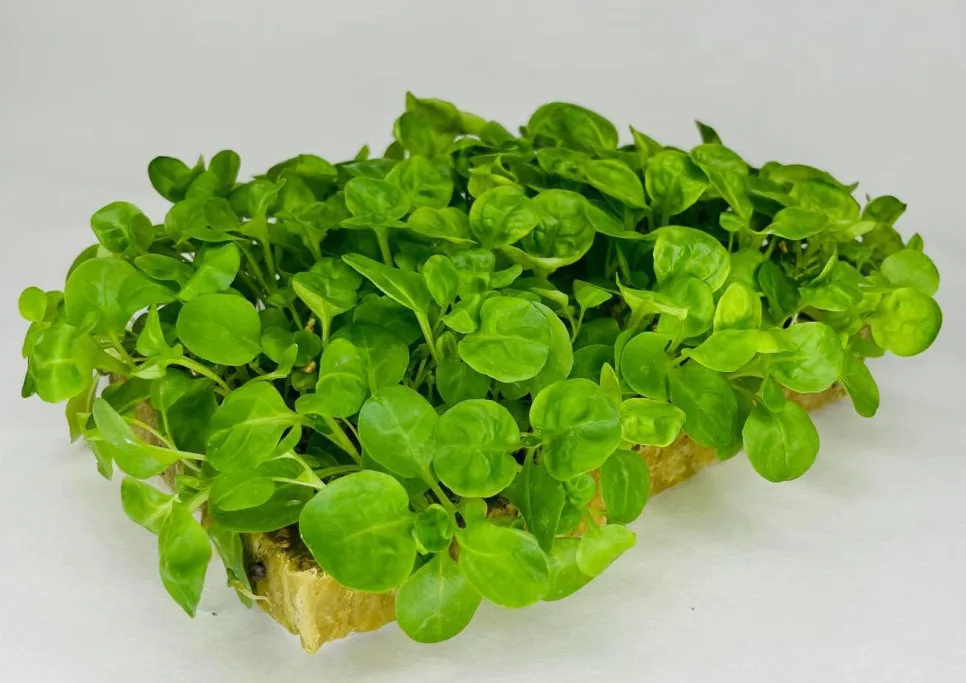
Gentle, Soft, Silky - similar to a tender leaf of young spinach, but lighter. The leaf does not wither for a long time after cutting
Why flavor may vary batch to batch
The taste of corn salad — delicate, nutty and sweet — practically does not change depending on the growing conditions. This is one of the most stable cultures. The only thing that significantly affects: at too warm cultivation (+24°C and above) leaves become limp and turn yellow quickly after cutting. At coolness (+14...+18°C) — dense, stable, long-lasting.
Culinary use
How to use
Corn Salad (Mâche) is a great culinary accent. Add fresh at the end of cooking or directly on the plate.
French salad with beets and goat cheese
corn salad is not a side dish here, but the main character. Baked beets, chevre cheese, walnuts and vinaigrette - a classic that needs no improvement
Toast with poached egg
a layer of corn salad under the egg provides an oily "pillow" that does not wilt from the heat and holds its shape until the last bite
Salad with pear and gorgonzola
sweet pear, spicy cheese and soft corn salad: three components that do not argue with each other
Bowl with salmon and avocado
corn salad instead of lettuce. The fattiness of the salmon and avocado emphasizes the nutty finish of the greens
Green smoothie
for those who are afraid of "green" taste. Corn salad in a blender gives color without a sharp taste - the perfect "invisible" ingredient
A cold snack on crackers
with cream cheese, capers and a handful of corn salad on top. It looks like a restaurant, it is prepared in a minute
Perfect pairings
Corn salad opens up in combination with sweet and sour flavors - they emphasize its nutty note
The fatty ingredients "reflect" the oiliness of the corn salad and enhance the nutty finish
Heavy cream sauces drown out the delicate taste — it is better to avoid
- Do not heat treat: from the heat, a tender leaf instantly turns into a slippery porridge without taste and shape.
- Do not refuel in advance: after 5–10 minutes in an acidic dressing, the leaf will settle and lose its volume. Season immediately before serving.
- Do not combine with very sharp components: watercress, mustard or chili will "destroy" the subtle nutty taste of corn salad. It is suitable for delicate, not aggressive combinations.
Home storage
How to store
Corn Salad (Mâche) keeps longer than most microgreens. Follow simple rules to keep it fresh for up to 3 weeks.
Don't cut more than you plan to eat right away. Store in refrigerator at +4...+6°C. No watering needed — natural moisture is enough.
Place in an open container or plate, cover with a damp paper towel. Don't seal — without air, greens yellow faster.
Don't wash until ready to eat. Wet greens spoil much faster. Rinse just before serving.
Nutrients & health
Benefits & composition
Corn Salad (Mâche) is valued for its rich vitamin-mineral composition and bioactive compounds typical of microgreens.
Like most microgreens, corn salad (mâche) contains a concentrated amount of nutrients relative to its weight — many times more than the mature plant.
| Protein | 2.0 g — building material for cells |
|---|---|
| Calories | ~26 kcal |
| Vitamins | A |
| Minerals | Potassium |
- There are no specific contraindications - corn salad does not contain mustard oils, alkaloids or irritants.
- It is well tolerated by a sensitive stomach and high acidity - it is mild and neutral in action.
- Suitable for a children's menu from the first introduction of greens: there is no sharpness, bitterness and distinct smell.
This information is general in nature and is not medical advice. Composition data: USDA FoodData Central.
Worth knowing
folic acid (B9)
Corn salad is a source of folic acid (B9), a vitamin that is traditionally included in the diet at various stages of life, in particular as part of a varied diet during pregnancy.
magnesium
It contains magnesium, a mineral that is involved in the work of the nervous system and muscles. Corn salad is suitable as part of the daily diet for those looking for light plant sources of this element.
of iron
The iron content in corn salad is higher than in most leafy salads — it is traditionally considered one of the "iron" greens along with spinach and arugula.
Antioxidants and biologically active substances
Microgreens are a concentrated source of antioxidants — compounds that are being studied in the context of protecting cells from oxidative stress. Regular consumption of a variety of microgreens is part of a balanced plant-based diet.

Corn Salad (Mâche): how to grow — step-by-step guide
Growing parameters, agronomy, common mistakesGrowing parameters
Medium, ribbed, non-mucous-forming
Watering
- Water it 1 time a day (in the morning)
- Bottom or careful top watering
- Corn salad is cool - at +10°C they grow, just slowly
- A sign of lack: tender rounded leaves curl slightly → water
Storage
| Uncut in tray | Fridge +4...+6°C | up to 3 weeks |
|---|---|---|
| Cut in container | Refrigerator | up to 7 days |
| Room temperature | 1–2 days |
Harvest
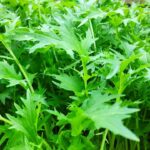
A rosette of 2–4 leaves is formed, the leaves have a characteristic spoon-shaped or elongated shape, a rich dark green color. Height 6–8 cm. If there are only cotyledons, wait another 4–5 days.
Cut as low as possible with a sharp knife or scissors - the corn salad stem is short. A tender leaf does not tolerate a blunt blade: it cuts the plant and leaves a crushed cut, which quickly darkens and licks.
Wash in cold water very carefully - corn salad does not tolerate rough handling. Shake gently in water, do not rub. Dry naturally - spread on a towel. Do not centrifuge.
Seasonal adjustments
- Germination: the seeds germinate poorly in the heat - the seedlings are uneven, some do not germinate at all
- Temperature: use an air conditioner, a cellar or a cold room - without this, the culture does not give a high-quality result
- Cycle: it is already long (18–26 days), in the heat it is extended by another 3–5 days
- Appearance: the leaf stretches out, turns pale, loses its characteristic rounded shape
- Recommendation: in the summer it is better to take a break or switch to seasonal crops
- Conditions: corn salad in its element - it grows denser, the leaf is dark green, the nutty taste is more pronounced
- Temperature: do not heat the substrate unnecessarily — +16...+18°C is already comfortable for this culture
- Expect: the cycle can be slightly longer up to 28 days, but the quality is maximum
Water pH and EC
The optimal range for corn salad: 6.0–7.0. Corn salad is unpretentious to pH. Cool temperature is much more important than pH for quality results.
Optimal range: 0.8–1.5 mS/cm. Low mineralization is ideal. At a cool temperature (+10–15°C), the substrate dries slowly — the risk of salinity is minimal.
Experienced grower tips
Plan your sowing 4 weeks ahead
Corn salad is not a "planted and sold after 10 days" crop. With a cycle of 18-26 days, you need a clear schedule: to have a constant harvest, sow a new batch every 5-7 days.
A live tray is the best packaging for selling
Due to the long cycle and delicate greens, it is more profitable to sell corn salad alive: less packaging costs, less risk of complaints, higher perceived value.
Control the temperature with a thermometer, not "by feel"
The difference between +20°C and +24°C is almost imperceptible to the touch, but critical for corn salad. An inexpensive digital thermometer with a sensor on the wire solves the problem.
Do not open the tray every day during the blackout
Corn salad reacts to changes in humidity and temperature more strongly than cabbage. Check once every 2 days - that's enough.
If the similarity is low, don't panic right away
Corn salad may sprout unevenly within 7–10 days. Give the tray a complete blackout and only then evaluate the result. Often the "bad" party levels itself by the 6th day.
Agronomy notes and common mistakes
- Sowing: No soaking. Medium-high density.
- Clamp: Light pressure (0.5–1 kg), 1 day.
- Temperature: +10...+18°C. The cooler it is, the more tender and tastier it is. It gets worse at +22°C.
- Watering: 1 time a day. When it's cool (+10°C), every other day is enough.
- Ventilation: moderate
- Growing temperature > 24°C → Liquid or zero sprouts, seeds rot → Lowering the temperature to +18...+20°C is critical for corn salad
- Impatience: early emergence → Sprouts are weak, thin, lie down → Keep full in the dark for 4–6 days until a confident growth of 3–4 cm
- Section at the cotyledon stage → The greens are not like corn salad, there is no characteristic shape → Waiting for the first pair of real leaves is another 4–5 days of patience
- Top watering during the growing season → Mildew at the base of the stems in the 2nd week → Only bottom watering in the tray, no exceptions
- Old or poor quality seeds → Similarity 30–50%, thin uneven carpet → Use seeds no older than 1 year, increase the rate
- Packaging "in longing" → Leaves stick together, lose their shape and appearance → Wide container without pressing, paper towel at the bottom
Variety selection
Field salad is ordinary
Vertue, Journal, Blanda
A standard choice for microgreens. Gentle taste, even germination, neutral base for mixes.
Large-leaf field salad
Plat d'Italie, Valery
Wider leaves and greater yield of mass. The taste is similar, but the texture is softer and juicier.
Що далі?
More crops in the catalog
Explore similar and contrasting flavors — from basil to amaranth