
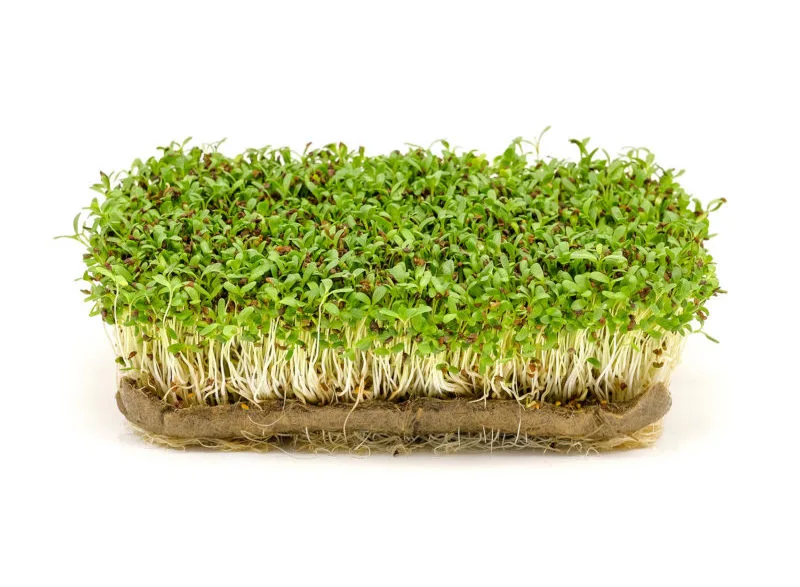
Flavor profile
Taste & aroma
Fresh, gentle, neutral - reminiscent of young green peas, but much gentler and less sweet. Light, grassy aroma.
reminiscent of young green peas, but much more delicate and less sweet. The taste is so delicate that alfalfa does not actually change the overall taste of the dish - it only adds a sense of freshness
Light, grassy - mowed grass and the first spring rain. Not spicy, not sharp. A scent that is felt more subliminally than overtly.
The main feature of culture. Thin elastic stems give a pleasant crunch with every bite - not rough, like a radish, but light, almost airy
Ripening and optimal harvest time
The cotyledons are opened, the taste is clean and fresh, the texture is as tender as possible — the optimal moment.
The first real leaf appears, the texture hardens a little, the taste becomes grassier.
The stem hardens, the crunch becomes coarser, the marketable appearance deteriorates.
Why flavor may vary batch to batch
Alfalfa is one of the most stable microgreens: the taste almost does not change depending on the conditions. But the texture and appearance depend on the temperature: at +18...+22°C sprouts are tender and juicy. At +24°C and above — tend to wither and turn yellow faster after cutting. The duration of cultivation significantly affects the content of isoflavones: longer vegetation (10+ days) gives a higher concentration.
Culinary use
How to use
Alfalfa is a great culinary accent. Add fresh at the end of cooking or directly on the plate.
Club sandwich or toast
a layer of alfalfa between ham and cheese - keeps its shape, does not get soggy, gives a crunch with every bite
Poke Bowl or Buddha Bowl
alfalfa as one of the components of the green zone — lightness and volume without dominance
Eggs benedict
a handful of alfalfa under the egg instead of spinach is a lighter and crispier base
Green smoothie
20-30 g of alfalfa in a blender together with spinach, cucumber and apple - an inconspicuous but essential part of the nutrient composition
Asian roll or rice paper
alfalfa inside - volume without weight, crunch without radish sharpness
Decor for soup or cream soup
a handful on top — "spring" lightness and textural contrast to the cream base
Perfect pairings
Sandwich, bowl, smoothie - the best combinations
Alfalfa does not get soggy under the sauce and keeps its crunch longer than lettuce
Alfalfa dissolves in the blender, leaving only freshness and nutrients without aftertaste or discoloration
- Do not add to hot dishes - the delicate texture instantly wilts from the heat
- Do not expect a taste accent - if a dish needs character, alfalfa is not the right culture, choose arugula or mustard
- Do not use as the only green in a salad - too light and neutral for an independent role, but perfect in a mix
Home storage
How to store
Alfalfa keeps longer than most microgreens. Follow simple rules to keep it fresh for up to 10–12 days.
Keep at +4...+6°C in the refrigerator. The term is up to 10–12 days. Alfalfa keeps turgor well in the tray thanks to the developed root system.
Place in an open container or plate, cover with a damp paper towel. Don't seal — without air, greens yellow faster.
Don't wash until ready to eat. Wet greens spoil much faster. Rinse just before serving.
Pro tip: **Practical hint for the grower:** Alfalfa is one of the cheapest crops to produce: cheap seeds, minimum seeding rate, simple agricultural techniques. The yield is low (28 g), but the cost is low. It is good to include in the basic assortment as an affordable position for customers who are just getting acquainted with microgreens.
Nutrients & health
Benefits & composition
Alfalfa is valued for its rich vitamin-mineral composition and bioactive compounds typical of microgreens.
Like most microgreens, alfalfa contains a concentrated amount of nutrients relative to its weight — many times more than the mature plant.
| Protein | 4.0 g — building material for cells |
|---|---|
| Calories | ~23 kcal |
| Vitamins | K |
| Minerals | Calcium, Iron, Phosphorus |
- For people with autoimmune diseases (systemic lupus and the like), some sources recommend that alfalfa be consumed sparingly because of its canavanine content, an amino acid that can interact with certain immune processes. Consultation with a doctor will be appropriate.
- People with allergies to legumes (peanuts, soybeans) should be careful - alfalfa belongs to the same family.
This information is general in nature and is not medical advice. Composition data: USDA FoodData Central.
Worth knowing
Alfalfa is a source
Alfalfa is a source of vitamin K and calcium, nutrients traditionally included in the diet to support bone tissue. At the same time, it is one of the lightest crops in terms of calories (~23 kcal per 100 g) - it can be added to any dish without counting calories.
Alfalfa phytoestrogens —
Alfalfa phytoestrogens are a subject of scientific interest in the context of women's health. In culinary amounts (a handful in a salad or smoothie), their effects are minimal and safe for most people.
Antioxidants and biologically active substances
Microgreens are a concentrated source of antioxidants — compounds that are being studied in the context of protecting cells from oxidative stress. Regular consumption of a variety of microgreens is part of a balanced plant-based diet.
Antioxidants and biologically active substances
Microgreens are a concentrated source of antioxidants — compounds that are being studied in the context of protecting cells from oxidative stress. Regular consumption of a variety of microgreens is part of a balanced plant-based diet.
Alfalfa: how to grow — step-by-step guide
Growing parameters, agronomy, common mistakesGrowing parameters
Small, hard, leguminous
Step-by-step guide
Seed preparation
Alfalfa is not soaked. Small hard seeds germinate well if the substrate is properly moistened without pretreatment.
Sowing
- Moisten the substrate evenly and well.
- Spread the seeds evenly. Norm 4 g — aim for a uniform distribution without thickened zones. When sowing more than 4–5 g, the plants suffocate each other, and rotting begins in the center of the box.
- Spray the surface abundantly with water from a spray bottle - the seeds should be well wet.
Alfalfa and clover are a perfect pair in the assortment. The same agricultural technology, the same cycle, minimal difference in taste. It is convenient to grow together, and it is profitable to sell "tender leguminous greens" as a mix.
Clamp — 1–2 kg
The clamp for alfalfa is needed for the rapid ingrowth of fine roots into the substrate and the formation of an even dense carpet. Without clamping, part of the sprouts remains "hanging" - the stems are uneven and tend to lie down.
Darkness (Blackout) — 4–5 days
Conditions:
- Complete darkness
- Temperature: +18...+22°C
- Watering is moderate, lower — the tender roots of alfalfa are sensitive to drying out; the substrate must remain evenly moist at all times
On the 2nd or 3rd day, thick white fluff will appear on the roots - root hairs, not mold. The test is standard: spray it with water and it will disappear. Mold will remain.
Shell reset: alfalfa usually sheds its seed coat on its own — it remains in the substrate or is easily washed away with water. If there are a lot of "helmets" on the leaf after coming out of the dark, spray on top and give it a few more hours.
A sign of readiness: the sprouts have raised the clamp, the height is 3–4 cm.
Vegetation in the light — 6–8 days
Alfalfa turns green quickly and evenly. The main task is not to overdo it and maintain uniform humidity.
Lighting: standard Alfalfa does not require intense light for color, but in very low light, the stem stretches out and turns pale - such a product quickly withers after cutting.
Watering: moderate, lower. The tender roots of alfalfa react quickly to drying out - the leaves immediately lose turgor. But overflow is also dangerous: with stagnation of moisture, the stem rots at the base.
Watering
- Moisturize 1-2 times a day EXCLUSIVELY fine fog
- NEVER water with a strong stream - the tiny sprouts stick together and die
- The best system: a spray bottle or a fine atomizer
- A sign of lack: tender sprouts begin to lie horizontally → mist gently
Storage
| Uncut in tray | Fridge +4...+6°C | up to 3 weeks |
|---|---|---|
| Cut in container | Refrigerator | up to 7 days |
| Room temperature | 1–2 days |
Harvest
- Cotyledons are fully opened, bright green
- The first true leaf has not yet appeared or is just emerging
- The crunch when touched is elastic and light
We cut bunches under the root with a sharp knife. Alfalfa is a "carpet" crop, it is cut quickly and conveniently.
Rinse in cold water before serving. Alfalfa tolerates washing well and does not darken. Dry in a salad spinner or with a paper towel.
Seasonal adjustments
- Soaking: reduce by 2–3 hours from the standard - the seeds are active in the heat
- Ventilation: open more often in the blackout phase to avoid excess moisture
- Watering: increase the frequency - the substrate dries faster at a higher temperature
- Expect: shortening of the cycle by 2–3 days, a more tender stem
- Soaking: increase by 2-3 hours from the standard - cold water is absorbed more slowly
- Placement: keep the trays in a warmer place (next to the battery, but not close to it)
- Watering: use water at room temperature—cold slows growth
- Expect: lengthening the cycle by 2-4 days, denser and more fragrant result
Water pH and EC
Optimum range for Alfalfa: 6.0–7.0. Alfalfa grows optimally in a neutral environment. As a legume, it is particularly sensitive to pH — at values above 7.5, a violation of nitrogen fixation is possible (not critical for microgreens, but it affects the taste).
Optimal range: 0.8–1.5 mS/cm. Low mineralization is ideal for tender alfalfa sprouts. Hard water (EC >2.0) can make it difficult for tiny seeds to germinate.
Experienced grower tips
Alfalfa is the best first crop for a beginner
Cheap seeds, simple agricultural technology, quick results. If you want to start with microgreens and understand the basic principles, alfalfa is an ideal start.
Desiccation is the main enemy
Unlike cabbages, which tolerate short-term drying, the tender roots of alfalfa react immediately. One missed watering in the heat — and the batch withers. Set a reminder or regular check.
Alfalfa + clover + broccoli = basic gentle mix
Three crops with the same agricultural technology and close cycles. Together, they give volume, different shades of green and a light variety of textures — a classic "healthy mix" for sandwiches and bowls.
Keeps crunch better than leafy greens
Alfalfa in a closed container at +4°C keeps the crunch for 7-9 days, which is better than most leafy crops. Convenient for a grower who ships once a week.
Position as "greens for those who don't like greens"
The neutral taste and light texture of alfalfa is an argument for those who add microgreens for benefit, not taste. Often, it is this culture that becomes the "entrance" of new buyers to the world of microgreens.
Agronomy notes and common mistakes
- Sowing: No soaking. Extremely high density - microseeds in a very thin even layer.
- Clamp: NO pressure - the tiny seeds do not tolerate pressure.
- Temperature: +18...+24°C. Moderate to warm temperatures are ideal.
- Watering: Mist ONLY, 1-2 times a day. The mucous membrane of the seed requires care.
- Ventilation: Critical. Mucous alfalfa sprouts stick together in a mass without ventilation.
- Fluff/mold confusion → Grover discards healthy tray → Spray with water: root hairs will disappear, mold will not
- Thickened sowing (more than 5 g) → Rotting of the stem in the center of the box from 4–5 days → Adhere to the norm of 4 g; when thickened, it will not be possible to fix it
- Drying out of the substrate → Leaves lose turgor, stems wither → Stable moderate humidity throughout the cycle; tender roots do not tolerate drying out
- Overflow → Decay of the stem at the base → Bottom watering, without standing water in the tray
- Weak lighting → Elongated pale stem, rapid wilting after cutting → Increase the intensity or move the boxes closer to the lamp
- Delay → Stiff stem, loss of delicate texture → Cut when the cotyledons are fully open, do not wait for a real leaf
Variety selection
Alfalfa sowing
Vega 87, Sinya hybridna, Yaroslavna
Standard selection. Tender shoots, mild taste, very fast germination.
Organic alfalfa seeds
Certified Organic Alfalfa
The same in agricultural technology, but without pesticides and fungicides. Important for organic production.
Що далі?
More crops in the catalog
Explore similar and contrasting flavors — from basil to amaranth