
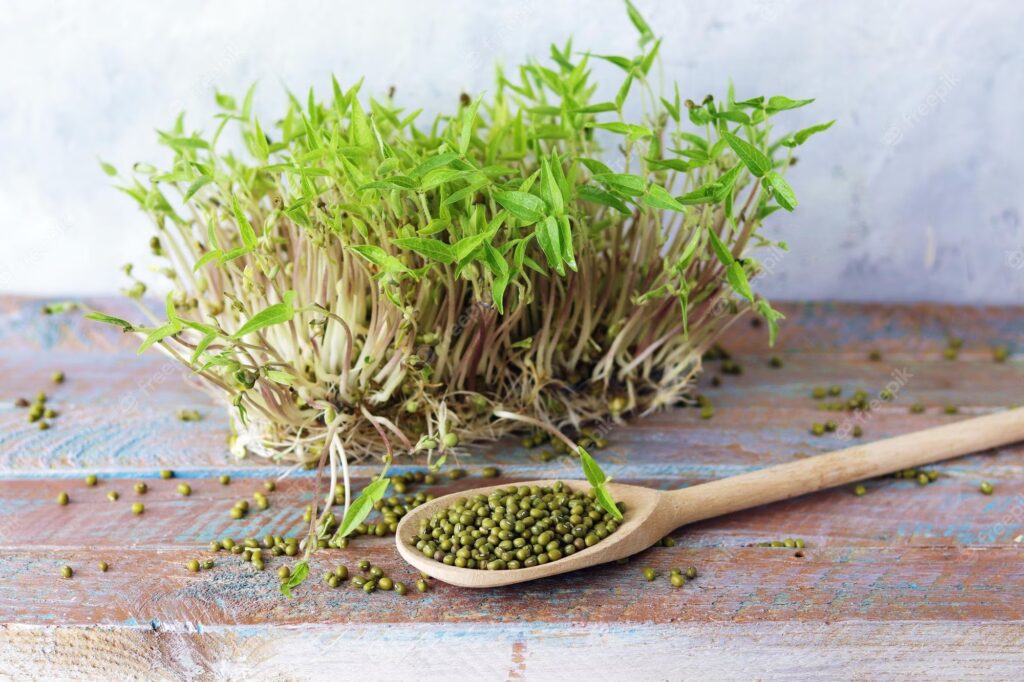
Flavor profile
Taste & aroma
Sweet, grassy, fresh - mung bean does not compete with the rest of the ingredients of the dish, but emphasizes its freshness. Neutral, fresh. No spice aroma.
mung bean does not compete with the rest of the ingredients of the dish, but emphasizes its freshness
Neutral, fresh. Without spiciness, without harshness - the pure "green" aroma of the sprout.
The main advantage of culture. The thick juicy stem literally "explodes" with freshness when bitten - like a cucumber, but more saturated
Ripening and optimal harvest time
A thick stem, large cotyledons, maximum crunch and juiciness are the classic format of sprouts.
The first real leaves appear, the stem is a little longer, the crunch remains, the taste is somewhat grassier.
The stem begins to harden and become fibrous, the leaf grows.
Why flavor may vary batch to batch
The crispness and taste of mung bean sprouts depend on the duration of germination. At shorter cycle (3-4 days) the sprouts are crunchy and almost tasteless — neutral. At a longer cycle (6–7 days) a soft bean flavor and a light grassy note appear. Temperature affects the texture: at +20...+22°C — juicy and crispy, at +26°C and above — more delicate, prone to rapid wilting.
Culinary use
How to use
Mung Bean is a great culinary accent. Add fresh at the end of cooking or directly on the plate.
Pho-bo or ramen
a handful of mash on a plate just before serving - a classic serving; hot broth will slightly warm, but will not boil the sprouts
pad thai
mung bean as a mandatory topping and part of the dish — together with peanuts and lime
Vietnamese spring rolls (gỏi cuốn)
mung beans inside with rice noodles, shrimp and fresh greens — for the right texture and volume
Salad with carrots and sesame dressing
mung beans + grated carrot + sesame oil + rice vinegar — a simple Asian salad in 5 minutes
Stir fry (wok)
mung bean is added 30 seconds before the end of cooking - it warms up, but retains its crunch
Bowl with rice and baked salmon
mung beans as a fresh, crunchy element next to warm components
Perfect pairings
Pho-bo, pad-tai, bowl are the best combinations
It is added to the plate fresh, so that the hot broth slightly "undermines" the stems, but does not boil them - the crunch remains with every sip
Ideal for salads with Thai or Korean dressings
- Do not cook longer than 1–2 minutes - the mung bean becomes soft and watery, the crunch disappears completely
- Do not use in dishes that require a spicy or distinct flavor accent — mung bean is neutral, it will not add character
- Do not replace mung beans with leafy greens in Asian dishes - the texture is fundamentally different
Home storage
How to store
Mung Bean keeps longer than most microgreens. Follow simple rules to keep it fresh for up to 10–12 days.
Keep at +4...+6°C in the refrigerator. The term is up to 10–12 days. Due to the dense structure of the stem, mung beans keep turgor very well.
Hermetic container at +4...+6°C. The term is up to 8–10 days. Important: do not pack wet - excess moisture accelerates decomposition. Be sure to dry before packing. Do not wash before use. ---
Don't wash until ready to eat. Wet greens spoil much faster. Rinse just before serving.
Pro tip: **Practical hint for the grower:** Mung bean is a record holder for weight output (250-300 g from a box) at a relatively low seed cost. This is one of the most profitable crops with the right agricultural technology. Position for Asian restaurants and food delivery where mung bean is a must ingredient and bought regularly.
Nutrients & health
Benefits & composition
Mung Bean is valued for its rich vitamin-mineral composition and bioactive compounds typical of microgreens.
Like most microgreens, mung bean contains a concentrated amount of nutrients relative to its weight — many times more than the mature plant.
| Protein | присутній g — building material for cells |
|---|---|
| Calories | ~30 kcal |
| Vitamins | C, K |
| Minerals | Potassium, Magnesium, Phosphorus |
- People with allergies to legumes (soy, peanuts, lentils) should be careful - mung bean belongs to the same family.
- The first use of large portions may cause slight bloating - as with most legumes, although sprouts are much better tolerated than cooked beans.
This information is general in nature and is not medical advice. Composition data: USDA FoodData Central.
Worth knowing
Mash in the format
Mung bean in the form of microgreens is absorbed much better than boiled mung beans - in the process of germination, part of the complex carbohydrates and phytic acid is broken down. This is the traditional argument in favor of sprouted mung beans in the Asian and Ayurvedic dietary tradition.
Culture is the source
The culture is a source of vitamin C and B vitamins with a very low calorie content (~30 kcal per 100 g) - you can eat large portions without counting calories.
Antioxidants and biologically active substances
Microgreens are a concentrated source of antioxidants — compounds that are being studied in the context of protecting cells from oxidative stress. Regular consumption of a variety of microgreens is part of a balanced plant-based diet.
Antioxidants and biologically active substances
Microgreens are a concentrated source of antioxidants — compounds that are being studied in the context of protecting cells from oxidative stress. Regular consumption of a variety of microgreens is part of a balanced plant-based diet.

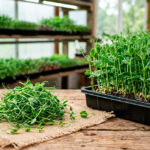

Mung Bean: how to grow — step-by-step guide
Growing parameters, agronomy, common mistakesGrowing parameters
Large, leguminous, with a hard shell, bright green
Step-by-step guide
Seed preparation — soaking for 10–12 hours
Soaking mung beans is a mandatory, not a desirable step. Without it, the hard shell does not allow the sprout to come out in time, and the seedlings will be thin and uneven.
How to soak:
- Pour in the beans cold with water - temperature is important. In warm water, mung beans start to ferment already during soaking, and a sour smell appears.
- Soak for 10-12 hours. You don't need much longer - over-soaked mung beans are also prone to souring.
- During this time, the beans will swell and increase in size by 2-3 times.
- Drain and rinse under cold running water before sowing.
A sign of normal soaking: the beans have increased in size, the shell has slightly wrinkled or started to crack along the seam. The smell is fresh, without acidity.
Problem symptom: a sour or unpleasant smell means that fermentation has begun. Such seeds should be washed and sown as soon as possible or soaked again in fresh cold water.
Soak mung beans in the refrigerator (+4°C) if the ambient temperature is above +22°C. The cold slows down fermentation and gives a more even soaking without the risk of souring.
Sowing
- Moisten the substrate evenly.
- Spread the swollen beans evenly a dense layer. 40 g of dry seeds will increase in size after soaking and fill the entire box. It is important that the beans lie in one layer - when stacked in two layers, the lower one will suffocate.
- Lightly spray the surface with water from a spray bottle.
Clamp — 1–2 kg
Masha is one of the strongest crops in terms of growth. Without pressure, the root system raises the entire layer of seeds into the air already on the first day — the sprouts grow evenly, but with the root up. The clamp forces the root to go deep into the substrate.
Rate: 1–2 kg. Even distribution throughout the box.
Darkness (Blackout) — 3–4 days
Conditions:
- Complete darkness or very low light
- Temperature: +18...+22°C
- Ventilation is mandatory from day one. A large mass of soaked seeds quickly sours with poor aeration. Ventilate the room or ensure air circulation every day
- Watering is moderate, lower - mung bean drinks a lot, but also sours with excess moisture
Shells ("helmets"): mung bean green shells often remain on the cotyledons. Unlike the hard skins of beets or Swiss chard, they are edible and not hard — not a defect. But if you want a clean look, sprinkle from above in the first days of vegetation: moisture helps the shells to come off.
A sign of readiness: the sprouts have confidently lifted the clamp, the height is 4–5 cm, the stem is dense and elastic.
Vegetation in the light — 5–7 days
Masha turns green quickly in the light and actively gains mass.
Watering: abundant, regular. The large biomass of mung bean actively evaporates moisture - the drying of the substrate is immediately noticeable by the appearance of the stems. Bottom watering is recommended, but mung bean also tolerates top shower - provided there is good ventilation. If the ventilation is weak, only the lower one.
Ventilation: retains its importance even at the stage of vegetation. With dense growth without air circulation, moisture accumulates in the lower part of the "forest" — the risk of acidification remains.
When to cut: at the stage of large opened cotyledons or at the appearance of the first true leaves between them - depending on the format you are growing. For classic sprouts — earlier (5–6 days). For microgreens with leaves — 8–10 days.
Watering
- Water it 1-2 times a day (in the morning - necessarily, in the evening - if it's warm)
- Lower watering is better; the top is permissible, but do not drown the seeds
- Masha germinates quickly and actively consumes water - do not let the substrate dry out
- A sign of lack: the sprouts stand straight, but the crunch disappears → water immediately
Storage
| Uncut in tray | Fridge +4...+6°C | up to 3 weeks |
|---|---|---|
| Cut in container | Refrigerator | up to 7 days |
| Room temperature | 1–2 days |
Harvest
- Cotyledons are large, open, bright green
- The stem is thick, elastic, juicy
- If desired, there are the first real leaves (a more "microgreen" format)
- Height 8–12 cm
Sharp knife under the root. The stem is thick and juicy - a clean cut is important for storage.
Rinse in cold water. Masha tolerates washing well. Important: be sure to dry before packing or storing - wet mung bean sours much faster than dry.
Seasonal adjustments
- Soaking: exclusively in the refrigerator - in warm water, mung bean starts to ferment after 8-10 hours
- Duration of soaking: reduce to 8–10 hours instead of the standard 10–12 — seeds swell faster when warm
- Ventilation: a fan on the rack is mandatory - without constant air movement, a sour smell appears on the 2nd day
- Odor control: check the tray every day in the first 4 days - at the first sour smell, immediately ventilate and reduce moisture
- Watering: reduce the rate - mung bean sours instantly in the presence of heat and excess moisture
- Thermostat: heating the substrate from below significantly improves the result - without heat, the seedlings are uneven and the cycle is extended to 13 days
- The risk of souring is lower: in winter, you can soak at room temperature - the cold naturally slows down fermentation
- Expect: prolongation of the cycle by 2–3 days; mung beans are denser and have a more pronounced bean flavor
Water pH and EC
The optimal range for mung beans: 6.0–7.5. Mung bean is tolerant to different pH values, including slightly alkaline environments. Even hard city water with a pH of 7.5–8.0 usually does not cause problems for a short cycle.
Optimal range: 0.8–1.5 mS/cm. Moderate mineralization is ideal. High EC (>2.0) when watering through a pallet can accumulate and give the finished product a somewhat grassy aftertaste.
Experienced grower tips
Cold water for soaking is not a recommendation, but a rule
The difference between soaking in cold (+10°C) and warm (+25°C) water is the difference between a fresh and sour product at the end. Especially critical in summer.
Smell is the main indicator of quality
Healthy mung beans smell fresh and neutral at all stages. Any acidity or unpleasant smell is a signal to act: increase ventilation, reduce watering, check the temperature. With a timely reaction, the party can still be saved.
250–300 g from the box is the highest yield among most cultures
At the cost of seeds of 40 g per box, this is one of the most profitable positions. But count the cost together with the cost of the soaked seed (it weighs three times more).
Mash tolerates an overhead shower — but only with ventilation
This is a rare advantage among microgreens. If you have good air circulation, watering mung beans from above with a shower nozzle is convenient and quick - abundant watering in seconds.
Asian cuisine restaurants are your regular customers
Mashed potatoes are a must-have ingredient in pho-bo, ramen, pad thai, and spring rolls. These establishments buy mung beans regularly and in large quantities. Start with one or two restaurants and mung beans will become your steady weekly supply.
Agronomy notes and common mistakes
- Sowing: Soaked (6–8 hours) mung bean — in a dense single layer. A small seed size gives a good yield.
- Clamp: 1–2 kg, 1–2 days. Mung bean sprouts quickly - a long press is not needed.
- Temperature: +20...+26°C. Heat-loving — growth slows down at +18°C; at +28°C it grows very quickly, but the quality is lower.
- Watering: 1-2 times a day. At a warm temperature (+26°C) - twice is mandatory.
- Ventilation: Important: in excess of heat and moisture, mung beans are prone to slimy coatings. Good air movement is prevention.
- Sowing without soaking → Liquid uneven germination, some seeds do not wake up → Soaking for 10–12 hours in cold water is mandatory
- Soaking in warm water or too long → Sour smell when soaking, fermentation → Soak in cold water (or in the refrigerator), no more than 12 hours
- Poor ventilation → Sour smell under pressure for 2-3 days → Ventilate daily; fan with a dense rack
- Weak grip → The root system lifts the seeds into the air → A pressure of 1–2 kg is mandatory, uniform throughout the box
- Drying after cutting → Mash withers and turns sour at room temperature → Store only at +4°C in a dry form; do not pack wet
- Delay → Stem hardens and becomes fibrous → Cut with large open cotyledons, do not wait too long
Variety selection
Mash green (standard)
Vigna radiata green beans
Standard selection. The maximum yield of mass among legumes, even germination.
Large-seeded mung bean
Jumbo Mung, Golden Mung
Greater output of weight per tray. The taste is identical - a neutral bean with a slight sweetness.
Що далі?
More crops in the catalog
Explore similar and contrasting flavors — from basil to amaranth