Flavor profile
Taste & aroma
Nutty, leguminous, tender — Reminiscent of young peas that have been generously sprinkled with lemon and lightly salted. Fresh, bean aroma.
It resembles young peas that have been generously sprinkled with lemon and lightly salted. Sour-fresh, leguminous, with noticeable organic acidity
Fresh, leguminous, earthy - a barely perceptible note of wet earth, which disappears when cut and does not affect the taste of the dish.
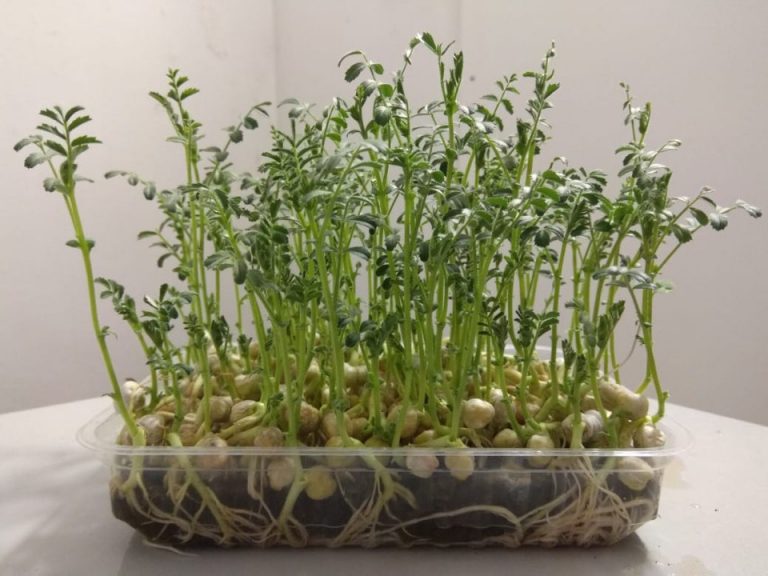
Dense, Juicy, Fleshy - this is what a healthy plant looks like
Why flavor may vary batch to batch
Tenderness and taste of chickpea sprouts depend on the duration of germination and temperature. At short cycle (3-4 days) sprouts are crispy, with a mild nutty taste. At a longer cycle (6–7 days) the taste is more pronounced and saturated, but the texture is more delicate. At temperature above +24°C sprouts quickly stagnate and become bitter - chickpeas do not tolerate heat well.
Culinary use
How to use
Chickpea is a great culinary accent. Add fresh at the end of cooking or directly on the plate.
Hummus
decorate the plate with chickpea sprouts from the same hummus. This is the decor, the taste connection, and the explanation of the dish without words. Be sure to sprinkle olive oil on top
Avocado toast without dressing
a handful of chickpeas instead of lemon juice and salt. Acidity and a salty accent are already in the greens
Fatty fish (salmon, mackerel)
chickpeas next to or on top. The sour-fresh accent balances the oiliness without the lemon
Warm meat dish
add after removing from heat. Villi and acid enliven heavy meat dishes
Mediterranean salad
with tomatoes, cucumbers, olives and feta. Chickpeas here replace the vinegar dressing and add a characteristic texture
Falafel
serve with chickpeas and thina instead of standard lettuce. Mediterranean duo in full force
Perfect pairings
The acid of the chickpeas acts as a dressing and eliminates the need to add vinegar or lemon
Acid "cuts" fat and refreshes heavy dishes
The contrast of textures (creamy paste + crispy hairy greens) and the taste connection between the ingredients
- Do not add to foods that already contain acid: if the dish contains tomatoes, vinegar or citrus juice, chickpeas will add excessive acidity. It either replaces the gas station, or it is not there at all.
- Do not heat treat: the heat causes the villi to lie down, the acid evaporates and the chickpeas become similar to any other fresh greens.
- Do not offer without warning: The "fluffy" texture and sour taste are unexpected for most people. A short explanation "these are natural hairs, not mold" removes 90% of questions.
- Do not combine with very sweet components: the acid of the chickpeas conflicts with the pronounced sweetness. Fruit salads and desserts are not his area.
Home storage
How to store
Chickpea keeps longer than most microgreens. Follow simple rules to keep it fresh for up to 3 weeks.
Don't cut more than you plan to eat right away. Store in refrigerator at +4...+6°C. No watering needed — natural moisture is enough.
Place in an open container or plate, cover with a damp paper towel. Don't seal — without air, greens yellow faster.
Don't wash until ready to eat. Wet greens spoil much faster. Rinse just before serving.
Nutrients & health
Benefits & composition
Chickpea is valued for its rich vitamin-mineral composition and bioactive compounds typical of microgreens.
Like most microgreens, chickpea contains a concentrated amount of nutrients relative to its weight — many times more than the mature plant.
| Protein | 8 g — building material for cells |
|---|---|
| Calories | ~50 kcal |
| Fiber | ~3–5 g |
- To people from increased acidity of the stomach chickpeas should be consumed carefully or avoided: organic acids can increase discomfort. Start with small amounts.
- To people prone to the formation of kidney stones it is worth remembering about the presence of oxalic acid and not to consume chickpeas in large quantities regularly - it is better to check with a doctor.
- Otherwise, chickpeas are well tolerated and have no specific restrictions for healthy people.
This information is general in nature and is not medical advice. Composition data: USDA FoodData Central.
Worth knowing
vegetable protein
Chickpea is one of the crops richest in vegetable protein among microgreens: like all legumes, it contains a complete set of amino acids in a significant concentration already at the sprout stage. This makes it an interesting option for those looking for a plant-based protein supplement.
apple and sorrel
Organic acids of chickpeas - malic and oxalic - are traditionally associated with stimulation of digestion and bile secretion. That is why chickpeas naturally "ask" for fatty dishes as a partner.
fibers
It is a source of fiber in a noticeable concentration. The hairs on a leaf are not just a textural feature, they are made up of plant cells with fiber that works as a soft mechanical support for the digestive tract.
Antioxidants and biologically active substances
Microgreens are a concentrated source of antioxidants — compounds that are being studied in the context of protecting cells from oxidative stress. Regular consumption of a variety of microgreens is part of a balanced plant-based diet.
Chickpea: how to grow — step-by-step guide
Growing parameters, agronomy, common mistakesGrowing parameters
Large, irregularly shaped beans
Watering
- Water it 1 time a day (in the morning)
- Bottom watering (through a pallet) is recommended; upper only when drying
- Chickpeas are more drought-resistant than peas - do not overmoisten: excess moisture quickly gives mold
- A sign of lack: the leaves curl a little, the substrate is dry to the touch → water
Storage
| Uncut in tray | Fridge +4...+6°C | up to 3 weeks |
|---|---|---|
| Cut in container | Refrigerator | up to 7 days |
| Room temperature | 1–2 days |
Harvest
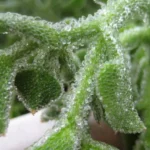
The leaves have opened, the hairs are distinct, the height is 8–12 cm. There are drops of acid dew on the leaf - this is a sign that the plant is in an active phase and the taste is maximum. If there are no acid drops yet, wait another 1-2 days.
With a sharp knife or scissors above the substrate. The stem is thicker than that of cabbage crops - cuts confidently. Cut in rows, not randomly across the tray.
Rinse in cold water - drops of acid dew will wash away. Dry on a towel. Remember: after washing, the acidic taste weakens somewhat (taste drops are washed away). If you sell in a live tray, the buyer cuts it himself and gets the maximum taste.
Seasonal adjustments
- Soaking: reduce by 2–3 hours from the standard - the seeds are active in the heat
- Ventilation: open more often in the blackout phase to avoid excess moisture and souring
- Watering: increase the frequency - the substrate dries faster at a higher temperature
- Acid dew: in the heat, the release of organic acids intensifies - collect on time, do not allow downtime
- Expect: shortening of the cycle by 2–3 days, a more tender stem
- Soaking: increase by 2-3 hours from the standard - cold water is absorbed more slowly
- Placement: keep the trays in a warmer place (next to the battery, but not close to it)
- Expect: prolongation of the cycle by 2-4 days, denser and richer result
Water pH and EC
The optimal range for chickpeas: 6.0–7.5. Chickpeas are tolerant to a wide pH range, including slightly alkaline environments. Even at pH 7.5–8.0 (hard water), there are practically no problems.
Optimal range: 0.8–1.5 mS/cm. Low mineralization is a priority. High EC (>2.0) with frequent watering can accumulate in the substrate and give a sour taste to the finished product.
Experienced grower tips
Prepare the customer for purchase
Lint and acid dew are two things that, without warning, cause questions and returns. Include an explanation on the package or in the description: "Clear drops are natural organic acids that give chickpeas their characteristic sour-fresh taste." The client to whom it was explained is satisfied. The client is surprised without explanation.
The fan is not an option, but equipment
Chickpea is the only crop where active blowing directly affects the marketability. Without ventilation, the acid accumulates on the leaves and leaves burns. A small USB fan aimed at the chickpea rack solves the problem completely.
A live tray is better than a cut one
After washing, the acid drops are washed away and the taste weakens. The buyer who cuts it himself gets the maximum taste and will explain to himself the villi and drops in a natural way.
Position as "natural gas station"
"Greens that are already salted and acidified" is a clear message for the buyer. Chickpeas replace lemon juice and salt in a dish — a concrete, practical benefit that's easy to explain.
Hydrogen peroxide during soaking - protection against acidification
Chickpeas tend to ferment more than peas or mung beans. A few drops of 3% peroxide in the first water during soaking is a simple and safe preventive measure.
Agronomy notes and common mistakes
- Sowing: Soaked (8–12 hours) chickpeas — in a dense single layer. Large seeds take up space - consider density.
- Clamp: 2 kg, 2–3 days. Chickpeas with a hard shell need a clamp for reliable contact with the substrate.
- Temperature: +20...+26°C. Chickpeas are heat-loving — at +16°C growth slows down significantly.
- Watering: 1 time a day. High humidity without ventilation is the main cause of mold.
- Ventilation: Good ventilation is critical — chickpeas are susceptible to mold complications in case of excessive humidity.
- Panic due to acid dew → Grover thinks "overflow" or "disease", stops watering → Touch the drop with your finger and taste it - if it is sour, everything is fine
- Confusion of villi with mold → Refusal of the batch → Explain to the customer in advance: villi are the physiology of chickpeas, not a fungus
- Poor ventilation → Brown spots of burns on the tips of the leaves from acid → A fan or active ventilation is a must
- Souring during soaking → Sour smell of beans, reduced germination → Change water every 6–8 hours, add hydrogen peroxide
- Sowing in several layers → Rot and smell from the bottom layer → One layer of beans - tight, but not a "sandwich"
- Weak grip → The beans are pushed up together with the substrate → 2 kg of the entire blackout
Variety selection
Nasturtium is annual
Jewel Mix, Whirlybird
Standard selection. Large leaf, honey-pepper flavor, even germination.
Climbing nasturtium
Empress of India, Black Velvet
Somewhat more spectacular leaves. The taste is identical - the spicy-honey profile is unchanged.
Що далі?
More crops in the catalog
Explore similar and contrasting flavors — from basil to amaranth