
Flavor profile
Taste & aroma
Sweet, nutty, tender - when cut higher, the taste of greens becomes more tender. Fresh, grassy aroma.
when cut higher, the taste of greens becomes more delicate
Fresh, grassy, leguminous - discrete, does not dominate other ingredients. Does not leave a specific "bean" smell, which occurs in cooked beans.
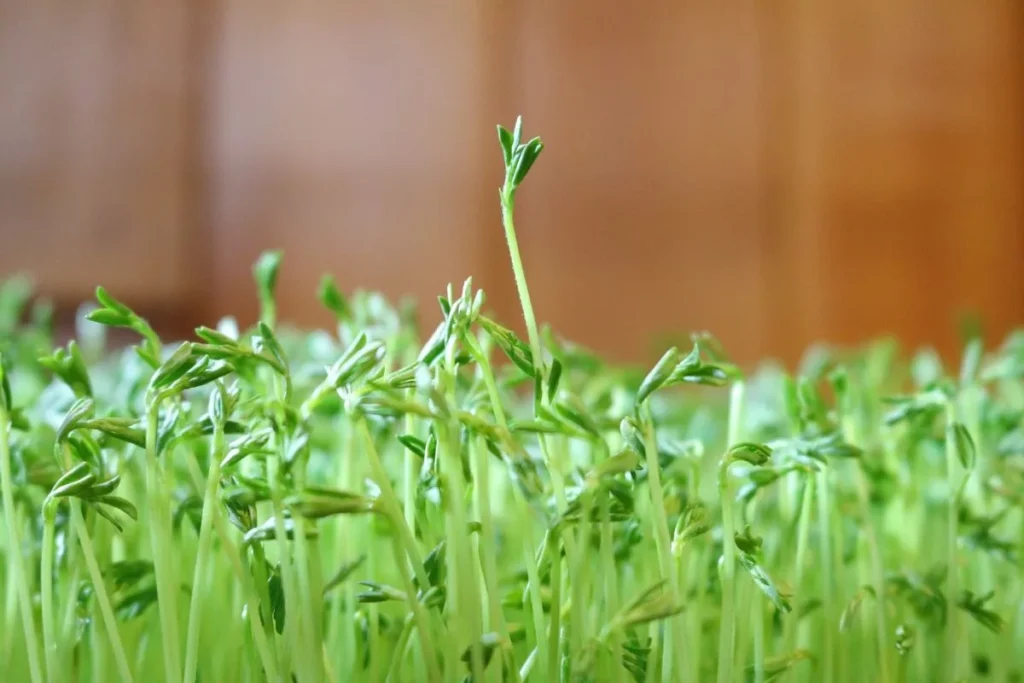
The stems are dense, filled with moisture, with a distinct crunch. The leaves are lacy, light - small paired leaves on thin stems
Ripening and optimal harvest time
Optimal moment: several layers of leaves, maximum juiciness, balanced taste.
The taste is richer, tendrils appear, the texture is slightly denser.
The stem begins to become woody, the taste becomes more neutral and slightly bitter.
Why flavor may vary batch to batch
The flavor of microgreen lentils can vary from batch to batch depending on several key factors:
- Germination temperature. At +18–20°C microgreens acquire a richer nutty taste; above +24°C — the taste becomes more grassy and slightly bitter.
- Duration of cultivation. Early cutting (7 days) gives a delicate, slightly sweet taste; late (10–12 days) — more pronounced "legume", dense.
- Substrate type. The taste is more delicate on coconut fiber; on the soil mixture - an earthy shade that enhances the "wild" nature of microgreens.
- Time of day of cutting. A slice in the morning after a night's rest captures more sugars — the taste is sweeter; after a stressful day - more neutral.
Culinary use
How to use
Lentil is a great culinary accent. Add fresh at the end of cooking or directly on the plate.
Snack instead of chips
a handful of lentils with a drop of lemon juice and a pinch of sea salt - crunchy, filling and guilt-free
Bowl with cereal
add to quinoa, bulgur or buckwheat - lentils provide a fresh contrast to a warm grain base
Soup before serving
a handful in a plate of hot tomato or meat soup - it will soften a little from the heat, but will retain its crunch and fresh taste
Avocado salad
lentils + avocado + cherry tomatoes + lemon dressing - a simple dish with a restaurant feel
Smoothies with protein
a bunch in a blender together with an apple, cucumber and ginger - the neutral taste will not spoil the cocktail, but will add vegetable protein
Toast with hummus
spread hummus on toasted bread, top with lentils and a drizzle of olive oil: a simple and nutritious breakfast
Perfect pairings
Salmon, soup, bowl are the best combinations
Lentils are a neutral but characteristic base
Lentils add a fresh texture and accent the protein without competing with flavor
- Do not add to dishes at the cooking stage - the crunch disappears instantly when heated
- Do not season with sour sauces long before serving - after 20-30 minutes the stalks will soften
- Do not replace all the greens in the salad with lentils - they are good in a mix, but alone can seem monotonous in taste
- Do not use as a decoration for dishes with a long shelf life - in 10-15 minutes on a warm plate it loses its elasticity
Home storage
How to store
Lentils are one of the most stable crops in storage. The dense stem and low moisture content in the leaf cells make it more durable than basil or dill.
Keep in the refrigerator at +2...+5°C. Cut into portions as needed - the rest stays fresh. Under these conditions, greens are stored for up to 10–14 days without losing their crunch.
Place in an open container or plate, cover with a damp paper towel. Don't seal — without air, greens yellow faster.
Don't wash until ready to eat. Wet greens spoil much faster. Rinse just before serving.
Pro tip: Lentils are well stored cut - the dense stem does not wither as quickly as basil or dill. This is an advantage when planning sales: you can cut a batch and sell it within a few days without losing quality.
Nutrients & health
Benefits & composition
Lentil is valued for its rich vitamin-mineral composition and bioactive compounds typical of microgreens.
Like most microgreens, lentil contains a concentrated amount of nutrients relative to its weight — many times more than the mature plant.
| Protein | 9 g — building material for cells |
|---|---|
| Calories | ~100 kcal |
| Vitamins | A, C |
| Minerals | Iron, Magnesium, Potassium, Zinc |
| Fiber | high |
- For people with high levels of uric acid: legumes contain purines - if prone to this condition, start with small portions and monitor the body's reaction
- For those with legumes that cause bloating: microgreens are absorbed much more easily than cooked lentils, but sensitive people should start with 20-30 g and gradually increase the portion
This information is general in nature and is not medical advice. Composition data: USDA FoodData Central.
Worth knowing
Vegetable protein in an easily digestible form
Lentils are traditionally considered one of the best vegetable sources of protein. Unlike cooked legumes, microgreens provide protein in its native form, not denatured by heat treatment. Can be an interesting addition to the diet for vegetarians, athletes and those looking for alternatives to meat.
iron
Lentils are a source of vegetable iron. For better assimilation of vegetable iron, it is worth combining it with products containing vitamin C - for example, with cherry tomatoes, bell pepper or lemon dressing.
Low glycemic index
Legumes are traditionally associated with a slow release of energy — without sudden spikes in blood sugar. Lentils as a microgreen can be an interesting addition to the diet for those who monitor the uniformity of energy throughout the day.
Fiber
provides a long-lasting feeling of satiety. It is the combination of protein and fiber that makes lentils one of the most satiating crops in the category of microgreens.
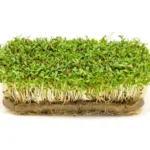
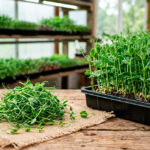
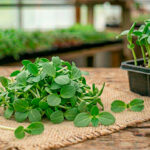
Lentil: how to grow — step-by-step guide
Growing parameters, agronomy, common mistakesGrowing parameters
Legume, medium size, smooth
Step-by-step guide
Seed preparation
For microgreens, green or brown edible lentils—those sold at a regular grocery store—are suitable. There are important nuances when choosing.
Which lentils are suitable:
- Green lentils (whole, with shell)
- Brown lentils (whole, shelled)
- Beluga black lentils
Which is not suitable:
- Red (orange) lentils - they are ground, without a shell. Soaked will simply dissolve and rot, will not germinate
- Chopped lentils ("halves") - the embryo is damaged, the germination is zero
- Any boiled or steamed lentils are "dead" grains.
Soaking is a mandatory stage:
- Cover the seeds with cold water in a ratio of 1:3
- Leave for 8-12 hours (overnight is convenient)
- After soaking, rinse with running water until clear - lentils secrete a specific mucus, which when left gives an unpleasant smell and increases the risk of mold
Add a teaspoon of apple cider vinegar to the soaking water to slightly acidify the environment and suppress pathogenic bacteria without harming the seeds. Before sowing, rinse with plain water.
Sowing
- Moisten the substrate evenly
- Spread the soaked and washed lentils in an even, dense layer
- The norm of 20–30 g gives the correct density - the seeds lie tightly, but in one layer without significant accumulation
- Lightly press with the palm of your hand or a flat object for tight contact with the substrate
Why is the norm important: less than 15 g — uneven, liquid "forest". More than 35 g — a suffocation zone appears in the center of the tray, where mold is almost guaranteed to appear in the lower tier.
Clamp
Required weight: 1–2 kg.
Lentils are a strong legume. Without pressure, the roots do not sink into the substrate, but raise the sprouts into the air. The result: uneven, unstable stairs that fall sideways.
How to organize:
- Empty tray on top + load 1–2 kg (a container filled with water, a board with a weight)
- The load must lie flat without distortions
Make a stack of several trays - the lower ones receive uniform pressure from the mass of the upper ones. For lentils and peas, this is the most effective way to organize a press without separate loads.
Darkness (Blackout) — 3–4 days
The pile stands in the dark at +18...+24°C. Lentils germinate quickly and amicably - this is one of the most reliable crops at this stage.
What is normal:
- The white fluff on the seeds is root fluff, not mold. It is slightly moistened and thready, but even
- The growth is uneven at the edges and in the center - it evens out in the light
What is not normal:
- Pungent sour or rotten smell → the seeds are not well washed after soaking or there is no ventilation
- Dark soft spots → decay. Reason: too dense sowing or raw substrate without drainage
Watering during a blackout: usually not needed. Lentils after soaking carry enough moisture for the first 3-4 days. If the temperature is higher than +24°C, spray from a sprayer on the 2nd day.
Vegetation in the light — 7–10 days
Expose to light when the sprouts reach 3-5 cm. Most sprouts will have their first tiny leaves by this time.
Lighting:
- LED phytolamps: 16–18 hours a day, distance 20–30 cm
- Natural windowsill: suitable, but turn the tray daily for even growth
- Lentils are not demanding on light intensity - they grow well at an average level
Watering:
- The bottom through the pallet is the main and best method
- 1-2 times a day depending on the temperature and humidity of the room
- A sign of deficiency: the leaves fade, the stems do not hold vertically
Ventilation:
Mold can develop in a dense mass of lentils (especially closer to the root neck) without air circulation. Provide moderate fan blowing or stable ventilation of the room from the first day in the light.
Cut just above the cotyledons (large seed lobes near the root)—they are edible, but hard and detract from the tenderness of the final product. The cut above gives greens without "pebbles" and a much nicer texture.
Watering
- Water it 1-2 times a day (in the morning - necessarily, in the evening - if the substrate has dried)
- Bottom watering is better - lentils are prone to stem rot when water gets on the sprouts
- The substrate should be moist, but not overmoistened
- A sign of lack: lacy leaves darken and dry from below → water through a tray
Storage
| Uncut in tray | Fridge +4...+6°C | up to 3 weeks |
|---|---|---|
| Cut in container | Refrigerator | up to 7 days |
| Room temperature | 1–2 days |
Harvest
- Height 10–12 cm
- Several tiers of small lacy leaves are formed at the top
- The stem is juicy, elastic, bright green
- The second real leaf has not yet started to grow
Scissors or a knife. Cut above the level of the cotyledons - the root part with large seed particles remains in the substrate. This increases product quality and facilitates packaging.
Rinse in cold water immediately before use or packaging. Wet greens stick together - let them drain and dry a little before packing.
Seasonal adjustments
- Reduce the soaking time to 6-8 hours: in warm water, the seeds swell faster, long soaking increases the risk of souring
- Rinse more thoroughly after soaking: in the heat, mucus is formed more actively and quickly gives off an unpleasant smell
- Ventilate the stack during a blackout: closed stack at +26°C — guaranteed risk of decay
- Shortening the cycle: expect a cut 2-3 days before the standard deadline
- Ventilation in the light is critical: a fan or constant ventilation is not an option, but a must
- Increase the soaking to 12-14 hours: cold water is absorbed more slowly, seeds need more time
- Water with water at room temperature: cold water at low temperatures stops root formation
- The cycle is extended by 2–4 days: growth slows down, but quality and crunch are better
Water pH and EC
The optimal range for Lentils: 6.0–7.0. Lentils prefer a neutral or slightly acidic environment. At a pH above 7.5, chlorosis (yellowing) of tender leaves may occur due to blocking the assimilation of trace elements.
Optimal range: 0.8–1.5 mS/cm. Low mineralization is ideal. For delicate lentils, a high EC (>2.0) can manifest as burning of the leaf edges during long-term cultivation.
Experienced grower tips
White fluff is always the norm
Root fluff on lentils (as well as peas) scares beginners, but it is a healthy sign. After exposure to light, it dries up and disappears within 1-2 days. True mold is green or black, with a pungent odor.
Always cut above the cotyledons
The large seed particles are hard and unpleasant to the tooth. A cut 1–2 cm above them gives tender greens without "pebbles" and significantly increases the quality of the product for the buyer.
Mix lentils + peas
Both cultures have the same cycle and the same conditions. In a 50/50 mix, peas add sweetness and tendrils, lentils add lacy leaves and a dense crunch. Looks spectacular, sold as a premium mix.
Store-bought lentils are a real option
For test batches or in the absence of special seeds, ordinary green lentils from the supermarket are suitable. The main thing is whole, not boiled and not chopped. After the first successful experiment, switch to seeds from specialized suppliers - germination and uniformity will be better.
Ventilation is not an option, but a rule
Among all crops of medium complexity, lentils are most prone to mold in the lower tier with dense sowing and stagnant air. A fan is the easiest and cheapest insurance against batch loss.
Agronomy notes and common mistakes
- Sowing: Soaking is mandatory - 8–12 hours in cold water, after which rinse until clear water. Distribute evenly in one dense layer, the rate of 20–30 g per standard tray.
- Clamp: 1–2 kg, 3–4 days. Without pressure, the roots do not go deep into the substrate - the sprouts rise into the air and fall to the side. The load must lie flat without distortions.
- Temperature: +18...+24°C. At +26°C and above, the risk of mold increases sharply - lentils are more sensitive than peas. At +16°C and below, growth slows down, but quality does not deteriorate.
- Watering: Lower through the pallet, 1-2 times a day. Lentils are particularly sensitive to stagnation of moisture on the stems — top watering is allowed only in case of a clear lack of moisture.
- Ventilation: Critical. Lentils are most susceptible to mold in the lower tier among legumes - ensure air movement above the trays from the first day in the light.
- Red or split lentils → Seeds do not germinate, rot → Use only whole green or brown seeds
- Poor rinsing after soaking → Sour smell in the first days, slime → Rinse to clear water after soaking
- Weak blowing in the light → Mold in the lower tier near the root → Fan or open ventilation from day one
- Too thick seeding (>35 g) → Suffocation and rotting in the center of the tray → Observe the norm of 20–30 g
- Cut with cotyledons → Hard "pebbles" in the product → Cut above the root lobes
- Overstay (15+ days) → The stem is fibrous, the taste is bitter → Cut no later than 12–14 days
- Weak grip → Unstable, falling stairs → Minimum 1 kg, even load
Variety selection
Green lentils
The most common and reliable choice. Stable similarity, even stairs, neutral taste with a slight nutty undertone. The largest yield of mass among all species.
Brown lentils
Similar agricultural technology, slightly more pronounced earthy aftertaste. Gives a beautiful dark green color of greenery.
Що далі?
More crops in the catalog
Explore similar and contrasting flavors — from basil to amaranth