
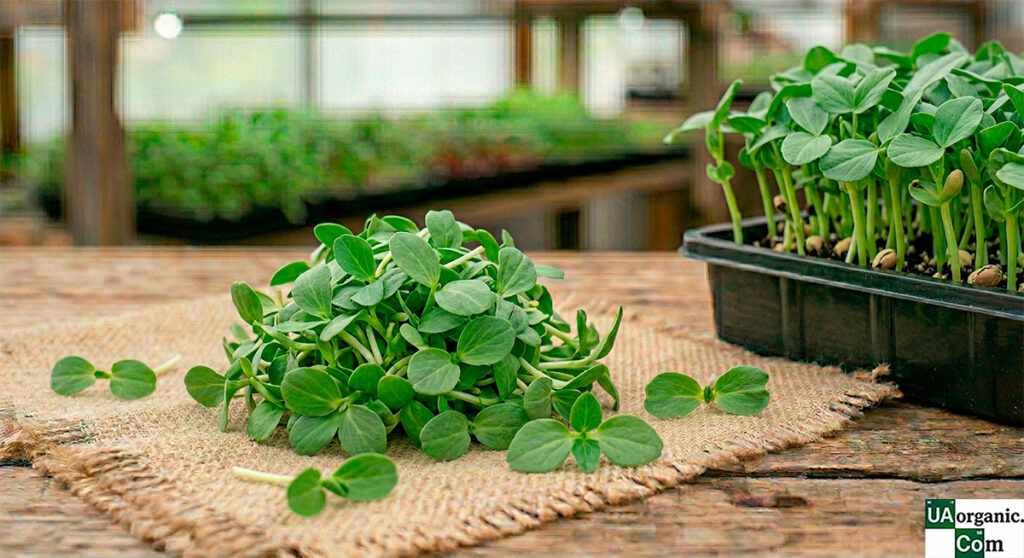
Flavor profile
Taste & aroma
Sweet, nutty, leguminous - similar to young green peas, but denser and deeper. Fresh, bean. Not an intense scent.
similar to young green peas, but denser and deeper. A slight astringency in the finish adds character
Fresh, bean. Not intense, but recognizable - like the smell of a newly opened pod of young beans.
The main advantage of culture. A thick, juicy, square cross-section stem with a crunch reminiscent of young asparagus or a stalk of celery
Ripening and optimal harvest time
The stems are still short, the taste is clean and sweet, the texture is delicate.
The height is 10–15 cm, the crunch is maximum, the nutty shade is distinct — the optimal moment of collection.
The stem begins to harden and become fibrous, the taste intensifies towards astringency.
Why flavor may vary batch to batch
The humidity of the substrate during cultivation significantly affects the taste. With excessive moisture, sprouts accumulate more bitter compounds — the characteristic "bean" bitterness intensifies. At optimal humidity, the taste is soft, pea-sweet. Temperature also plays a role: at cool cultivation (+16...+18°C) the sprouts are denser and sweeter, with warm (+22...+24°C) - juicier, but with a more pronounced bean taste.
Culinary use
How to use
Fava Bean is a great culinary accent. Add fresh at the end of cooking or directly on the plate.
Salad with parmesan and lemon dressing
chopped fava beans + parmesan shavings + olive oil + lemon juice — minimum ingredients, maximum taste
Steak with green garnish
fava next to steak instead of traditional greens is an equal partner in terms of texture and taste
Wok with garlic
30 seconds on high heat with garlic and soy sauce - one of the rare options for microgreens that do not melt from the heat
A snack by itself
fava stalks are crunchy and filling, an alternative to celery stalks or carrot sticks
Bowl with quinoa or brown rice
fava beans as the main green ingredient provide volume, protein and texture
Eggs benedict or omelette
thick juicy stalks under the egg instead of spinach - a different, denser and richer accompaniment
Perfect pairings
Parmesan, steak, bowl — the best combinations
The dense texture of fava beans stands up next to heavy meat — it doesn't get lost or distract
The stalks are cut into pieces of 2–3 cm and mixed with cheese
- Do not use whole stems in a salad - they are too large, it is more convenient to cut them into pieces of 2-3 cm
- Do not keep on fire for more than 1-2 minutes - with prolonged heat treatment, fava softens and loses its crunch
- Do not replace delicate microgreens where a delicate presentation is required - fava is coarse and massive, it is not a decoration for dessert
Home storage
How to store
Fava Bean keeps longer than most microgreens. Follow simple rules to keep it fresh for up to 10–12 days.
Keep at +4...+6°C in the refrigerator. The term is up to 10–12 days. Due to the dense structure of the stem, fava beans retain turgor much longer than leafy greens. Cut immediately before use.
Hermetic container at +4...+6°C. The term is up to 8–10 days. The stems do not darken and wither quickly - this is one of the most convenient crops to store after cutting. Do not wash before use. ---
Don't wash until ready to eat. Wet greens spoil much faster. Rinse just before serving.
Pro tip: **Practical hint for the grower:** Fava gives a record yield of 250-300g per box thanks to its massive fleshy stems. But the cost of seeds is high (40 g per box), so the culture is justified at premium positioning. Restaurants perceive fava beans as "microgreens for serious dishes" - emphasize this argument when selling.
Nutrients & health
Benefits & composition
Fava Bean is valued for its rich vitamin-mineral composition and bioactive compounds typical of microgreens.
Like most microgreens, fava bean contains a concentrated amount of nutrients relative to its weight — many times more than the mature plant.
| Protein | дуже високий для зелені g — building material for cells |
|---|---|
| Calories | ~35 kcal |
| Vitamins | K, C |
| Minerals | Iron, Magnesium, Potassium |
- Important: For people with favism (a genetic deficiency of the enzyme G6PD), eating fava beans—both as microgreens and in any other form—can cause a serious reaction. If you cannot tolerate regular beans or horse peas, fava microgreens are also not suitable for you.
- People prone to high levels of uric acid should limit their consumption of legumes, including fava beans, because of their purine content.
- When first consumed, start with a small portion — like most legumes, fava beans can cause bloating, although microgreens are much easier to digest than cooked beans.
This information is general in nature and is not medical advice. Composition data: USDA FoodData Central.
Worth knowing
There are fava beans
Fava beans are one of the richest plant-based sources of protein in a microgreens format—suitable as part of a varied diet for those following a plant-based diet or looking for alternatives to animal protein.
The culture contains L-DOPA
The culture contains L-DOPA, a natural amino acid that is a precursor to dopamine. This substance is studied in the context of the effect on neurotransmitter exchange. In culinary quantities of microgreen fava beans, this effect is not clinical, but the culture is often included in the diet as part of a neutral-positive diet.
Antioxidants and biologically active substances
Microgreens are a concentrated source of antioxidants — compounds that are being studied in the context of protecting cells from oxidative stress. Regular consumption of a variety of microgreens is part of a balanced plant-based diet.
Antioxidants and biologically active substances
Microgreens are a concentrated source of antioxidants — compounds that are being studied in the context of protecting cells from oxidative stress. Regular consumption of a variety of microgreens is part of a balanced plant-based diet.
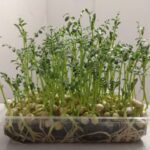
Fava Bean: how to grow — step-by-step guide
Growing parameters, agronomy, common mistakesGrowing parameters
Beans are the largest seed among microgreens
Step-by-step guide
Seed preparation — soaking for 12–24 hours
Fava beans are the largest seed among all microgreens. Without soaking, the hard shell does not allow the sprout to come out in time - the sprouts will be uneven, and some of the seeds may not come out at all.
How to soak:
- Pour the beans with water at room temperature in a ratio of 1:3.
- Soak for 12-24 hours. It is advisable to change the water every 8-12 hours.
- You can add a few drops of hydrogen peroxide (3%) to the soaking water to reduce the risk of mold developing on the surface of large beans.
- Before sowing, wash the beans under running water.
A sign of readiness for sowing: the shell of the bean has slightly increased and shriveled slightly, some are already starting to "open" at the seam.
Sowing
- Moisten the substrate evenly - it should be well wet.
- Spread the beans in one layer evenly across the box. 40 g is approximately 20–30 seeds. There should be a distance of 1–2 cm between beans: the space between large seeds is poorly ventilated and is a risk area for mold.
- Lightly press each bean against the substrate - so that it has contact with the wet medium along the entire bottom surface.
After the decomposition of the beans, spray the surface with a solution of phytosporin or a weak solution of peroxide (1:20). The large surface area of the beans collects mold spores — prevention at the start is much more effective than fighting the fungus later.
Clamp — 2 kg
The fava press is mandatory and more important than it might seem. The root system of beans is extremely powerful - without heavy pressure, the root will lift the entire layer of seeds into the air in the first day. It is necessary to force the root to go deep into the substrate.
Standard: 2 kg. Even distribution of weight throughout the box is mandatory.
Darkness (Blackout) — 3–4 days
Fava beans are one of the fastest crops to start despite their large seeds. Sprouts come out powerfully and confidently.
Conditions:
- Complete darkness: cover with a second box or move to a dark place
- Temperature: +18...+22°C
- Ventilation is critical from day one. The space between large beans is poorly ventilated, and moist stagnant air easily accumulates there, which provokes mold. Open the room or provide air circulation every day
- Watering is moderate, lower
A sign of readiness: the sprouts have confidently raised the clamp, the height is 5–7 cm.
Vegetation in the light — 8–12 days
Fava in the light grows quickly and spectacularly - sprouts resemble miniature trees. The main task is not to overdo it and ensure ventilation.
Watering: moderate but regular. A large vegetative mass of fava actively evaporates moisture - the drying of the substrate is immediately noticeable by the appearance of the leaves.
Ventilation: retains its importance even at the stage of vegetation. With dense growth and poor circulation, the lower leaves turn yellow and rot.
Bob at the base: sometimes the bean rises together with the sprout and remains at the base of the stem above the substrate. It is bitter and hard - it is not suitable for food. It is necessary to cut above the level of the bean.
Watering
- Water it 1-2 times a day (in the morning - necessarily, in the evening - if the substrate has dried)
- Bottom watering (through a tray) is the best option; top is acceptable, but avoid soaking the stems
- Fava beans are hydroponics, similar to peas: do not let the substrate dry out
- A sign of lack: leaves fade, stems stand straight but thin → water immediately
Storage
| Uncut in tray | Fridge +4...+6°C | up to 3 weeks |
|---|---|---|
| Cut in container | Refrigerator | up to 7 days |
| Room temperature | 1–2 days |
Harvest
- Height 10–15 cm
- The top formed a beautiful rosette of 2-3 leaves
- The stem is still juicy, not fibrous - check by bending slightly: the juicy stem is springy, fibrous - breaks
A sharp knife. The stems are thick and juicy - a blunt tool grinds and presses instead of cutting. Cut above the level of the bean, if it has risen above the substrate.
Rinse in cold water before serving. Fava tolerates washing well due to its dense structure. Dry with a paper towel.
Seasonal adjustments
- Soaking: reduce by 2–3 hours from the standard - the seeds are active in the heat
- Ventilation: open more often in the blackout phase to avoid excess moisture
- Watering: increase the frequency - the substrate dries faster at a higher temperature
- Expect: shortening of the cycle by 2–3 days, a more tender stem
- Soaking: increase by 2-3 hours from the standard - cold water is absorbed more slowly
- Placement: keep the trays in a warmer place (next to the battery, but not close to it)
- Watering: use water at room temperature—cold slows growth
- Expect: lengthening the cycle by 2-4 days, denser and more fragrant result
Water pH and EC
Optimum range for fava beans: 6.0-7.0. Fava beans are not picky about pH, but grow optimally in a weakly acidic to neutral environment. At a pH higher than 7.5 (hard tap water), slight yellowing of the edges of the leaves is possible on the 10th–12th day.
Optimal range: 0.8–1.5 mS/cm. For microgreens on a substrate without additives, EC is of secondary importance. Very mineralized water (EC >2.0) with frequent watering can give a slight bitterness in the finished product.
Experienced grower tips
Fava is the record holder for output
250–300 g from one berry box is the highest figure among all cultures. But do not forget to consider the cost: 40 g of seeds per box is much more than 3-5 g for most crops.
Cut - not whole
When selling or serving fava beans, tell the customer to cut the stems into pieces of 2-3 cm. Whole stems of 15 cm are inconvenient to eat, but when cut, they immediately acquire the desired format for a salad or side dish.
Ventilation is more important than watering
In most cultures, the most common mistake is overflow. Favas have poor aeration between large beans. If you have a fan on the rack, direct the flow to the fava boxes from day one.
Fava can withstand heat treatment
This is a rare advantage for microgreens. Expand the application: not only salad, but also warm dishes, wok, side dish. Chefs appreciate it.
Warn about favism
When selling to restaurants or retail, be sure to indicate on the package or in the description that the product contains fava beans and is contraindicated in G6PD deficiency. It's not just politeness, it's a matter of safety.
Agronomy notes and common mistakes
- Sowing: Soaked (8–12 h) beans - in a dense single layer, evenly. Large seeds are a must.
- Clamp: 2–3 kg evenly, 2–3 days. Critical: without clamping, the roots do not go deep into the substrate.
- Temperature: +18...+24°C. At +26°C, growth slows down; at +16°C — slowly but evenly.
- Watering: 1-2 times a day, bottom watering is a priority. Beans do not tolerate stagnation of moisture in the lower layer.
- Ventilation: moderate Large cotyledons tolerate ventilation well, but do not like cold drafts.
- Insufficient soaking → Uneven growth: some sprouts are already 5 cm, others have not yet woken up → Soaking for 12–24 hours is mandatory; with uneven stairs, wait for the majority and then take it to the light
- Poor ventilation under the clamp → Mold between beans for 2-3 days → Ventilate the room daily; the distance between beans when sowing is 1–2 cm
- Insufficient clamping → The root lifts the seed layer into the air, the sprouts "hang" → 2 kg of pressure is mandatory, evenly distributed over the box
- Sowing without mold prevention → Mold on the surface of the beans from the first day → Treat the seeds with peroxide or phytosporin during soaking or after
- Delay in vegetation → The stem becomes fibrous, the leaves turn yellow from below → Cut at a height of 10–15 cm, do not wait any longer
- The cut includes a bean → Bitterness in the dish from the residue of the bean shell → Cut above the level of the bean; if necessary, remove the beans with your hands before serving
Variety selection
Horse beans are large-seeded
Vyshhorodsky, Astra, Rose
Standard selection. Large mass output, rich bean taste, even germination.
Horse beans are small-seeded
Little Mermaid, Postman, Typhoid
Less output but denser texture. The taste is more pronounced - ideal for accent dishes.
Що далі?
More crops in the catalog
Explore similar and contrasting flavors — from basil to amaranth