
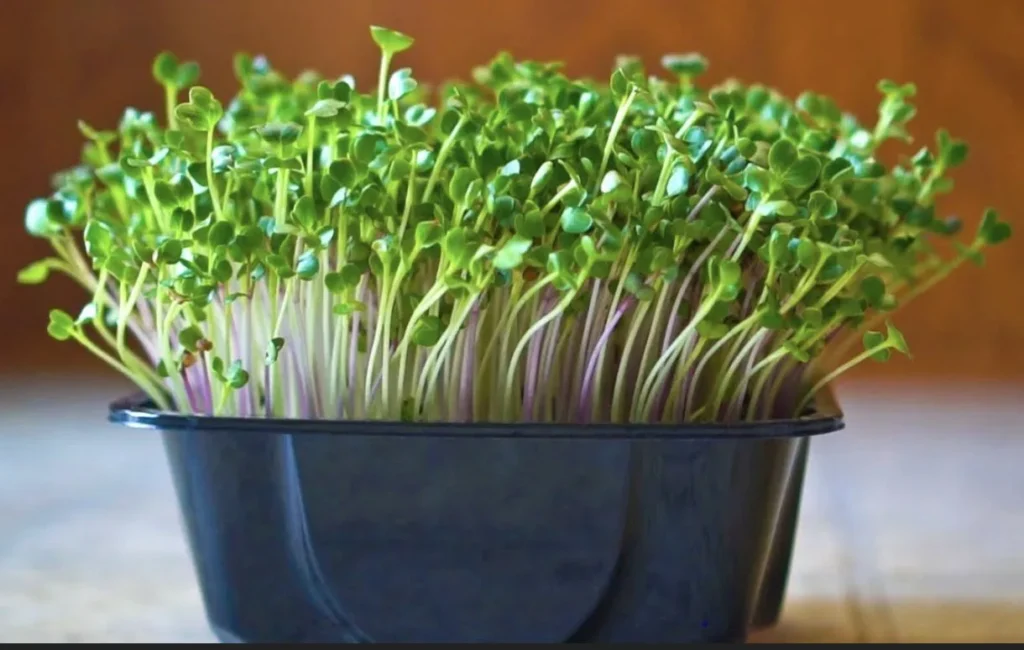
Flavor profile
Taste & aroma
Soft, grassy, nutty - something between young spinach and beet greens. Fresh, neutral aroma.
something between baby spinach and beet greens. Very delicate: not dominating, not interrupting, just present
Fresh, neutral, almost imperceptible. Does not leave any extraneous smell.
The most delicate among all microcultures are thin stems and small leaves that are almost not felt separately in the dish. Lightness and airiness, not crunch
Ripening and optimal harvest time
The cotyledons have just opened, the taste is the most tender and clean.
Optimal: sprouts 5–8 cm high, maximum balance of nutrition and taste.
The first real leaves appear, the stem begins to become woody, the taste becomes more distinctly grassy.
Why flavor may vary batch to batch
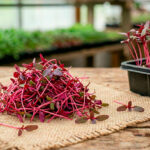
The color depends on the variety. Red Quinoa — pink or burgundy stems, visually impressive. White quinoa — green or cream stems, neutral appearance. The difference in taste between the varieties is minimal. When growing the red variety, the intensity of the color depends on the lighting — with strong light, the color is more saturated.
Culinary use
How to use
Quinoa is a great culinary accent. Add fresh at the end of cooking or directly on the plate.
Avocado toast
a handful of quinoa on top instead of or next to other microgreens — light, tender, beautiful (especially the red variety)
Smoothies
banana + mango + a handful of quinoa — you enrich the drink with vegetable protein without changing the taste
Bowl
as one of the components of mixed greens, where quinoa plays the role of "air filler"
Cream soup when serving
a few stalks of red quinoa on the surface — a bright splash of color on a cream background
Ricotta or soft cheese on bread
quinoa on top + a drop of honey — a simple and beautiful snack
Egg dishes
omelette, poached eggs - sprinkle on top when serving, the stems will slightly wilt from the heat
Perfect pairings
Avocado, eggs, bowl are the best combinations
Quinoa "lies" on avocado toast or ricotta without interrupting their delicate taste
Perfect for those who don't like the "grassy" taste — quinoa dissolves imperceptibly
- Don't expect crunch — the texture of quinoa is delicate and thin; add sunflower or peas separately for crunch
- Do not add to a hot dish during cooking - the tender sprouts will instantly wilt from the heat
- Do not store in an airtight package with condensation - quinoa is sensitive to moisture during storage, the stems stick together and darken
Home storage
How to store
Quinoa keeps longer than most microgreens. Follow simple rules to keep it fresh for 5–7 days.
Refrigerator +4...+6°C. The term in the tray is 5–7 days. Cut just before serving.
Place in an open container or plate, cover with a damp paper towel. Don't seal — without air, greens yellow faster.
Don't wash until ready to eat. Wet greens spoil much faster. Rinse just before serving.
Nutrients & health
Benefits & composition
Quinoa is valued for its rich vitamin-mineral composition and bioactive compounds typical of microgreens.
Like most microgreens, quinoa contains a concentrated amount of nutrients relative to its weight — many times more than the mature plant.
| Protein | Повний амінокислотний профіль g — building material for cells |
|---|---|
| Calories | ~35 kcal |
| Vitamins | A, C, E |
| Minerals | Iron, Magnesium, Calcium, Zinc |
- Quinoa is one of the most hypoallergenic microcultures — there are no specific restrictions for most people
- With confirmed sensitivity to quinoa or the quinoa family (Chenopodiaceae: spinach, beetroot, amaranth) - should be avoided
- Plant-based iron from quinoa is better absorbed in combination with vitamin C - add lemon juice or tomatoes to the dish
This information is general in nature and is not medical advice. Composition data: USDA FoodData Central.
Worth knowing
Complete vegetable protein
Quinoa is one of the few crops that contains all the essential amino acids. This makes it an interesting addition to the diet for those who eat meat-free or are looking for a variety of protein sources.
iron
is found in quinoa in an appreciable amount for a plant product. Plant-based iron is traditionally better absorbed in combination with vitamin C — lemon juice or tomatoes with a quinoa dish will enhance absorption.
Gluten-free culture
Quinoa is not a grain — it belongs to the leguminous family (like spinach, beets, amaranth). Suitable for people with gluten sensitivity.
Magnesium and zinc
in the composition make quinoa interesting for those who monitor the diversity of the mineral composition of the diet.
Quinoa: how to grow — step-by-step guide
Growing parameters, agronomy, common mistakesGrowing parameters
Small, disk-shaped (pseudo-cereal culture)
Step-by-step guide
Seed preparation
Quinoa seeds are very small and disk-shaped - one of the smallest among microcultures. Soaking is prohibited: with prolonged contact with water, small seeds sour and stick together in a lump. Sow only dry.
Sowing
- Moisten the substrate evenly
- Spread the seeds as evenly as possible - due to their small size, unevenness is critical
- Spray liberally from a spray bottle
- Press lightly with the palm of your hand
Due to the very small size of quinoa seeds, it is convenient to sow them through a fine sieve. An alternative is to mix with dry vermiculite: light vermiculite is easily visible and helps control uniformity.
Clamp — 0.5–1 kg
The pressure is light - quinoa seeds are small and easily crushed by a heavy load. 0.5–1 kg is enough for rooting.
Darkness (Blackout) — 2–3 days
Quinoa germinates quickly — one of the fastest starters among microcultures.
What is normal: sprouts already on the 2nd day; uneven height - the quinoa goes down in waves.
What is NOT normal: mold on the roots → waterlogging. Quinoa is especially sensitive to excess moisture at the start, the roots are tender. Ventilate, reduce substrate humidity.
Watering: usually not needed. When drying out, very careful bottom watering through a pallet, the minimum amount of water.
Vegetation in the light — 5–7 days
Lighting: LED phytolamps 16–18 hours a day. Moderate intensity - with excessively powerful light, the leaves become stiffer, with weak light - the stems are stretched and lie down. For Red Quinoa, stronger light gives a richer pink-burgundy color.
Temperature: +20...+22°C is optimal. When overheating (+26°C and above), the stems become too thin and weak, lie down.
Watering: very careful, 1 time a day or less often - only the lower one through the pallet. The substrate is moist, but the air around the stems is dry. Good ventilation is a must.
If the quinoa has fallen, a light blow with a fan helps to lift and strengthen the stems. Air movement stimulates stem thickening.
Watering
- Water it 1-2 times a day (in the morning - mandatory)
- Bottom or shallow top watering - quinoa is moderately moisture-loving
- Cooler temperatures require less watering — monitor
- A sign of lack: small leaves are slightly curled and matted → water
Storage
| Uncut in tray | Fridge +4...+6°C | up to 3 weeks |
|---|---|---|
| Cut in container | Refrigerator | up to 7 days |
| Room temperature | 1–2 days |
Harvest
The cotyledons have fully opened, the height is 5–8 cm. Do not be late: when the first pair of real leaves appear, the stem begins to become woody, and the taste becomes distinctly grassy.
Sharpen with a sharp knife or scissors in one movement - the greens are very soft and easily crumple from several passes.
Immediately before use or sale.
Seasonal adjustments
- Temperature: quinoa does not like heat — at +26°C and above, the stems become thin and tend to lie down
- Placement: choose the coolest place indoors, away from direct sunlight
- Cycle: shorten by 1-2 days - do not wait for the leaf to fully open
- Ventilation: important in warm weather - dense sowing will mold faster
- Color: Red Quinoa produces a paler pink in the heat—if color is important, grow in the cool
- Best season: optimum temperature — quinoa grows evenly and stably, stems are stronger
- Color: Red Quinoa gives the most saturated pink-burgundy shade when cool
- Cycle: can be extended by 1-2 days - do not rush to cut
Water pH and EC
Optimal range for quinoa: 6.0–7.5. Quinoa is a salt-resistant and relatively undemanding pH crop. Tolerates both weakly acidic and weakly alkaline environments. Hard tap water is fine.
Optimal range: 1.0–2.0 mS/cm. Quinoa is one of the most drought- and salt-resistant crops. Can handle higher EC than most microgreens when hydroponically. In substrate cultivation, EC is not critical.
Experienced grower tips
Red Quinoa sells itself
Pink and burgundy color on the background of ordinary green immediately attracts attention. If you want a spectacular photo for the menu or social networks, red quinoa is the best.
Less is better
Quinoa is easy to pour over. When in doubt, water less: tender roots recover from slight drying out much better than from excess moisture.
Quinoa in the mix
By itself, it is very tender and voluminous, but without crunch. In a mix with peas or sunflower (20-30% quinoa), you get the nutritional composition of a superfood and an interesting texture at the same time.
The fastest culture for planning
8–10 days — together with watercress, one of the shortest cycles. With weekly deliveries, quinoa is convenient for filling the "windows" between slower crops.
Agronomy notes and common mistakes
- Sowing: No soak or rinse. Very high density. Small seeds evenly.
- Clamp: Without clamping.
- Temperature: +15...+20°C. Quinoa is a cool crop. At +24°C it is susceptible to mold.
- Watering: 1-2 times a day. When it's cool (+15°C) — once a day.
- Ventilation: It is important. Quinoa is prone to mold in warm temperatures without ventilation.
- Soaking seeds → Sours, sticks together, does not come off → Sow only dry
- Heavy press (2+ kg) → Retardation of seedlings, damage to sprouts → Only 0.5–1 kg
- Overflow at the start → Mildew on tender roots → Minimum moisture, good ventilation
- Overheating (+26°C and above) → Thread-like weak stems, lying → Keep at +20...+22°C
- Late collection → Wooden stem, herbal taste → Cut with open cotyledons, 5–8 cm
- Hermetic packaging is cut → Condensation, sticking, darkening → Half-open package during storage
Variety selection
Red Quinoa
The best choice for microgreens. Pink and burgundy stems look spectacular and immediately sell the product visually. The taste is identical to white quinoa.
White quinoa
Neutral green-cream color, classic look. Suitable for mixes where a neutral base is required.
Що далі?
More crops in the catalog
Explore similar and contrasting flavors — from basil to amaranth