Flavor profile
Taste & aroma
Intense, spicy, bitter - chia belongs to the same family as mint and sage, and you can feel it. Fresh, grassy aroma.
chia is in the same family as mint and sage, and it shows. Not neutral greenery for the background, but an independent taste accent
Fresh, grassy, with a subtle medicinal note. It resembles the smell of fresh mint or lemon balm, but more restrained. When you touch the leaves, the aroma intensifies.
Very gentle and soft. The leaves are velvety, covered with small hairs
Ripening and optimal harvest time
The cotyledons are opened, the taste is the most delicate, the bitterness is minimal.
The optimal moment: a hint of a real leaf appears, the aroma is maximum.
Bitterness intensifies, leaves become coarser, quality decreases.
Why flavor may vary batch to batch
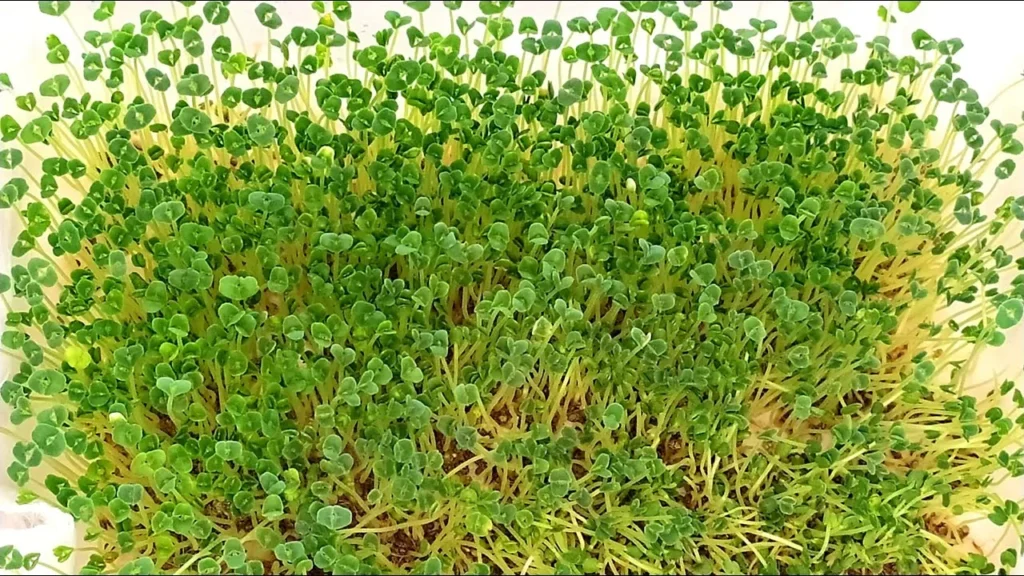
Chia in sprouts has a neutral, slightly nutty taste - the taste profile practically does not change depending on the growing conditions. But the appearance depends on the lighting: at bright lighting sprouts are deep green and dense. At weak light - pale yellowish and elongated. Feature: chia seeds form slime when soaked - sowing on the substrate is carried out without prior soaking.
Culinary use
How to use
Chia is a great culinary accent. Add fresh at the end of cooking or directly on the plate.
Green smoothie
chia + banana + mango + coconut milk - fruits completely neutralize bitterness, the color is bright green
Avocado toast
mashed avocado + lemon + a pinch of chia on top — the fatty base softens the bitterness, the minty note refreshes
Gazpacho or okroshka
a handful of chia into the cold soup just before serving — adds freshness and a spicy accent
Salad with sweet vegetables
cherry tomatoes, bell pepper, corn + chia as a spicy additive (not the base)
Cream cheese on crackers
spread the cheese, on top - chia leaves and a drop of honey - a contrast of sweet, fatty and spicy
Detox water
a few stalks in a glass with cucumber and lemon - the minty note of chia complements the refreshing drink
Perfect pairings
The best way to introduce these greens into the diet without discomfort
Avocado, cream cheese, ricotta, olive oil - fats soften the sharpness and help absorb the fat-soluble components of greens
Tomatoes, lemon juice, balsamic vinegar - the acid contrasts interestingly with the mint note and makes the taste more complex
- Do not use as a salad base - due to the intense bitterness, large portions are uncomfortable; chia is a supplement, not a base
- Do not combine with other bitter or sharp flavors (arugula, mustard, horseradish) - bitterness accumulates
- Do not heat - the essential oils will evaporate, leaving only a rough herbal taste
- Do not sell cut without explaining the taste - an unprepared buyer may be surprised by the intensity
Home storage
How to store
Chia is one of the most capricious crops to store after cutting. Gentle velvet leaves quickly wither without moisture and stick together from excess.
Keep at room temperature or at +10...+15°C — not in a regular refrigerator. Cut immediately before use. It can be stored in a tray at the right temperature for up to 10 days.
Place in a sealed container with a small piece of damp paper towel in the bottom to maintain humidity without direct contact with water. At +4...+6°C, the term is only 3–5 days. The quality drops quickly.
Don't wash until ready to eat. Wet greens spoil much faster. Rinse just before serving.
Pro tip: **Sell live in a tray** - for chia, this is not just a recommendation, but the best commercial strategy. Cut chia can only be stored for 3-5 days and requires special conditions. Live tray - the buyer cuts himself, the greens are always fresh, and your logistics are simplified.
Nutrients & health
Benefits & composition
Chia is valued for its rich vitamin-mineral composition and bioactive compounds typical of microgreens.
Like most microgreens, chia contains a concentrated amount of nutrients relative to its weight — many times more than the mature plant.
| Protein | 5.0 g — building material for cells |
|---|---|
| Calories | ~50 kcal |
| Vitamins | A, C |
| Minerals | Calcium, Iron, Potassium |
| Fiber | high |
- For children who are sensitive to bitter taste: it is better to add it to a smoothie or hide it in a dish with a sweet base - in open form, bitterness can repel
- For people taking blood thinners: omega-3s have a mild effect on blood viscosity — consult your doctor about the amount in your diet when taking the appropriate medications
- For those who expect a neutral taste: chia has a pronounced character - if you are looking for an inconspicuous base, it is better to choose spinach or tat soy
This information is general in nature and is not medical advice. Composition data: USDA FoodData Central.
Worth knowing
Omega-3 in vegetable form
Chia is one of the well-known plant sources of ALA (alpha-linolenic acid). Microgreens contain them in their native, unprocessed form—an interesting addition to the diet for those looking for plant-based sources of omega-3s outside of fish and fish oil.
Calcium
Chia is traditionally considered a plant source of this mineral. For better absorption of calcium from plant sources, it should be combined with products containing vitamin D.
Antioxidants
flavonoids and quercetin are present in young green chia in a concentrated form. They are traditionally associated with the protection of cells from oxidative stress.
Fiber
In combination with omega-3, chia makes an interesting addition to the diet for those who monitor the work of digestion and the uniformity of energy throughout the day.
Similar crops
Similar by taste microgreens
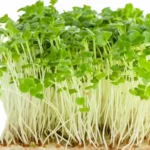
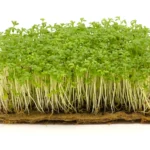
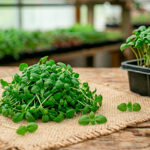
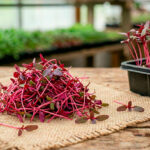
If you are looking to complement or replace Chia:
Chia: how to grow — step-by-step guide
Growing parameters, agronomy, common mistakesGrowing parameters
Mucilaginous - forms a gel when in contact with water
Step-by-step guide
Seed preparation
Chia is a mucilaginous seed. Upon contact with water, it is instantly covered with a transparent gel shell - mucilage. This changes all the standard rules of working with seeds.
Soaking is strictly prohibited. If you soak chia in a standard way, you will get a homogeneous gel mass that cannot be evenly distributed over the substrate. Sow only dry.
Check before sowing:
- The seeds are dry and loose - without clumping
- The sprayer is set to a very fine mist — a coarse jet will dislodge the seeds after sowing
- The substrate is prepared and moistened in advance
If the seeds stick together during storage, this is a sign of high humidity. Dry in a dry place for several hours before sowing. Even minimal moisture activates slime formation and makes uniform sowing difficult.
Sowing
This is the most important and delicate step in growing chia. The whole result depends on the uniformity of sowing.
- Moisten the substrate in advance - it should be evenly moist, without puddles
- Sprinkle evenly dry seeds on the surface - slowly, low above the substrate
- The norm of 3–4 g is a thin, uniform layer. The seeds should not lie in heaps
- Spray abundantly with a fine mist from the atomizer - a transparent gel will form around each seed, which will "glue" it to the substrate
- After moisturizing do not move the seeds — the gel fixes the position
Why the norm is critical: more than 5 g - the seeds lie in several layers. The lower layer without air access becomes an environment for bacteria: gel + heat + lack of ventilation = rotten smell on the 2nd day.
After spraying, cover the tray with a transparent lid or film and look at the uniformity of distribution from above - uneven areas are visible immediately. You can still fix it for 10-15 minutes until the gel hardens completely.
Greenhouse effect instead of pressure
Pressing with weight for chia is impossible. The load will stick to the gel layer and, when removed, will pull out the entire crop along with the substrate.
Instead of pressure, there is a greenhouse effect:
- Cover the tray with a transparent film with several small holes or a transparent lid with a slot
- Goal: 100% humidity inside until fully rooted
- Do not cover hermetically - minimum ventilation is mandatory, otherwise the gel becomes an environment for bacteria
When to shoot: when most of the sprouts have taken root and green leaves are visible - the 3rd-4th day. It is dangerous to remove earlier: the gel will dry out and the sprouts that have not yet taken root will die.
Darkness (Blackout) — 3–4 days
The tray stands under a dome or film in the dark at +20...+24°C.
What is normal:
- Transparent or whitish gel around the seeds is normal, do not wash off
- Uneven stairs in height - chia sprouts in waves
- Light specific smell - herbal, slightly medicinal
What is not normal:
- Pungent sour or rotten smell → bacterial infection due to excess moisture or airtight covering. Ventilate, check ventilation
- Dark liquid spots → the beginning of decay. The reason: too dense sowing or lack of ventilation under the dome
- The seeds do not germinate on the 4th day → either it dried out when sowing, or the temperature is too low
Watering during a blackout: unnecessary and dangerous. Excess moisture + closed space = perfect environment for rot. If the substrate is clearly dry, spray very carefully from the sprayer around the perimeter, avoiding direct contact with the sprouts.
Vegetation in the light — 6–8 days
Remove the dome gradually: first leave it open for a few hours, then remove it completely. A sudden change in humidity from 100% to room temperature can cause stress in young sprouts.
Lighting:
- LED phytolamps: 16–18 hours a day, distance 20–30 cm
- Natural windowsill with diffused light: suitable
- Avoid direct sunlight - tender leaves can get burned
Watering:
- Only the lower one through the pallet — after the roots have gone into the substrate
- The first 2–3 days in the light — watering from above is still dangerous: drops on the leaves leave spots and hairs stick together
- A sign of a lack of moisture: the leaves wilt slightly and become dull - water from below
Ventilation:
After removing the dome, moderate ventilation is mandatory. The mucus around the root continues to exist and without air circulation can become a breeding ground for bacteria. But don't be fanatical - strong blowing dries tender leaves.
Raise the tray on the stand - air will pass from below through the tray and naturally ventilate the root zone without directly blowing the leaves.
Watering
- Water it 1-2 times a day ONLY by bottom watering (through a tray)
- NEVER water from above - chia seeds produce a powerful mucilage and stick together
- The tray is always filled by 0.5–1 cm — chia "drinks" water from below
- A sign of lack: gel formation decreases, the sprouts begin to lay down → add water to the tray
Storage
| Uncut in tray | Fridge +4...+6°C | up to 3 weeks |
|---|---|---|
| Cut in container | Refrigerator | up to 7 days |
| Room temperature | 1–2 days |
Harvest
- Opened cotyledons and the first hint of a real leaf
- Height 4–6 cm
- The leaves are velvety, bright green, without flaccidity
- To the touch - mint or sage aroma
Chia quickly turns bitter after the true leaves appear. Don't delay.
It is difficult. The stems are short, the growth zone is close to the substrate. Use sharp scissors and cut above the gel layer - it's easy to catch pieces of mat or remaining seeds. Cut slowly and carefully.
Seasonal adjustments
- Bacterial risk: in the heat, the gel around the seeds becomes a more active environment for bacteria — ventilation under the dome is critically important
- Dome: reduce the time to 2-3 days, when the roots are warm, they go into the substrate faster - the delay of the dome increases the risk of rot
- Remove the dome gradually and immediately provide air circulation
- Watering: water more often - the substrate dries out faster, and tender leaves do not signal thirst as clearly as coarser crops
- Expect: shortening the cycle by 1-2 days, but a higher risk of complications with the gel
- Heat mat is mandatory: below +18°C chia germinates very slowly or does not germinate at all — heating the substrate is critical
- Even in warm weather the substrate can be colder — the heat mat solves this very problem
- Dome: extend the time up to 4–5 days — when it is cool, the roots are fixed more slowly
Water pH and EC
Optimal range for Chia: 5.5–7.0. Chia is unpretentious to pH and tolerates a neutral environment well. The gel coat of the seed buffers the effect of pH on germination.
Optimal range: 0.8–1.5 mS/cm. Low mineralization is ideal. The gel shell of chia seeds interacts with mineral salts — high EC (>2.0) can disrupt the gel structure.
Experienced grower tips
Dryness of seeds is a condition for even sowing
The most common cause of an uneven chia carpet is seeds with high humidity, which partially stick together before sowing. Store in an airtight container and check for fluidity before each sowing.
Transparent cover - control of uniformity
After spraying, immediately cover with a transparent cap and look from above. Uneven areas or clumps of seeds are clearly visible through the clear glass - you have 10-15 minutes to correct the dryness with a toothpick or fingertip.
Two trays of chia instead of one large one
A standard tray of 11×19 cm is the optimal size for chia. Larger trays cause problems with the uniformity of sowing and ventilation. If you need a larger volume, sow two separate trays.
Live tray as the main sales format
Chia is one of the few crops where selling live is not just an option, but the most practical solution. "Grow Kit: Chia" is a product in itself. Add a card with cutting instructions and a smoothie recipe to the tray and get premium packaging at no extra cost.
Do not rush to remove the dome
The most common mistake after the start is to remove the film on the 2nd day "to see how it is". Each opening sharply reduces humidity, and sprouts that have not yet taken root die. Open only when you see sure green sprouts.
Agronomy notes and common mistakes
- Sowing: DRY - DO NOT WET. Chia turns into a gel in water. A thin even layer on the substrate.
- Clamp: Without clamping.
- Temperature: +20...+26°C. Chia is heat-loving. It grows slowly at +18°C.
- Watering: EXCLUSIVELY lower. The gel shell protects against desiccation better than most cultures.
- Ventilation: It is important. Gel matrix without ventilation - risk of anaerobic bacteria.
- Soaking seeds → Gel "brick", impossible to sow → Sow only dry - no exceptions
- Coconut substrate → Dirty harvest, coconut sticks in the gel → Only flax, jute or agrocotton
- Weight press → All seed sticks to cover when removed → Only dome or film with ventilation
- Hermetic covering → Rotten smell on the 2nd day → Mandatory minimum ventilation under the dome
- The cut is too low → Pieces of mat and remaining seeds in the product → Cut above the gel layer, slowly and carefully
- Top watering after removing the dome → Spots on the leaves, clumping of hairs → Only bottom watering through a tray
- Storage at +2°C → Leaves darken and wither → Store at +4...+6°C or sell alive
- Dense sowing (>5 g) → Bacterial rot in the center → The norm is 3–4 g, do not exceed
Variety selection
Chia seeds (black seeds)
Salvia hispanica
Standard selection. Mucus-forming gel when wetting is normal physiology. Neutral taste.
White chia
Salvia hispanica white seed
A more neutral look in the finale. The taste is identical, but the farming techniques are completely the same.
What's next?
More crops in the catalog
Explore similar and contrasting flavors — from basil to amaranth