
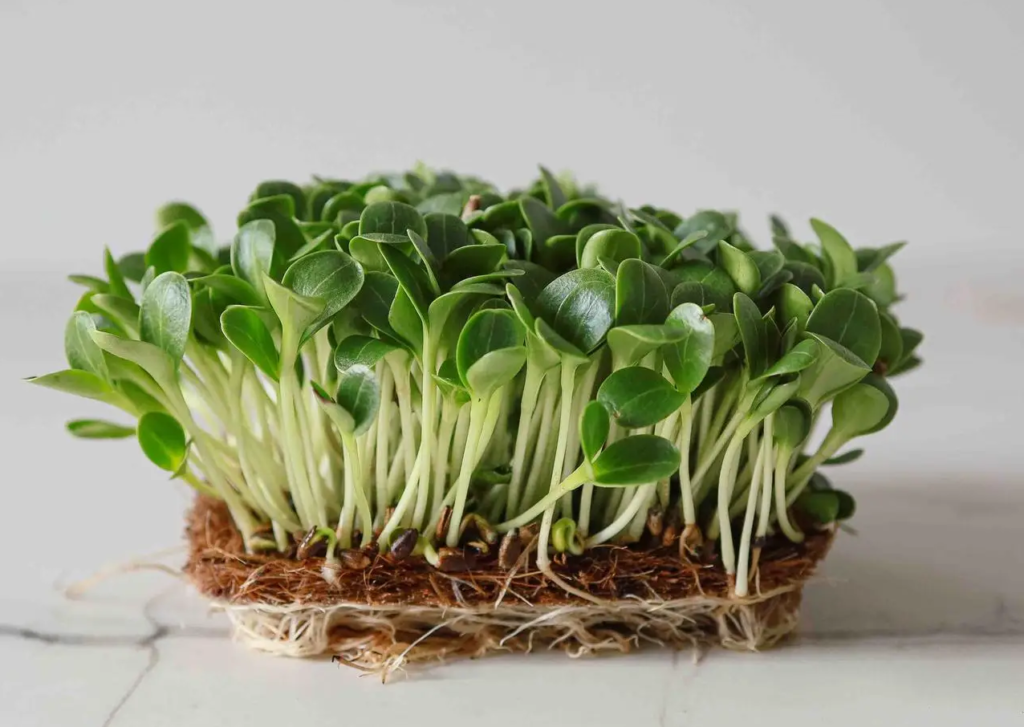
Flavor profile
Taste & aroma
Earthy, grassy, bitter - it is specific, associated with medicinal herbs. Neutral fragrance.
it is specific, associated with medicinal herbs. At the same time, the bitterness is not sharp and does not burn: after the first bite, you feel a dense meaty texture and a nutty shade that remains for longer
Neutral, the smell of fresh hay or field grass. Without harsh essential oil notes, without spice. The aroma does not disturb or repulse - it is simply grassy.
Very dense, fleshy - it resembles a sunflower, but a little harder. The stem is thick and elastic
Why flavor may vary batch to batch
Milk thistle is a slow and capricious culture. The content of silymarin (the main active component) depends primarily on the quality of the seeds, not on the growing conditions. But the appearance of sprouts changes significantly: at bright lighting the leaves develop a characteristic marble pattern. At low light — plain green sprouts without a decorative effect.
Culinary use
How to use
Milk Thistle is a great culinary accent. Add fresh at the end of cooking or directly on the plate.
Green smoothie
20–30 g of milk thistle + banana + apple + water — the taste of fruit, the benefits of silymarin
Mixed salad
15–20% milk thistle on a background of spinach or arugula + olive oil and lemon
A functional snack
a handful of milk thistle + a drop of olive oil + sea salt — simply and deliberately
Avocado toast with thistle
a few twigs on top — decoratively and functionally
Cream soup with milk thistle
add to the plate after serving, do not cook - silymarin will be preserved
Bowl with cereals and greens
quinoa + spinach + cucumber + 20% milk thistle — a balanced functional bowl
Perfect pairings
Banana, apple or mango completely mask the bitterness of thistle
The neutral green base absorbs the bitterness of thistle and gives a balanced taste
Fats improve the assimilation of silymarin — a functional and tasteful pair
- Do not add to hot dishes - heat treatment destroys silymarin and reduces the activity of other compounds
- Do not use as the main greens in a salad - bitters absorb the taste of everything else
- Do not leave the tray until the real leaves appear - the thorns make the greens unsafe to eat
Home storage
How to store
Milk Thistle keeps longer than most microgreens. Follow simple rules to keep it fresh for up to 10–12 days.
Keep at +2...+5°C in the refrigerator. The term is up to 10–12 days. A dense leaf keeps turgor well.
Place in an open container or plate, cover with a damp paper towel. Don't seal — without air, greens yellow faster.
Don't wash until ready to eat. Wet greens spoil much faster. Rinse just before serving.
Nutrients & health
Benefits & composition
Milk Thistle is valued for its rich vitamin-mineral composition and bioactive compounds typical of microgreens.
Like most microgreens, milk thistle contains a concentrated amount of nutrients relative to its weight — many times more than the mature plant.
| Protein | 4.5 g — building material for cells |
|---|---|
| Calories | ~40 kcal |
| Vitamins | E, K, D |
| Minerals | Zinc, Copper |
- People with gallstones should consult a doctor before regular use - milk thistle has a choleretic effect and can provoke the movement of stones.
- Pregnant and lactating women - only after consultation with a doctor.
- For children - due to the specific taste and active pharmacological effect, it is not recommended without a prescription.
This information is general in nature and is not medical advice. Composition data: USDA FoodData Central.
Worth knowing
Silymarin is the main active ingredient
A flavonoid complex contained mainly in milk thistle seeds. In microgreens, it is present in a lower concentration than in mature seeds, but in a living cellular form with better bioavailability compared to dried preparations.
Support of liver function
Traditionally, silymarin is included in protocols for supporting the function of the liver and biliary tract. The absorption of silymarin is improved when combined with fats—olive oil is a classic partner for milk thistle.
Fat-soluble active substances
Silymarin belongs to the group of fat-soluble flavonoids. This explains why milk thistle is traditionally used with oil: absorption is much worse without fats.
Antioxidant support
Silymarin is considered an antioxidant and can be an interesting addition to the diet of people who pay attention to anti-inflammatory nutrition.

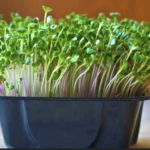

Milk Thistle: how to grow — step-by-step guide
Growing parameters, agronomy, common mistakesGrowing parameters
A large, hard shell, similar to a sunflower seed
Step-by-step guide
Soaking — 12–24 hours (required)
Thistle seeds have a very hard outer shell - without soaking, a large part does not germinate or gives delayed, uneven sprouts.
How to soak:
- Cover the seeds with cold or room temperature water.
- Soak for 12-24 hours. Optimal — 18–20 hours.
- Some growers add a few drops of 3% hydrogen peroxide to disinfect the surface of the seed and better soften the shell.
- Drain the water, rinse under running water.
A sign of a ready seed: swelled, increased in size, the shell became softer. The smell is fresh.
Sowing
- Moisten the substrate evenly and abundantly.
- Spread the swollen seeds evenly in one layer. 25–30 g — a moderately dense layer without overlays. Due to the large size of the seeds, it is easy to control.
- Spray the surface with water from a spray bottle.
Clamp — 1–2 kg (heavy)
A heavy press is critically important for two things at once:
- Root fixation - strong thistle roots easily lift a light weight. Without sufficient pressure, the seed flies up and the "helmet" cannot be removed by the substrate.
- Mechanical removal of the shell — when a sprout breaks through the substrate under heavy pressure, the hard shell is subjected to mechanical pressure and slips off more easily. Light pressure does not give this effect.
Darkness (Blackout) — 4–5 days
Conditions:
- Complete darkness
- Temperature: +18...+22°C
- Stable humidity - the substrate should remain evenly moist all the time
- Bottom watering + spraying from above if necessary
Fighting with the "helmet": this is the central problem of milk thistle. A hard woody shell often remains on the cotyledons after emerging from the dark — greens with "helmets" are unfit for sale (hard, impossible to eat).
The solution is the "greenhouse effect" in the last 24 hours of the blackout:
- Sprinkle liberally on top
- Cover with film or polyethylene over the clamp
- Create maximum humidity and warmth
- Spray again before taking out into the light
- If the helmets have not come off, give another 12 hours under the same conditions
A sign of readiness: most of the sprouts have shed their shell, wide oval cotyledons are opening, height 3–4 cm.
Vegetation in the light — 7–9 days
Lighting: good lighting forms a wide fleshy leaf. In low light, the sprout is elongated and the leaf remains narrow.
Watering: moderate, regular, lower. After a longer cycle (12–15 days), control the humidity of the substrate - not drying out, but not overwetting either.
⚠️ Critical rule: watch for the appearance of a real leaf every day in the last 2-3 days.
Thistle is a thistle. Its real leaves have thorns on the edges. The first pair of real leaves makes the product dangerous for consumption - the customer may injure the mouth or esophagus. Cut strictly before their appearance, at the stage of large smooth cotyledons.
Watering
- Water it 1-2 times a day (in the morning - mandatory)
- Lower watering through a pallet is better; the upper one is allowed carefully
- Thistle is a slow germinator (5–7 days); do not rush to increase watering "because it does not grow"
- A sign of lack: large leaves wither slightly, stems become soft → water through a tray
Storage
| Uncut in tray | Fridge +4...+6°C | up to 3 weeks |
|---|---|---|
| Cut in container | Refrigerator | up to 7 days |
| Room temperature | 1–2 days |
Harvest
- Large, open oval cotyledons of light green color
- The leaf is smooth - without teeth and spines on the edges
- Height 6–8 cm
- The first pair of true leaves has not yet appeared
Sharp knife under the root. The stems are juicy and crunchy.
Inspect the cut for husks. Any "helmet" on a piece of paper is a defect. Greens with hard shells cannot be sold.
Seasonal adjustments
- Soaking: reduce by 2–3 hours from the standard - the seeds are active in the heat
- Ventilation: open more often in the blackout phase to avoid excess moisture
- Watering: increase the frequency - the substrate dries faster at a higher temperature
- Expect: shortening of the cycle by 2–3 days, a more tender stem
- Soaking: increase by 2-3 hours from the standard - cold water is absorbed more slowly
- Placement: keep the trays in a warmer place (next to the battery, but not close to it)
- Watering: use water at room temperature—cold slows growth
- Expect: lengthening the cycle by 2-4 days, denser and more fragrant result
Water pH and EC
The optimal range for milk thistle: 6.0–7.5. Milk thistle tolerates neutral and weakly alkaline environments well. Wide pH tolerance makes it a convenient crop.
Optimal range: 1.0–2.0 mS/cm. Moderate mineralization is ideal. The hard shell of the seed protects against osmotic stress - milk thistle is slightly more resistant to hard water.
Experienced grower tips
Hydrogen peroxide when soaking is not necessary, but it helps
A few drops of 3% peroxide per glass of water when soaking softens the shell and disinfects the seed surface. The percentage of "hard hats" at the exit decreases noticeably.
The "greenhouse effect" is a standard procedure, not an extreme measure
Unlike other cultures, where the greenhouse is "if it doesn't go down", for thistle it is a mandatory last step of each cycle. Film + plenty of hydration in the last 24 hours of the blackout — build it into the protocol.
Daily review after the 10th day — no exceptions
The appearance of the first true leaf is the end of the cycle. Set a reminder on the 11th and 12th day after sowing and check the leaf for the presence of teeth. One extra day and the batch is unusable.
Sell with a "cheat sheet"
Milk thistle is the only crop where the customer needs instructions for use. Add a small card to the package: "Add 15-20% to green smoothies or salads. Do not heat. Use with oil for better absorption." This removes the barrier and increases customer satisfaction.
Position next to pharmacy goods - not with greens
At farmers' markets or online catalogs, list milk thistle under the Functional Greens / Superfoods category, not among regular microgreens. This is how she finds her buyer, and does not scare away those who are looking for salad greens.
Agronomy notes and common mistakes
- Sowing: Soaked (6–8 hours) milk thistle in an even, dense layer. Hard seed coat.
- Clamp: Hard press (2 kg), 2–3 days. Necessary for embedding hard seeds in the substrate.
- Temperature: +18...+24°C. A moderate temperature is ideal.
- Watering: 1-2 times a day. Bottom watering prevents rot during slow germination.
- Ventilation: Important: a slow grower without ventilation is prone to mold on the surface of the substrate.
- Insufficient soaking → Uneven germination, some seeds do not wake up → Soaking for 18–24 hours is mandatory; you can add peroxide
- Light pressure → "Helmets" are not removed, the seeds fly up → 1–2 kg pressure — heavy, uniform throughout the box
- Sale with husk → Customer cannot eat - hard shell on teeth → Inspection of each tray before sale; "greenhouse effect" solves systemically
- Overstaying until the thorns → The first pair of real leaves with teeth → Observe daily after the 10th day; cut until a real leaf appears
- Weak lighting → Narrow elongated leaf → Good lighting 16 h/day; close to the lamp
- Overflow → Rotting with a long cycle → Moderate bottom watering; without standing water
Variety selection
Spotted milk thistle
Silybum marianum standard
The only type for microgreens. Large seeds, slow germination, but unique decorativeness.
Thistle from the fields
Heritage varieties
The content of silymarin is slightly higher. Agricultural technology is identical - the freshness of the seeds of the new crop is important.
What's next?
More crops in the catalog
Explore similar and contrasting flavors — from basil to amaranth