
Flavor profile
Taste & aroma
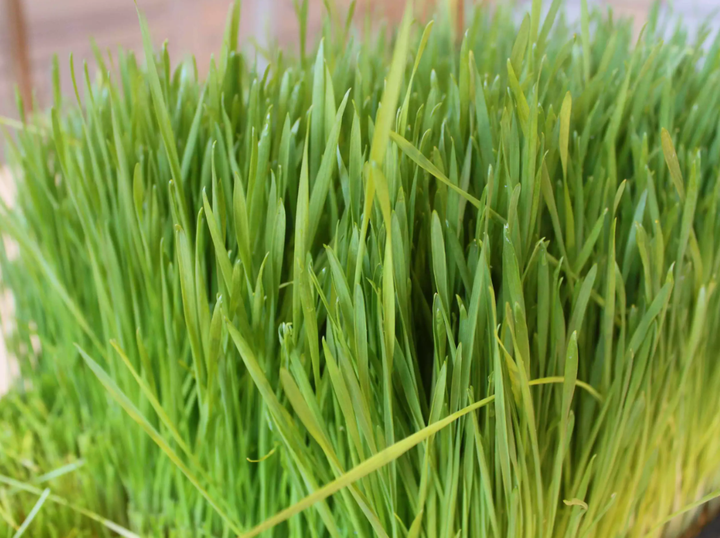
Sweet, grassy, tender — Milk-grassy, sweet, with a light freshness — without bitterness and without harshness, characteristic of wheat. Fresh, grassy aroma.
Milk-herbal, sweet, with a slight freshness - without bitterness and without sharpness, characteristic of wheat. If wheat wheatgrass is a "blow of cheerfulness", then oat grass is a "hug"
Fresh, grassy, cereal - reminiscent of fresh hay and a summer field, unobtrusive and one of the few cereal aromas that is liked even without consumption.
Tender, Soft, Fibrous - characteristic of grass grass. It is recommended for people to consume in the form of juice or smoothie: long juicy stems can be chewed, but the fiber is hard and poorly digested
Why flavor may vary batch to batch
The sweet taste of oats depends on the lighting and stage of cultivation. At bright light and a temperature of +18...+22°C sprouts accumulate more simple sugars - the taste is sweeter and richer. At low light the taste is more neutral. The optimal cut is at 8–10 days, when the first leaves spread out: a later cut gives a rougher texture.
Culinary use
How to use
Oat is a great culinary accent. Add fresh at the end of cooking or directly on the plate.
Morning shot of wheatgrass
30–50 ml of pure juice, maybe with a drop of lemon - a classic detox format
Green smoothie
wheatgrass + banana + apple + water — green color, fruit taste
Smoothies with ginger
wheatgrass + lemon + ginger + honey is an invigorating morning option
Herbal tea
brew young sprouts with water at 75–80°C, insist for 5 minutes — soft and soothing
Live tray for animals
cats and dogs instinctively need greens — oat grass is safe and healthy
Green detox cocktail
wheatgrass + cucumber + lime + mint + water — refreshing and rich in chlorophyll
Perfect pairings
A banana, apple or mango completely masks the grassy taste of wheatgrass
Spicy and sour dressing emphasizes the green character of the juice and adds a refreshing note
Cucumber or celery in a smoothie give volume without competing with the cereal taste
- Do not add to dishes without juice: it will not work to chew a whole cereal grass in a salad: the fibers are not chewed and not digested. Only juice or smoothies.
- Do not consume juice on an empty stomach in large quantities: concentrated wheatgrass. Start with 15–20 ml, increase gradually.
- Do not store freshly squeezed juice: drink immediately. After 20 minutes, most of the active compounds are oxidized.
- Do not give animals other cereals instead of oats: wheat and barley are much harder and can be less comfortable for a cat's stomach.
Home storage
How to store
Oat keeps longer than most microgreens. Follow simple rules to keep it fresh for up to 3 weeks.
Don't cut more than you plan to eat right away. Store in refrigerator at +4...+6°C. No watering needed — natural moisture is enough.
Place in an open container or plate, cover with a damp paper towel. Don't seal — without air, greens yellow faster.
Don't wash until ready to eat. Wet greens spoil much faster. Rinse just before serving.
Nutrients & health
Benefits & composition
Oat is valued for its rich vitamin-mineral composition and bioactive compounds typical of microgreens.
Like most microgreens, oat contains a concentrated amount of nutrients relative to its weight — many times more than the mature plant.
| Protein | 4.0 g — building material for cells |
|---|---|
| Calories | ~30 kcal |
| Fiber | very high content |
- To people from celiac disease or gluten sensitivity it is worth paying attention: the green mass of oats itself does not contain gluten, but cross-contamination with grain during cutting is very likely. It is recommended to check with a doctor.
- At acute stomach ulcers the coarse fiber of the whole herb can increase irritation — it is better to choose strained juice or wait for remission.
- Start using wheatgrass with 15–20 ml per day and gradually increase to 50–100 ml — sudden introduction of a large amount of green juice can cause nausea in an unprepared organism.
This information is general in nature and is not medical advice. Composition data: USDA FoodData Central.
Worth knowing
vitamins of group B
Oats are a source of B vitamins — especially B1, B2 and B6, which are traditionally associated with supporting the nervous system. That is why oat grass is characterized as a "soothing" cereal in contrast to the more tonic wheat.
silicon
It contains a significant concentration of silicon, a mineral traditionally associated with the condition of the skin, nails and hair (in animals). For cats, this is one of the reasons for the instinctive attraction to oat grass.
Chlorophyll
in the green part, oats have a structure similar to hemoglobin - instead of an iron atom, a magnesium atom is in the center of the molecule. It is the subject of active research regarding its effect on hematopoiesis, although specific clinical results are still being determined.
Fiber
oat grass is coarse and insoluble - for humans this means the need for juice or a smoothie (chewing does not give the same effects). For animals, this mechanical fiber helps to clean the stomach of wool and improves peristalsis.
Oat: how to grow — step-by-step guide
Growing parameters, agronomy, common mistakesGrowing parameters
Cereal grain in the shell (husk)
Watering
- Water it 2 times a day (morning and evening - mandatory)
- Lower watering is better; the upper one is permissible in the first days
- Oats are active consumers of water, especially in the phase of active growth
- A sign of lack: the tips of the leaves turn yellow, the cereal "brush" loses uniformity → water
Storage
| Uncut in tray | Fridge +4...+6°C | up to 3 weeks |
|---|---|---|
| Cut in container | Refrigerator | up to 7 days |
| Room temperature | 1–2 days |
Harvest
The height is 12–15 cm, the leaves are wide and juicy, the color is bright green along the entire length. If there are yellow stems from below - cut immediately, the culture begins to overripe. The second leaf has not yet started to grow or is just emerging.
With a knife or scissors in bunches above the substrate. Do not cut below the root - leave 2-3 cm of stems for the second wave.
Leave the tray after the first cut. Water and put in the light. After 5-7 days, the second wave will grow - it is weaker and shorter, but quite suitable for animals. For people, the second wave is less juicy and less saturated.
Seasonal adjustments
- Soaking: reduce by 2–3 hours from the standard - the seeds are active in the heat
- Ventilation: open more often in the blackout phase to avoid excess moisture
- Watering: increase the frequency - the substrate dries faster at a higher temperature
- Expect: shortening of the cycle by 2–3 days, a more tender stem
- Soaking: increase by 2-3 hours from the standard - cold water is absorbed more slowly
- Placement: keep the trays in a warmer place (next to the battery, but not close to it)
- Watering: use water at room temperature—cold slows growth
- Expect: lengthening the cycle by 2-4 days, denser and more fragrant result
Water pH and EC
Optimum range for Wives: 6.0–7.5. Oats tolerate neutral and slightly alkaline environments well. Even at pH 7.5–8.0 (hard water), cereal microgreens do not show noticeable deviations during the 10-day cycle.
Optimal range: 0.5–1.2 mS/cm. Cereals are light consumers of minerals. Low EC is ideal for a delicate sweet taste. A high EC (>1.5) can give a slightly bitter herbal shade.
Experienced grower tips
Pet shop and pet-market is your main market
Oats as "cat grass" are in stable demand all year round. Create an offer for pet stores in the format of live trays: pet store owner resells as "fresh cat grass", constant rotation, regular orders.
Hydrogen peroxide when soaking - always
The shell of the oat grain accumulates microflora. Disinfection by soaking is the easiest and cheapest way to reduce the risk of mold.
The fan is constantly, not once
A dense "lawn" of 300 g is a microclimate inside with increased humidity. The fan directed at the rack should work throughout the growing season, not only during inspection.
Sell "Grow kit" with instructions
Live tray + card "how to water and when to cut" - the buyer is satisfied, there are no questions, word of mouth is working. Especially for buyers with pets.
Plan rotation for peak days
Weekend markets, healthy food fairs, animal shows are the peak sales points. With a cycle of 9-11 days, it is easy to calculate the sowing date for a specific event.
Agronomy notes and common mistakes
- Sowing: Soaked (6–8 hours) and washed oats — a dense carpet in one layer. Even distribution is the key to an even "lawn".
- Clamp: 1.5–2 kg, 2–3 days. Like all cereals, it needs a clamp for reliable contact of the root with the substrate.
- Temperature: +15...+20°C. Cereals are cool crops; at +24°C they grow faster, but are less tender.
- Watering: 2 times a day is mandatory. Oats do not tolerate drying out - the tips of the leaves turn yellow in a few hours.
- Ventilation: Good ventilation is important. A dense grass carpet without air movement risks "swelling" from below.
- Whole grain oats instead of husked → Frequent mold on grains → Taking oats in the chaff is a more stable start
- Lack of ventilation in the light → Moldy "cobweb" in the root zone on the 3rd-4th day → Fan or active ventilation from the first day in the light
- Insufficient watering in the later stages → Yellow tips, grass laying → Twice a day on the 6th-7th day; large volume of mass = large volume of watering
- Weak grip → Grains with roots rise up → 2 kg all blackout
- Selling to the overgrown → Yellowing from below, stiff stem → Cut at a height of 12–15 cm, do not wait
- There is no second wave → Cut under the root → Leave 2–3 cm of stems after cutting
Variety selection
Whole grain oats
Naked oat, Nu Oat
No husk — easier germination, no need to water separately. Smooth tender sprouts.
Flaky oats
Geant Roux, Bethany
With a vole - longer soaking is required. The output is more massive, the stem is smoother with proper preparation.
Що далі?
More crops in the catalog
Explore similar and contrasting flavors — from basil to amaranth