
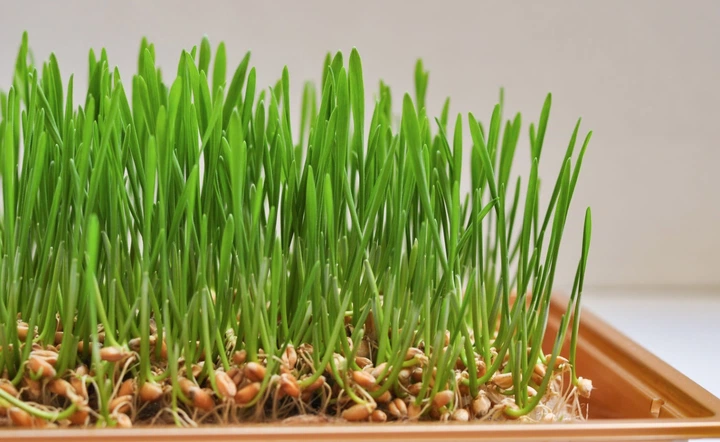
Flavor profile
Taste & aroma
Sweet, grassy, rich - the smell and taste of a freshly mown summer meadow. The smell of freshly cut grass, the aroma.
the smell and taste of freshly mown summer meadow. Unlike anything else in the microgreens catalog
The smell of freshly cut grass is bright, green, summery. It is felt immediately when slicing.
Tender, Fibrous, Soft - adult wheat stalks of 12–15 cm are difficult to chew. That is why wheatgrass is drunk in the form of juice, and not eaten whole
Why flavor may vary batch to batch
The content of chlorophyll and the "grassy" intensity of wheatgrass depend on the lighting and time of cutting. At bright light (+18...+22°C) there is more chlorophyll - the juice is saturated green, the taste is pronounced. At low light stems are pale yellowish, less nutritious. The optimal cut — on the 7–10th day, when the first new leaf appears ("joint" stage). A later cut gives coarser and less nutritious greens.
Culinary use
How to use
Wheatgrass is a great culinary accent. Add fresh at the end of cooking or directly on the plate.
Morning shot of wheatgrass
30-50 ml of pure juice, maybe with a drop of lemon - a classic detox morning
Green smoothie
wheatgrass + apple + banana + water — green color, fruit taste
Smoothies with ginger
wheatgrass + lemon + ginger + honey — invigorating and warming
Green detox cocktail
wheatgrass + cucumber + lime + mint + water is a refreshing option
Live tray on the table
restaurants serve a tray of wheatgrass for self-slicing — a spectacular restaurant serving
Herbal tea
brew young sprouts with water at 75–80°C, infuse for 5 minutes - a soft soothing drink
Perfect pairings
An apple, banana or mango completely masks the grassy taste of wheatgrass
Sour-spicy steam emphasizes the green character of the juice and adds an invigorating effect
Cucumber or celery in a smoothie give volume without competing with the cereal taste
- Do not eat whole wheatgrass in large quantities - the tough fibrous structure is difficult to digest
- Do not squeeze with a centrifugal juicer - it does not cope with hard cereal stalks, there is little juice and a lot of noise
- Do not wait more than 15 days - the juice becomes bitter, the quality drops sharply
Home storage
How to store
Wheatgrass keeps longer than most microgreens. Follow simple rules to keep it fresh for up to 10 days.
Refrigerator +2...+5°C. The term is up to 10 days. Cut just before juicing—juice from freshly cut greens is best.
Refrigerator +2...+5°C, tightly closed container. The term is 7–10 days. The juice from chilled cut greens is a little less fresh than freshly cut, but the quality is still good. **Squeezed juice:** store in an airtight container in the refrigerator for no more than 24 hours - it oxidizes quickly. It is better to squeeze in portions before use. ---
Don't wash until ready to eat. Wet greens spoil much faster. Rinse just before serving.
Nutrients & health
Benefits & composition
Wheatgrass is valued for its rich vitamin-mineral composition and bioactive compounds typical of microgreens.
Like most microgreens, wheatgrass contains a concentrated amount of nutrients relative to its weight — many times more than the mature plant.
| Protein | 7.5 g — building material for cells |
|---|---|
| Calories | ~29 kcal |
| Vitamins | E, C |
| Minerals | Iron, Calcium, Magnesium, Zinc |
- Start with small doses (15-20 ml of juice) and gradually increase - concentrated juice can cause nausea in the first days
- For people with a sensitive stomach, dilute with water or apple juice
- If you are allergic to cereals or have celiac disease, consult your doctor before regular use
This information is general in nature and is not medical advice. Composition data: USDA FoodData Central.
Worth knowing
Chlorophyll
the green pigment of plants that provides photosynthesis. Wheat contains one of the highest levels of chlorophyll of any food plant. Chlorophyll is the subject of active research in the context of antioxidant properties.
17 amino acids
, including essential ones — wheatgrass is a vegetable source of a complete amino acid profile in the composition of fresh juice.
Iron, magnesium and zinc
wheatgrass contains appreciable concentrations for a plant product.
Gluten issues:
gluten is found in the grain of wheat, but **not in the green sprouts**. Clinical data on the safety of wheatgrass for people with celiac disease are conflicting - if you have celiac disease or a confirmed gluten sensitivity, you should consult your doctor before using it.
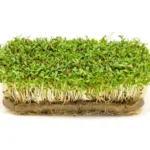
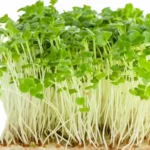

Wheatgrass: how to grow — step-by-step guide
Growing parameters, agronomy, common mistakesGrowing parameters
Big, cereal
Step-by-step guide
Soaking — 12–24 hours
Soaking is mandatory for wheat — it activates the seeds and shortens the cycle by 2–3 days.
Technology:
- Rinse the grain under cold water
- Fill with clean water at room temperature for 12-24 hours
- Drain the water, wash the grain and sow immediately
Wheat grain often carries mold spores on the surface of the hull. Add a few drops of hydrogen peroxide (3%) or biofungicide solution to the soaking water - this reduces the risk of mold in subsequent dense sowing. After soaking, be sure to rinse the grain with clean water.
Sowing
The norm of 45 g is a very dense sowing. The grain is laid in 1–2 layers over the entire surface of the tray — a continuous carpet.
- Evenly moisten the substrate - the depth of moistening is important, coconut or soil 2-3 cm
- Spread the grain evenly — avoid "bumps" where the seeds will dry out
- Spray liberally on top
- Install the clamp
A flat surface is half the battle. The "humps" from the seeds dry out and give bald spots in the carpet. After spreading the grain, carefully level it with the palm of your hand and only then install the clamp.
Clamp — 1–2 kg
A strong clamp is mandatory. Powerful wheat roots without fixation lift the entire "carpet" with seeds into the air — the tray becomes unstable and uneven.
- Empty tray on top + 1–2 kg evenly
- Keep the entire period of darkness
Darkness (Blackout) — 3–4 days
Remove the clamp and open it when the sprouts have reached a height of 2–3 cm and rest against the clamp.
What is normal:
- Friendly level sprouts already on the 2nd day
- A slightly yellowish color in the dark is normal, it will turn green in the light
What is NOT normal:
- "Cobwebs" or gray mold between sprouts → poor air exchange + excess moisture. Ventilate immediately, reduce watering
- Musty smell → the same reason
Watering: moderate lower when drying. Grain drinks a lot, but stagnation of water is the cause of mold.
Vegetation in the light — 7–9 days
Lighting — for chlorophyll:
- LED phytolamps: 16–18 hours a day
- Bright lighting = rich green color and maximum concentration of chlorophyll
- In low light - pale yellow greens with a low chlorophyll content
Temperature: +18...+22°C. Wheat is not picky about temperature.
Watering: wheat drinks much more water than most microcultures. Water abundantly using the lower method, but let the substrate dry between waterings — do not keep it constantly wet.
Ventilation is critically important. A dense carpet of 45 g of seed in a small tray is an ideal environment for mold. Daily intensive ventilation or constant blowing with a fan is a must.
On the 5th to 7th day, check the greens from below — between the stems and the substrate. If a white "cobweb" is visible, it is early mold. You can still save: reduce watering, increase ventilation, carefully spray from below with a weak solution of hydrogen peroxide (1%).
Watering
- Water it 2 times a day (morning and evening)
- Lower watering is better - wheat is moisture-loving and does not tolerate drying out
- In warm conditions (+24°C and above), additional watering during the day may be necessary
- A sign of lack: the tips of the leaves turn yellow and dry up → water and check the humidity of the tray
Storage
| Uncut in tray | Fridge +4...+6°C | up to 3 weeks |
|---|---|---|
| Cut in container | Refrigerator | up to 7 days |
| Room temperature | 1–2 days |
Harvest
- Height 12–15 cm
- The second leaf begins to form ("tube phase") - this is a signal for immediate collection
- Do not overdo it - the juice becomes bitter
Sharp knife or scissors at height 1–2 cm from the seed - not lower. Cut above the seed line to avoid trapping grain residue or mold at the bottom.
Screw juicer only. Immediately after the cut.
Seasonal adjustments
- Mold: the risk increases dramatically in the heat and dense sowing — ventilate the trays twice a day, even in the germination phase
- Ventilation: a fan on low speed or an open window with no draft from day one is a must
- Watering: reduce the frequency - excess moisture in the heat gives mold already on the 3rd day
- The cycle accelerates: cut at a height of 10–12 cm, do not wait for the 7th day
- Expect: a shorter output and a weaker taste of the juice is the norm for summer
- Coolness reduces the risk of mold — one of the few advantages of winter for wheatgrass
- Cycle can be extended for 2-3 days; cut at a height of 12–15 cm
- Lighting: with short winter days, chlorophyll is synthesized worse — 12-14 hours of light increases the quality of the juice
Water pH and EC
Optimal range for wheatgrass: 6.0–7.0. Wheat is not picky about pH. Normal tap water is fine. Hard water can leave a white coating on the stems - this is a salt deposit, not a disease.
Optimal range: 0.8–1.5 mS/cm. Wheatgrass is grown mainly on a soil substrate without additives — cereals receive enough nutrition from the endosperm of the seeds. Mineral supplements are not required during standard cultivation.
Experienced grower tips
Ventilation is the main parameter for wheatgrass
A dense seeding of 45 g in a small tray is the highest mold risk in the catalog. A fan for constant ventilation is the best investment for a stable result.
Live tray in HoReCa format
Restaurants and juice bars willingly buy live wheatgrass in a tray - the customer cuts himself immediately before squeezing. This is both quality and marketing at the same time. Wheatgrass in a live tray on the bar counter is a powerful visual element for a health food establishment.
Seed disinfection is a mandatory investment of 5 minutes
Peroxide or biofungicide during soaking dramatically reduces the risk of mold. This simple procedure saves trays that would otherwise have to be thrown away.
Wheatgrass + barley on sale
Both cereal wheatgrasses with identical agrotechnics and a similar cycle. The difference in the taste of the juice: wheat is sweeter, barley is softer and less intense. Offer both - the client will choose or buy a mix.
Agronomy notes and common mistakes
- Sowing: Soaked (8–12 h) and washed wheat — a dense carpet in 1–2 layers. Even filling is the basis of a uniform carpet.
- Clamp: 2 kg evenly, 2-3 days. Without clamping, wheat roots "hang" over the substrate.
- Temperature: +15...+20°C. Classic wheatgrass tastes better when cool; at +24°C it grows faster, but is less sweet.
- Watering: 2 times a day is mandatory. Wheat drinks actively - do not miss the evening watering.
- Ventilation: Important: a dense carpet of wheat with stagnant air is prone to mold in the root zone.
- Skip the soaking → Slow and uneven start, liquid sowing → 12–24 h soaking is mandatory
- Poor ventilation → "Web" of mold between sprouts → Daily airing, fan
- Constantly wet substrate → Rotting of the roots, mold from below → Water abundantly, but let it dry out between waterings
- Weak lighting → Yellow or pale greens, little chlorophyll → Powerful phytolamps, bright lighting
- Overstay (15+ days) → Bitter juice, tough fibrous stem → Cut at a height of 12–15 cm, in the "tube phase"
- Savings on seeds (<45 g) → Liquid sowing — the stems fall, there is little juice → 45 g — the technological norm for a dense carpet
- The cut is too low → Remains of grain and mold fall into the juice → Cut at a height of 1–2 cm from the seed level
Variety selection
Soft wheat
Triticum aestivum most varieties
Standard selection. Even sprouts, moderate sweetness, stable germination.
Durum wheat
Triticum durum, Amber Durum
Thicker stem, clearer cereal taste. Useful when you need a pronounced texture.
Що далі?
More crops in the catalog
Explore similar and contrasting flavors — from basil to amaranth